

The tectonic theory for glacial inception has two
advantages:
1. It explains the persistence of cold climates, even outside
the episodes of ‘snowball’ glaciation for the duration of
the Neoproterozoic, as long as the continents are dispersed along the equator. This configuration is observed
in a window from 750 to 600 Ma (Torsvik et al. 2001)
and thus includes the two extreme episodes.
2. It also explains why such global glaciations did not occur
in more recent times. The equatorial configuration of the
continents, the driver of global glaciation, never occurred
during the Phanerozoic.
The possibility that clathrates (complexes formed from
several molecules of methane and present today in certain
marine sediments) played a destabilizing role has been
proposed to explain the triggering of the Marinoan glaciation
and the decrease of the d
13 C of the carbonate sediments just
before glaciation (Fig. 26.8). This hypothesis suggests an ad
hoc increase in CH 4 degassing from sediments just before
glaciation. The result is a decrease of d
13 C in the sea water
and an increase in the level of atmospheric CH 4 . The
resulting global warming disturbs the paleothermostat and
CO 2 is consumed faster by the weathering of the silicates.
The methane valve then closes for reasons that have still to
be discovered and the remaining CO 2 level is no longer
sufficient to prevent tipping into global glaciation. Finally,
Pavlov et al. (2003) suggest that atmospheric methane levels
remained high throughout the Proterozoic (100–300 ppmv)
and that an additional episode of oxygenation of the surface
layers created the conditions favorable to glaciation in the
Neoproterozoic. This scenario is similar to the one elaborated to explain the Huronian glaciations. Rapid oxidation of
methane to CO 2 considerably reduces the greenhouse effect
in a time window too short for the paleothermostat to
rebalance the temperature of the Earth’s surface.
During Glaciation
During the main glacial period, the near absence of sedimentation does not allow data-based reconstruction. As a
result, all theories are based on climate modeling. The
average annual temperature over land during a complete
glaciation is about −25 °C in the equatorial zone, with the
coldest point being reached on the West African Craton with
−110 °C (Donnadieu et al. 2003). The oceans become
covered over with ice very quickly. The thickness of the sea
ice is subject of debate. Model-based simulations suggest
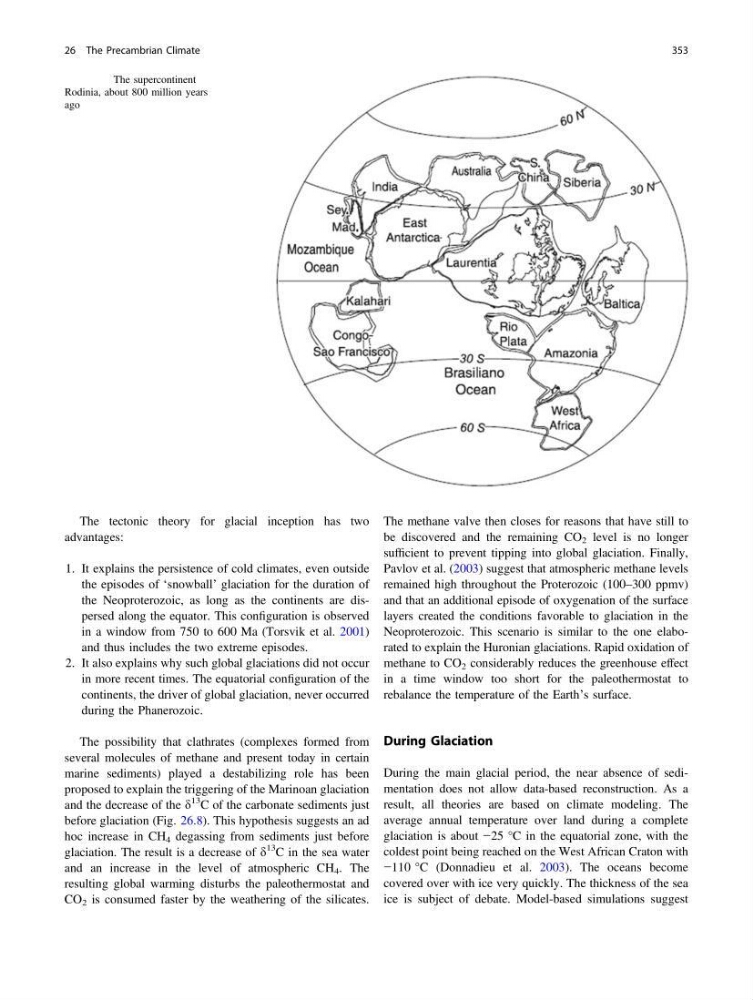
Fig. 26.9 The supercontinent
Rodinia, about 800 million years
ago
26 The Precambrian Climate
353
advantages:
1. It explains the persistence of cold climates, even outside
the episodes of ‘snowball’ glaciation for the duration of
the Neoproterozoic, as long as the continents are dispersed along the equator. This configuration is observed
in a window from 750 to 600 Ma (Torsvik et al. 2001)
and thus includes the two extreme episodes.
2. It also explains why such global glaciations did not occur
in more recent times. The equatorial configuration of the
continents, the driver of global glaciation, never occurred
during the Phanerozoic.
The possibility that clathrates (complexes formed from
several molecules of methane and present today in certain
marine sediments) played a destabilizing role has been
proposed to explain the triggering of the Marinoan glaciation
and the decrease of the d
13 C of the carbonate sediments just
before glaciation (Fig. 26.8). This hypothesis suggests an ad
hoc increase in CH 4 degassing from sediments just before
glaciation. The result is a decrease of d
13 C in the sea water
and an increase in the level of atmospheric CH 4 . The
resulting global warming disturbs the paleothermostat and
CO 2 is consumed faster by the weathering of the silicates.
The methane valve then closes for reasons that have still to
be discovered and the remaining CO 2 level is no longer
sufficient to prevent tipping into global glaciation. Finally,
Pavlov et al. (2003) suggest that atmospheric methane levels
remained high throughout the Proterozoic (100–300 ppmv)
and that an additional episode of oxygenation of the surface
layers created the conditions favorable to glaciation in the
Neoproterozoic. This scenario is similar to the one elaborated to explain the Huronian glaciations. Rapid oxidation of
methane to CO 2 considerably reduces the greenhouse effect
in a time window too short for the paleothermostat to
rebalance the temperature of the Earth’s surface.
During Glaciation
During the main glacial period, the near absence of sedimentation does not allow data-based reconstruction. As a
result, all theories are based on climate modeling. The
average annual temperature over land during a complete
glaciation is about −25 °C in the equatorial zone, with the
coldest point being reached on the West African Craton with
−110 °C (Donnadieu et al. 2003). The oceans become
covered over with ice very quickly. The thickness of the sea
ice is subject of debate. Model-based simulations suggest
Fig. 26.9 The supercontinent
Rodinia, about 800 million years
ago
26 The Precambrian Climate
353