

that this thickness must have rapidly exceeded a kilometer
(Goodman 2006). However, for photosynthetic activity to
persist during glaciation, the existence of thinner ice
allowing light to filter through, at least in some areas, would
be required. In contrast to the simulation suggesting thick ice
everywhere, Hyde et al. (2000) presented a possibility where
open water areas persisted in the tropical zone, while the rest
of the ocean was completely covered with ice. This simulation was performed by coupling an energy balance model
with an ice model. Nevertheless, simulations carried out with
climate models taking into account the general circulation of
the atmosphere and the ocean show that this solution is not
stable. The ocean was probably entirely covered with ice
with no real “oasis zones” where life could exist. By contrast, the presence of thin ice (of around 10 m thick) in the
equatorial zone may have been possible. This was suggested
by McKay (2000) and then modeled by Pollard and Kasting
(2005). As for land masses, ice sheets became quickly
established. Donnadieu et al. (2003) showed that by setting
the CO 2 pressure at the pre-industrial value of 280 ppmv and
by reducing the solar constant by 6%, the continental ice
sheet would have taken 400,000 years to reach its equilibrium size of 190 million km
3 of ice covering 90% of continental surfaces (Fig. 26.12). Its maximum thickness would
have been 5000 m. Even when the ice cover became total,
light snowfall would have continued on the continents due to
the sublimation of ice from the sea ice. In addition, the ice
sheet would have remained dynamic as its base was wet. Ice
flow rates of 5–10 m/year have been calculated for the most
continental parts of the ice sheet and a rate of 50 m/year for
coastal areas (Donnadieu et al. 2003). An active water cycle
is therefore maintained during total glaciation, even if it is
greatly reduced.
Exiting from Glaciation
In order to exit from glaciation, very high levels of CO 2 are
required. Caldeira and Kasting (1992) calculated that a fully
engulfed Earth would require 0.12 bar of CO 2 to initiate
deglaciation. According to these authors, the greenhouse
effect then becomes sufficiently powerful to counteract the
high albedo of a totally frozen Earth. Unfortunately, the
energy balance model used to produce this estimate was
probably too simple for this particular environment but, even
more importantly, the solar constant was fixed at its present
value. Taking a solar constant of 6%, the deglaciation
threshold becomes 0.29 bar. Pierrehumbert (2004) has also
shown that the use of a GCM further pushes back this
threshold for deglaciation and that 0.29 bar must be
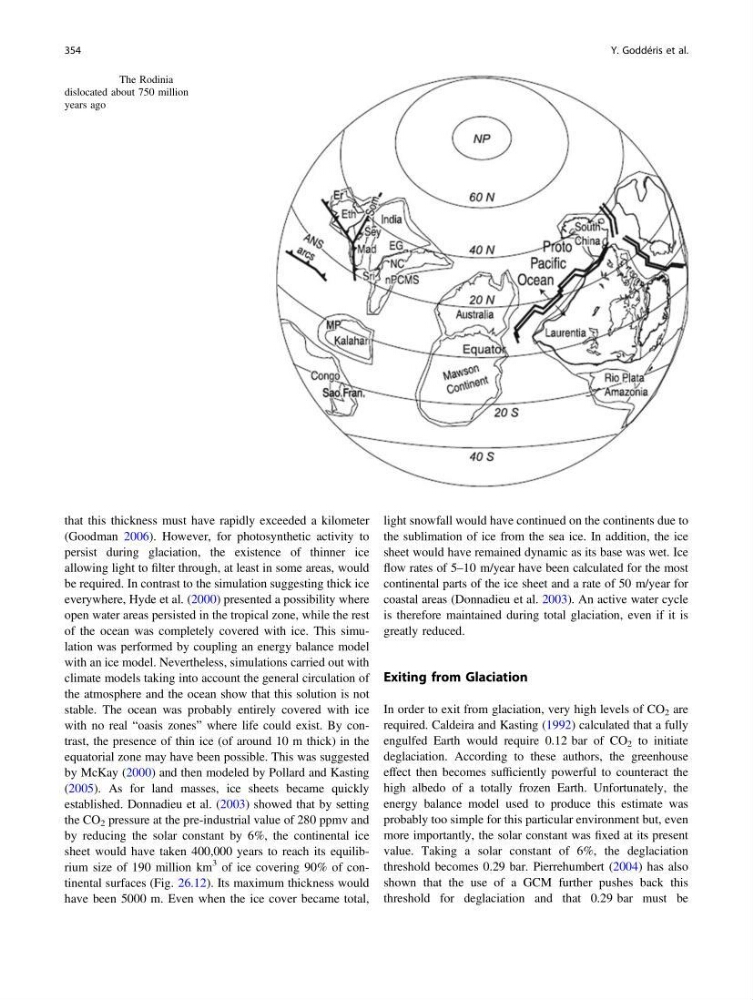
Fig. 26.10 The Rodinia
dislocated about 750 million
years ago
354
Y. Goddéris et al.
(Goodman 2006). However, for photosynthetic activity to
persist during glaciation, the existence of thinner ice
allowing light to filter through, at least in some areas, would
be required. In contrast to the simulation suggesting thick ice
everywhere, Hyde et al. (2000) presented a possibility where
open water areas persisted in the tropical zone, while the rest
of the ocean was completely covered with ice. This simulation was performed by coupling an energy balance model
with an ice model. Nevertheless, simulations carried out with
climate models taking into account the general circulation of
the atmosphere and the ocean show that this solution is not
stable. The ocean was probably entirely covered with ice
with no real “oasis zones” where life could exist. By contrast, the presence of thin ice (of around 10 m thick) in the
equatorial zone may have been possible. This was suggested
by McKay (2000) and then modeled by Pollard and Kasting
(2005). As for land masses, ice sheets became quickly
established. Donnadieu et al. (2003) showed that by setting
the CO 2 pressure at the pre-industrial value of 280 ppmv and
by reducing the solar constant by 6%, the continental ice
sheet would have taken 400,000 years to reach its equilibrium size of 190 million km
3 of ice covering 90% of continental surfaces (Fig. 26.12). Its maximum thickness would
have been 5000 m. Even when the ice cover became total,
light snowfall would have continued on the continents due to
the sublimation of ice from the sea ice. In addition, the ice
sheet would have remained dynamic as its base was wet. Ice
flow rates of 5–10 m/year have been calculated for the most
continental parts of the ice sheet and a rate of 50 m/year for
coastal areas (Donnadieu et al. 2003). An active water cycle
is therefore maintained during total glaciation, even if it is
greatly reduced.
Exiting from Glaciation
In order to exit from glaciation, very high levels of CO 2 are
required. Caldeira and Kasting (1992) calculated that a fully
engulfed Earth would require 0.12 bar of CO 2 to initiate
deglaciation. According to these authors, the greenhouse
effect then becomes sufficiently powerful to counteract the
high albedo of a totally frozen Earth. Unfortunately, the
energy balance model used to produce this estimate was
probably too simple for this particular environment but, even
more importantly, the solar constant was fixed at its present
value. Taking a solar constant of 6%, the deglaciation
threshold becomes 0.29 bar. Pierrehumbert (2004) has also
shown that the use of a GCM further pushes back this
threshold for deglaciation and that 0.29 bar must be
Fig. 26.10 The Rodinia
dislocated about 750 million
years ago
354
Y. Goddéris et al.