

iridium (brought by cosmic materials falling to the ground)
on pack ice for 3–12 million years and its inclusion in
sediments at the time of an ice flood corresponding to the
end of Marinoan glaciation (Bodiselitsch et al. 2005). These
last decades the chronology of Neoproterozoic glaciations
has been considerably improved. The chronology is now
well established with two dissymmetric glaciations: a long
lasting Sturtian episode for more that 50 Ma and a shorter
Marinoan episode lasting around 15 Ma separated by a short
interglacial period only lasting 10 Ma (Hoffman et al. 2017).
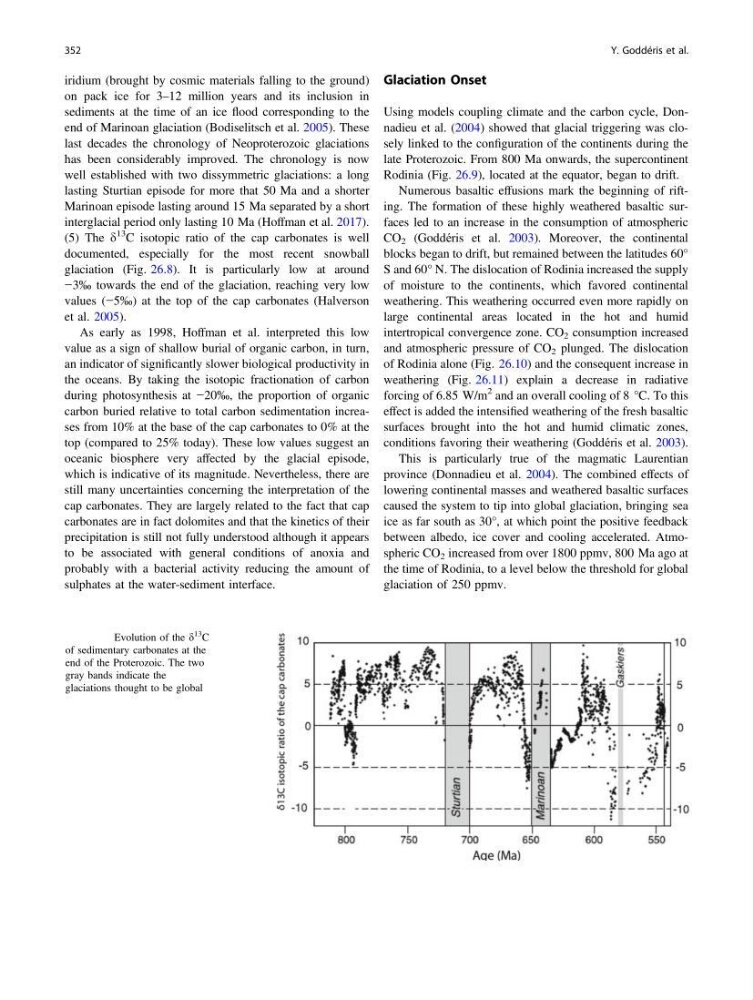
(5) The d
13 C isotopic ratio of the cap carbonates is well
documented, especially for the most recent snowball
glaciation (Fig. 26.8). It is particularly low at around
−3‰ towards the end of the glaciation, reaching very low
values (−5‰) at the top of the cap carbonates (Halverson
et al. 2005).
As early as 1998, Hoffman et al. interpreted this low
value as a sign of shallow burial of organic carbon, in turn,
an indicator of significantly slower biological productivity in
the oceans. By taking the isotopic fractionation of carbon
during photosynthesis at −20‰, the proportion of organic
carbon buried relative to total carbon sedimentation increases from 10% at the base of the cap carbonates to 0% at the
top (compared to 25% today). These low values suggest an
oceanic biosphere very affected by the glacial episode,
which is indicative of its magnitude. Nevertheless, there are
still many uncertainties concerning the interpretation of the
cap carbonates. They are largely related to the fact that cap
carbonates are in fact dolomites and that the kinetics of their
precipitation is still not fully understood although it appears
to be associated with general conditions of anoxia and
probably with a bacterial activity reducing the amount of
sulphates at the water-sediment interface.
Glaciation Onset
Using models coupling climate and the carbon cycle, Donnadieu et al. (2004) showed that glacial triggering was closely linked to the configuration of the continents during the
late Proterozoic. From 800 Ma onwards, the supercontinent
Rodinia (Fig. 26.9), located at the equator, began to drift.
Numerous basaltic effusions mark the beginning of rifting. The formation of these highly weathered basaltic surfaces led to an increase in the consumption of atmospheric
CO 2 (Goddéris et al. 2003). Moreover, the continental
blocks began to drift, but remained between the latitudes 60°
S and 60° N. The dislocation of Rodinia increased the supply
of moisture to the continents, which favored continental
weathering. This weathering occurred even more rapidly on
large continental areas located in the hot and humid
intertropical convergence zone. CO 2 consumption increased
and atmospheric pressure of CO 2 plunged. The dislocation
of Rodinia alone (Fig. 26.10) and the consequent increase in
weathering (Fig. 26.11) explain a decrease in radiative
forcing of 6.85 W/m
2 and an overall cooling of 8 °C. To this
effect is added the intensified weathering of the fresh basaltic
surfaces brought into the hot and humid climatic zones,
conditions favoring their weathering (Goddéris et al. 2003).
This is particularly true of the magmatic Laurentian
province (Donnadieu et al. 2004). The combined effects of
lowering continental masses and weathered basaltic surfaces
caused the system to tip into global glaciation, bringing sea
ice as far south as 30°, at which point the positive feedback
between albedo, ice cover and cooling accelerated. Atmospheric CO 2 increased from over 1800 ppmv, 800 Ma ago at
the time of Rodinia, to a level below the threshold for global
glaciation of 250 ppmv.
Fig. 26.8 Evolution of the d
13 C
of sedimentary carbonates at the
end of the Proterozoic. The two
gray bands indicate the
glaciations thought to be global
352
Y. Goddéris et al.
on pack ice for 3–12 million years and its inclusion in
sediments at the time of an ice flood corresponding to the
end of Marinoan glaciation (Bodiselitsch et al. 2005). These
last decades the chronology of Neoproterozoic glaciations
has been considerably improved. The chronology is now
well established with two dissymmetric glaciations: a long
lasting Sturtian episode for more that 50 Ma and a shorter
Marinoan episode lasting around 15 Ma separated by a short
interglacial period only lasting 10 Ma (Hoffman et al. 2017).
(5) The d
13 C isotopic ratio of the cap carbonates is well
documented, especially for the most recent snowball
glaciation (Fig. 26.8). It is particularly low at around
−3‰ towards the end of the glaciation, reaching very low
values (−5‰) at the top of the cap carbonates (Halverson
et al. 2005).
As early as 1998, Hoffman et al. interpreted this low
value as a sign of shallow burial of organic carbon, in turn,
an indicator of significantly slower biological productivity in
the oceans. By taking the isotopic fractionation of carbon
during photosynthesis at −20‰, the proportion of organic
carbon buried relative to total carbon sedimentation increases from 10% at the base of the cap carbonates to 0% at the
top (compared to 25% today). These low values suggest an
oceanic biosphere very affected by the glacial episode,
which is indicative of its magnitude. Nevertheless, there are
still many uncertainties concerning the interpretation of the
cap carbonates. They are largely related to the fact that cap
carbonates are in fact dolomites and that the kinetics of their
precipitation is still not fully understood although it appears
to be associated with general conditions of anoxia and
probably with a bacterial activity reducing the amount of
sulphates at the water-sediment interface.
Glaciation Onset
Using models coupling climate and the carbon cycle, Donnadieu et al. (2004) showed that glacial triggering was closely linked to the configuration of the continents during the
late Proterozoic. From 800 Ma onwards, the supercontinent
Rodinia (Fig. 26.9), located at the equator, began to drift.
Numerous basaltic effusions mark the beginning of rifting. The formation of these highly weathered basaltic surfaces led to an increase in the consumption of atmospheric
CO 2 (Goddéris et al. 2003). Moreover, the continental
blocks began to drift, but remained between the latitudes 60°
S and 60° N. The dislocation of Rodinia increased the supply
of moisture to the continents, which favored continental
weathering. This weathering occurred even more rapidly on
large continental areas located in the hot and humid
intertropical convergence zone. CO 2 consumption increased
and atmospheric pressure of CO 2 plunged. The dislocation
of Rodinia alone (Fig. 26.10) and the consequent increase in
weathering (Fig. 26.11) explain a decrease in radiative
forcing of 6.85 W/m
2 and an overall cooling of 8 °C. To this
effect is added the intensified weathering of the fresh basaltic
surfaces brought into the hot and humid climatic zones,
conditions favoring their weathering (Goddéris et al. 2003).
This is particularly true of the magmatic Laurentian
province (Donnadieu et al. 2004). The combined effects of
lowering continental masses and weathered basaltic surfaces
caused the system to tip into global glaciation, bringing sea
ice as far south as 30°, at which point the positive feedback
between albedo, ice cover and cooling accelerated. Atmospheric CO 2 increased from over 1800 ppmv, 800 Ma ago at
the time of Rodinia, to a level below the threshold for global
glaciation of 250 ppmv.
Fig. 26.8 Evolution of the d
13 C
of sedimentary carbonates at the
end of the Proterozoic. The two
gray bands indicate the
glaciations thought to be global
352
Y. Goddéris et al.