

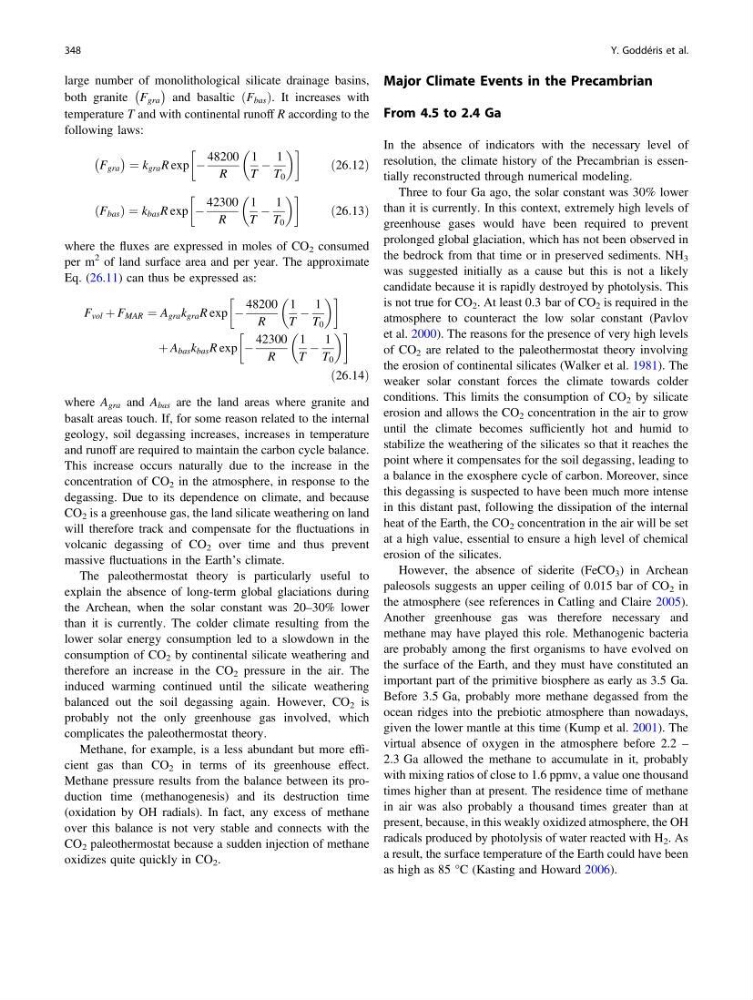
large number of monolithological silicate drainage basins,
both granite F gra
À
Á
and basaltic F bas
ð
Þ. It increases with
temperature T and with continental runoff R according to the
following laws:
F gra
À
Á ¼ k gra R exp À
48200
R
1
T
À
1
T 0
!
ð26:12Þ
F bas
ð
Þ ¼ k bas R exp À
42300
R
1
T
À
1
T 0
!
ð26:13Þ
where the fluxes are expressed in moles of CO 2 consumed
per m
2 of land surface area and per year. The approximate
Eq. (26.11) can thus be expressed as:
F vol þ F MAR ¼ A gra k gra R exp À
48200
R
1
T
À
1
T 0
!
þ A bas k bas R exp À
42300
R
1
T
À
1
T 0
!
ð26:14Þ
where A gra and A bas are the land areas where granite and
basalt areas touch. If, for some reason related to the internal
geology, soil degassing increases, increases in temperature
and runoff are required to maintain the carbon cycle balance.
This increase occurs naturally due to the increase in the
concentration of CO 2 in the atmosphere, in response to the
degassing. Due to its dependence on climate, and because
CO 2 is a greenhouse gas, the land silicate weathering on land
will therefore track and compensate for the fluctuations in
volcanic degassing of CO 2 over time and thus prevent
massive fluctuations in the Earth’s climate.
The paleothermostat theory is particularly useful to
explain the absence of long-term global glaciations during
the Archean, when the solar constant was 20–30% lower
than it is currently. The colder climate resulting from the
lower solar energy consumption led to a slowdown in the
consumption of CO 2 by continental silicate weathering and
therefore an increase in the CO 2 pressure in the air. The
induced warming continued until the silicate weathering
balanced out the soil degassing again. However, CO 2 is
probably not the only greenhouse gas involved, which
complicates the paleothermostat theory.
Methane, for example, is a less abundant but more efficient gas than CO 2 in terms of its greenhouse effect.
Methane pressure results from the balance between its production time (methanogenesis) and its destruction time
(oxidation by OH radials). In fact, any excess of methane
over this balance is not very stable and connects with the
CO 2 paleothermostat because a sudden injection of methane
oxidizes quite quickly in CO 2 .
Major Climate Events in the Precambrian
From 4.5 to 2.4 Ga
In the absence of indicators with the necessary level of
resolution, the climate history of the Precambrian is essentially reconstructed through numerical modeling.
Three to four Ga ago, the solar constant was 30% lower
than it is currently. In this context, extremely high levels of
greenhouse gases would have been required to prevent
prolonged global glaciation, which has not been observed in
the bedrock from that time or in preserved sediments. NH 3
was suggested initially as a cause but this is not a likely
candidate because it is rapidly destroyed by photolysis. This
is not true for CO 2 . At least 0.3 bar of CO 2 is required in the
atmosphere to counteract the low solar constant (Pavlov
et al. 2000). The reasons for the presence of very high levels
of CO 2 are related to the paleothermostat theory involving
the erosion of continental silicates (Walker et al. 1981). The
weaker solar constant forces the climate towards colder
conditions. This limits the consumption of CO 2 by silicate
erosion and allows the CO 2 concentration in the air to grow
until the climate becomes sufficiently hot and humid to
stabilize the weathering of the silicates so that it reaches the
point where it compensates for the soil degassing, leading to
a balance in the exosphere cycle of carbon. Moreover, since
this degassing is suspected to have been much more intense
in this distant past, following the dissipation of the internal
heat of the Earth, the CO 2 concentration in the air will be set
at a high value, essential to ensure a high level of chemical
erosion of the silicates.
However, the absence of siderite (FeCO 3 ) in Archean
paleosols suggests an upper ceiling of 0.015 bar of CO 2 in
the atmosphere (see references in Catling and Claire 2005).
Another greenhouse gas was therefore necessary and
methane may have played this role. Methanogenic bacteria
are probably among the first organisms to have evolved on
the surface of the Earth, and they must have constituted an
important part of the primitive biosphere as early as 3.5 Ga.
Before 3.5 Ga, probably more methane degassed from the
ocean ridges into the prebiotic atmosphere than nowadays,
given the lower mantle at this time (Kump et al. 2001). The
virtual absence of oxygen in the atmosphere before 2.2 –
2.3 Ga allowed the methane to accumulate in it, probably
with mixing ratios of close to 1.6 ppmv, a value one thousand
times higher than at present. The residence time of methane
in air was also probably a thousand times greater than at
present, because, in this weakly oxidized atmosphere, the OH
radicals produced by photolysis of water reacted with H 2 . As
a result, the surface temperature of the Earth could have been
as high as 85 °C (Kasting and Howard 2006).
348
Y. Goddéris et al.
both granite F gra
À
Á
and basaltic F bas
ð
Þ. It increases with
temperature T and with continental runoff R according to the
following laws:
F gra
À
Á ¼ k gra R exp À
48200
R
1
T
À
1
T 0
!
ð26:12Þ
F bas
ð
Þ ¼ k bas R exp À
42300
R
1
T
À
1
T 0
!
ð26:13Þ
where the fluxes are expressed in moles of CO 2 consumed
per m
2 of land surface area and per year. The approximate
Eq. (26.11) can thus be expressed as:
F vol þ F MAR ¼ A gra k gra R exp À
48200
R
1
T
À
1
T 0
!
þ A bas k bas R exp À
42300
R
1
T
À
1
T 0
!
ð26:14Þ
where A gra and A bas are the land areas where granite and
basalt areas touch. If, for some reason related to the internal
geology, soil degassing increases, increases in temperature
and runoff are required to maintain the carbon cycle balance.
This increase occurs naturally due to the increase in the
concentration of CO 2 in the atmosphere, in response to the
degassing. Due to its dependence on climate, and because
CO 2 is a greenhouse gas, the land silicate weathering on land
will therefore track and compensate for the fluctuations in
volcanic degassing of CO 2 over time and thus prevent
massive fluctuations in the Earth’s climate.
The paleothermostat theory is particularly useful to
explain the absence of long-term global glaciations during
the Archean, when the solar constant was 20–30% lower
than it is currently. The colder climate resulting from the
lower solar energy consumption led to a slowdown in the
consumption of CO 2 by continental silicate weathering and
therefore an increase in the CO 2 pressure in the air. The
induced warming continued until the silicate weathering
balanced out the soil degassing again. However, CO 2 is
probably not the only greenhouse gas involved, which
complicates the paleothermostat theory.
Methane, for example, is a less abundant but more efficient gas than CO 2 in terms of its greenhouse effect.
Methane pressure results from the balance between its production time (methanogenesis) and its destruction time
(oxidation by OH radials). In fact, any excess of methane
over this balance is not very stable and connects with the
CO 2 paleothermostat because a sudden injection of methane
oxidizes quite quickly in CO 2 .
Major Climate Events in the Precambrian
From 4.5 to 2.4 Ga
In the absence of indicators with the necessary level of
resolution, the climate history of the Precambrian is essentially reconstructed through numerical modeling.
Three to four Ga ago, the solar constant was 30% lower
than it is currently. In this context, extremely high levels of
greenhouse gases would have been required to prevent
prolonged global glaciation, which has not been observed in
the bedrock from that time or in preserved sediments. NH 3
was suggested initially as a cause but this is not a likely
candidate because it is rapidly destroyed by photolysis. This
is not true for CO 2 . At least 0.3 bar of CO 2 is required in the
atmosphere to counteract the low solar constant (Pavlov
et al. 2000). The reasons for the presence of very high levels
of CO 2 are related to the paleothermostat theory involving
the erosion of continental silicates (Walker et al. 1981). The
weaker solar constant forces the climate towards colder
conditions. This limits the consumption of CO 2 by silicate
erosion and allows the CO 2 concentration in the air to grow
until the climate becomes sufficiently hot and humid to
stabilize the weathering of the silicates so that it reaches the
point where it compensates for the soil degassing, leading to
a balance in the exosphere cycle of carbon. Moreover, since
this degassing is suspected to have been much more intense
in this distant past, following the dissipation of the internal
heat of the Earth, the CO 2 concentration in the air will be set
at a high value, essential to ensure a high level of chemical
erosion of the silicates.
However, the absence of siderite (FeCO 3 ) in Archean
paleosols suggests an upper ceiling of 0.015 bar of CO 2 in
the atmosphere (see references in Catling and Claire 2005).
Another greenhouse gas was therefore necessary and
methane may have played this role. Methanogenic bacteria
are probably among the first organisms to have evolved on
the surface of the Earth, and they must have constituted an
important part of the primitive biosphere as early as 3.5 Ga.
Before 3.5 Ga, probably more methane degassed from the
ocean ridges into the prebiotic atmosphere than nowadays,
given the lower mantle at this time (Kump et al. 2001). The
virtual absence of oxygen in the atmosphere before 2.2 –
2.3 Ga allowed the methane to accumulate in it, probably
with mixing ratios of close to 1.6 ppmv, a value one thousand
times higher than at present. The residence time of methane
in air was also probably a thousand times greater than at
present, because, in this weakly oxidized atmosphere, the OH
radicals produced by photolysis of water reacted with H 2 . As
a result, the surface temperature of the Earth could have been
as high as 85 °C (Kasting and Howard 2006).
348
Y. Goddéris et al.