

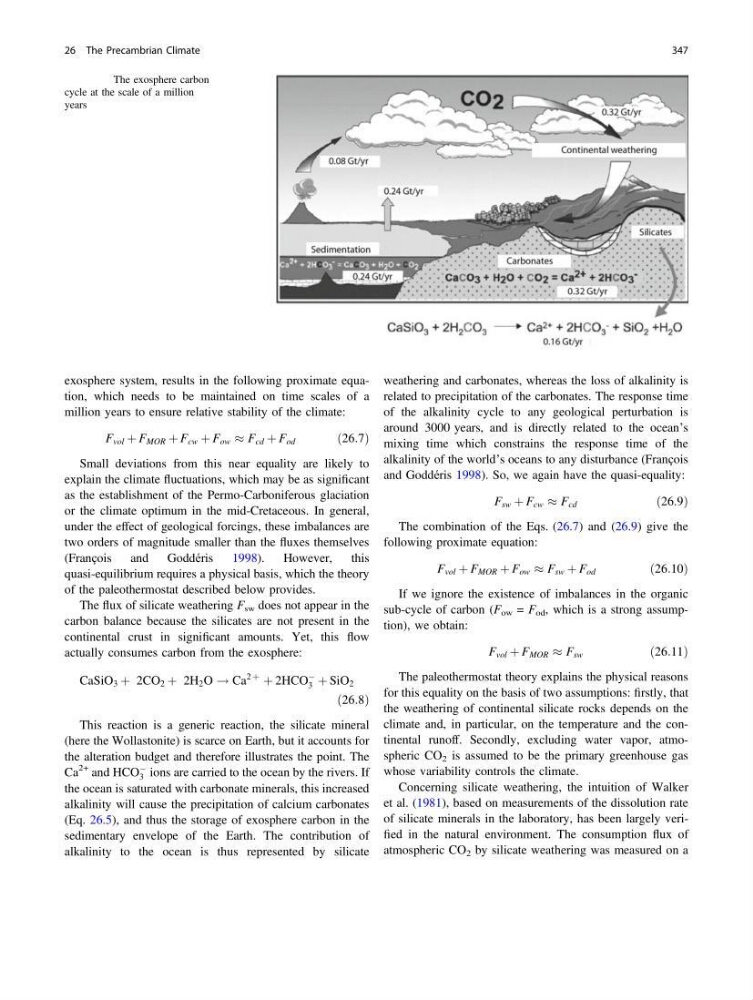
exosphere system, results in the following proximate equation, which needs to be maintained on time scales of a
million years to ensure relative stability of the climate:
F vol þ F MOR þ F cw þ F ow % F cd þ F od
ð26:7Þ
Small deviations from this near equality are likely to
explain the climate fluctuations, which may be as significant
as the establishment of the Permo-Carboniferous glaciation
or the climate optimum in the mid-Cretaceous. In general,
under the effect of geological forcings, these imbalances are
two orders of magnitude smaller than the fluxes themselves
(François and Goddéris 1998). However, this
quasi-equilibrium requires a physical basis, which the theory
of the paleothermostat described below provides.
The flux of silicate weathering F sw does not appear in the
carbon balance because the silicates are not present in the
continental crust in significant amounts. Yet, this flow
actually consumes carbon from the exosphere:
CaSiO 3 þ 2CO 2 þ 2H 2 O ! Ca
2 þ
þ 2HCO
À
3 þ SiO 2
ð26:8Þ
This reaction is a generic reaction, the silicate mineral
(here the Wollastonite) is scarce on Earth, but it accounts for
the alteration budget and therefore illustrates the point. The
Ca
2+ and HCO
À
3 ions are carried to the ocean by the rivers. If
the ocean is saturated with carbonate minerals, this increased
alkalinity will cause the precipitation of calcium carbonates
(Eq. 26.5), and thus the storage of exosphere carbon in the
sedimentary envelope of the Earth. The contribution of
alkalinity to the ocean is thus represented by silicate
weathering and carbonates, whereas the loss of alkalinity is
related to precipitation of the carbonates. The response time
of the alkalinity cycle to any geological perturbation is
around 3000 years, and is directly related to the ocean’s
mixing time which constrains the response time of the
alkalinity of the world’s oceans to any disturbance (François
and Goddéris 1998). So, we again have the quasi-equality:
F sw þ F cw % F cd
ð26:9Þ
The combination of the Eqs. (26.7) and (26.9) give the
following proximate equation:
F vol þ F MOR þ F ow % F sw þ F od
ð26:10Þ
If we ignore the existence of imbalances in the organic
sub-cycle of carbon (F ow = F od , which is a strong assumption), we obtain:
F vol þ F MOR % F sw
ð26:11Þ
The paleothermostat theory explains the physical reasons
for this equality on the basis of two assumptions: firstly, that
the weathering of continental silicate rocks depends on the
climate and, in particular, on the temperature and the continental runoff. Secondly, excluding water vapor, atmospheric CO 2 is assumed to be the primary greenhouse gas
whose variability controls the climate.
Concerning silicate weathering, the intuition of Walker
et al. (1981), based on measurements of the dissolution rate
of silicate minerals in the laboratory, has been largely verified in the natural environment. The consumption flux of
atmospheric CO 2 by silicate weathering was measured on a
Fig. 26.3 The exosphere carbon
cycle at the scale of a million
years
26 The Precambrian Climate
347
million years to ensure relative stability of the climate:
F vol þ F MOR þ F cw þ F ow % F cd þ F od
ð26:7Þ
Small deviations from this near equality are likely to
explain the climate fluctuations, which may be as significant
as the establishment of the Permo-Carboniferous glaciation
or the climate optimum in the mid-Cretaceous. In general,
under the effect of geological forcings, these imbalances are
two orders of magnitude smaller than the fluxes themselves
(François and Goddéris 1998). However, this
quasi-equilibrium requires a physical basis, which the theory
of the paleothermostat described below provides.
The flux of silicate weathering F sw does not appear in the
carbon balance because the silicates are not present in the
continental crust in significant amounts. Yet, this flow
actually consumes carbon from the exosphere:
CaSiO 3 þ 2CO 2 þ 2H 2 O ! Ca
2 þ
þ 2HCO
À
3 þ SiO 2
ð26:8Þ
This reaction is a generic reaction, the silicate mineral
(here the Wollastonite) is scarce on Earth, but it accounts for
the alteration budget and therefore illustrates the point. The
Ca
2+ and HCO
À
3 ions are carried to the ocean by the rivers. If
the ocean is saturated with carbonate minerals, this increased
alkalinity will cause the precipitation of calcium carbonates
(Eq. 26.5), and thus the storage of exosphere carbon in the
sedimentary envelope of the Earth. The contribution of
alkalinity to the ocean is thus represented by silicate
weathering and carbonates, whereas the loss of alkalinity is
related to precipitation of the carbonates. The response time
of the alkalinity cycle to any geological perturbation is
around 3000 years, and is directly related to the ocean’s
mixing time which constrains the response time of the
alkalinity of the world’s oceans to any disturbance (François
and Goddéris 1998). So, we again have the quasi-equality:
F sw þ F cw % F cd
ð26:9Þ
The combination of the Eqs. (26.7) and (26.9) give the
following proximate equation:
F vol þ F MOR þ F ow % F sw þ F od
ð26:10Þ
If we ignore the existence of imbalances in the organic
sub-cycle of carbon (F ow = F od , which is a strong assumption), we obtain:
F vol þ F MOR % F sw
ð26:11Þ
The paleothermostat theory explains the physical reasons
for this equality on the basis of two assumptions: firstly, that
the weathering of continental silicate rocks depends on the
climate and, in particular, on the temperature and the continental runoff. Secondly, excluding water vapor, atmospheric CO 2 is assumed to be the primary greenhouse gas
whose variability controls the climate.
Concerning silicate weathering, the intuition of Walker
et al. (1981), based on measurements of the dissolution rate
of silicate minerals in the laboratory, has been largely verified in the natural environment. The consumption flux of
atmospheric CO 2 by silicate weathering was measured on a
Fig. 26.3 The exosphere carbon
cycle at the scale of a million
years
26 The Precambrian Climate
347