

context of geological time. If the history of the Earth was
condensed into one day, the entire carbon content of the
ocean and atmosphere would be recycled about every 3 s.
This short response time is obviously linked to the small size
of the exosphere carbon reservoir (3 Â 10
18 mol) and to the
fluxes in exchanges of matter (of around 10
12
–10
13 mol of
carbon per year) between this reservoir and the geological
reservoirs. The implications of this short residence time are
important for the climate. Any imbalance between the carbon inflows (e.g. solid soil degassing) and outflows (e.g.
CO 2 consumption due to silicate weathering) that would
have occurred over several million years (a short timescale
compared to the history of the Earth) would cause gigantic
fluctuations (several orders of magnitude) of the carbon
dioxide content in the atmosphere, with dramatic consequences for the climate. Fluctuations of this scale have not
occurred in the history of the Earth, apart from some isolated
episodes of global glaciations at the end of the Proterozoic.
The carbon input and output flows must therefore be close to
equilibrium over the geological time scale, from 10
6 to
10
9 years (see François and Goddéris (1998) for a complete
mathematical assessment).
The carbon cycle at the million-year scale is described in
Fig. 26.3. Only geological flows are taken into account, all
rapid recycling (biosphere fluxes and ocean-atmosphere
interface) are ignored.
The inflows to the ocean-atmosphere system are soil
degassing from volcanoes, F vol and from the oceanic ridges
F MOR ; the dissolution of the continental carbonates which
transfers carbon from the continental crust to the ocean in the
dissolved form HCO
À
3 F cw ; and the oxidation of old sedimentary organic compounds exposed to the atmosphere F ow
(black shales, for example, sediments rich in organic matter
deposited during episodes of large-scale ocean anoxia and
which are exposed to the atmosphere by tectonic activity):
CaCO 3 þ CO 2 þ H 2 O ! Ca
2 þ
þ 2HCO
À
3
ð26:3Þ
dissolution of continental carbonates by carbonic acid:
CH 2 O þ O 2 ! 2HCO
À
3 þ H
þ
ð26:4Þ
oxidation of sedimentary organic carbon.
The sinks are represented by the precipitation of carbonate minerals F cd on the ocean floor or on the continental
shelves, through the mediation or not of biocalcification, and
the burial of organic carbon within sediments F od , both on
land and in the ocean.
Ca
2 þ
þ 2HCO
À
3 ! CaCO 3 þ CO 2 þ H 2 O
ð26:5Þ
precipitation of carbonates
CO 2 þ H 2 O ! CH 2 O þ O 2
ð26:6Þ
autotrophic productivity and burial of organic carbon.
The long-term equilibrium of the carbon cycle, mathematically required because of its low residence time in the
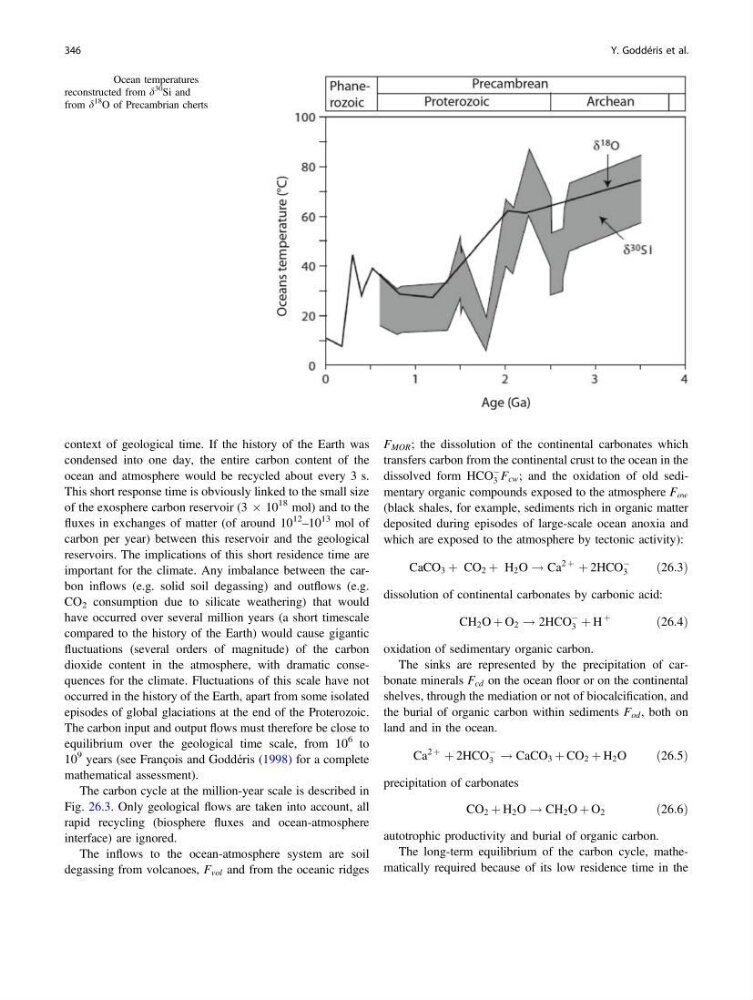
Fig. 26.2 Ocean temperatures
reconstructed from d
30
Si and
from d
18
O of Precambrian cherts
346
Y. Goddéris et al.
condensed into one day, the entire carbon content of the
ocean and atmosphere would be recycled about every 3 s.
This short response time is obviously linked to the small size
of the exosphere carbon reservoir (3 Â 10
18 mol) and to the
fluxes in exchanges of matter (of around 10
12
–10
13 mol of
carbon per year) between this reservoir and the geological
reservoirs. The implications of this short residence time are
important for the climate. Any imbalance between the carbon inflows (e.g. solid soil degassing) and outflows (e.g.
CO 2 consumption due to silicate weathering) that would
have occurred over several million years (a short timescale
compared to the history of the Earth) would cause gigantic
fluctuations (several orders of magnitude) of the carbon
dioxide content in the atmosphere, with dramatic consequences for the climate. Fluctuations of this scale have not
occurred in the history of the Earth, apart from some isolated
episodes of global glaciations at the end of the Proterozoic.
The carbon input and output flows must therefore be close to
equilibrium over the geological time scale, from 10
6 to
10
9 years (see François and Goddéris (1998) for a complete
mathematical assessment).
The carbon cycle at the million-year scale is described in
Fig. 26.3. Only geological flows are taken into account, all
rapid recycling (biosphere fluxes and ocean-atmosphere
interface) are ignored.
The inflows to the ocean-atmosphere system are soil
degassing from volcanoes, F vol and from the oceanic ridges
F MOR ; the dissolution of the continental carbonates which
transfers carbon from the continental crust to the ocean in the
dissolved form HCO
À
3 F cw ; and the oxidation of old sedimentary organic compounds exposed to the atmosphere F ow
(black shales, for example, sediments rich in organic matter
deposited during episodes of large-scale ocean anoxia and
which are exposed to the atmosphere by tectonic activity):
CaCO 3 þ CO 2 þ H 2 O ! Ca
2 þ
þ 2HCO
À
3
ð26:3Þ
dissolution of continental carbonates by carbonic acid:
CH 2 O þ O 2 ! 2HCO
À
3 þ H
þ
ð26:4Þ
oxidation of sedimentary organic carbon.
The sinks are represented by the precipitation of carbonate minerals F cd on the ocean floor or on the continental
shelves, through the mediation or not of biocalcification, and
the burial of organic carbon within sediments F od , both on
land and in the ocean.
Ca
2 þ
þ 2HCO
À
3 ! CaCO 3 þ CO 2 þ H 2 O
ð26:5Þ
precipitation of carbonates
CO 2 þ H 2 O ! CH 2 O þ O 2
ð26:6Þ
autotrophic productivity and burial of organic carbon.
The long-term equilibrium of the carbon cycle, mathematically required because of its low residence time in the
Fig. 26.2 Ocean temperatures
reconstructed from d
30
Si and
from d
18
O of Precambrian cherts
346
Y. Goddéris et al.