

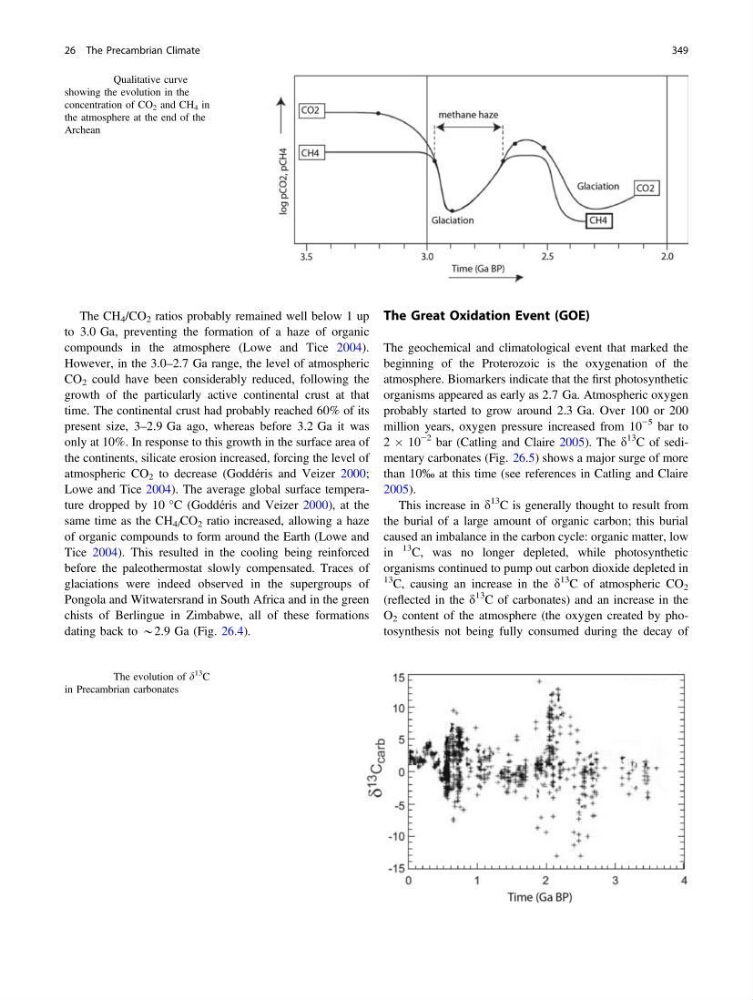
The CH 4 /CO 2 ratios probably remained well below 1 up
to 3.0 Ga, preventing the formation of a haze of organic
compounds in the atmosphere (Lowe and Tice 2004).
However, in the 3.0–2.7 Ga range, the level of atmospheric
CO 2 could have been considerably reduced, following the
growth of the particularly active continental crust at that
time. The continental crust had probably reached 60% of its
present size, 3–2.9 Ga ago, whereas before 3.2 Ga it was
only at 10%. In response to this growth in the surface area of
the continents, silicate erosion increased, forcing the level of
atmospheric CO 2 to decrease (Goddéris and Veizer 2000;
Lowe and Tice 2004). The average global surface temperature dropped by 10 °C (Goddéris and Veizer 2000), at the
same time as the CH 4/ CO 2 ratio increased, allowing a haze
of organic compounds to form around the Earth (Lowe and
Tice 2004). This resulted in the cooling being reinforced
before the paleothermostat slowly compensated. Traces of
glaciations were indeed observed in the supergroups of
Pongola and Witwatersrand in South Africa and in the green
chists of Berlingue in Zimbabwe, all of these formations
dating back to *2.9 Ga (Fig. 26.4).
The Great Oxidation Event (GOE)
The geochemical and climatological event that marked the
beginning of the Proterozoic is the oxygenation of the
atmosphere. Biomarkers indicate that the first photosynthetic
organisms appeared as early as 2.7 Ga. Atmospheric oxygen
probably started to grow around 2.3 Ga. Over 100 or 200
million years, oxygen pressure increased from 10
−5 bar to
2 Â 10
−2 bar (Catling and Claire 2005). The d
13 C of sedimentary carbonates (Fig. 26.5) shows a major surge of more
than 10‰ at this time (see references in Catling and Claire
2005).
This increase in d
13 C is generally thought to result from
the burial of a large amount of organic carbon; this burial
caused an imbalance in the carbon cycle: organic matter, low
in
13 C, was no longer depleted, while photosynthetic
organisms continued to pump out carbon dioxide depleted in
13 C, causing an increase in the d
13 C of atmospheric CO 2
(reflected in the d
13 C of carbonates) and an increase in the
O 2 content of the atmosphere (the oxygen created by photosynthesis not being fully consumed during the decay of
Fig. 26.4 Qualitative curve
showing the evolution in the
concentration of CO 2 and CH 4 in
the atmosphere at the end of the
Archean
Fig. 26.5 The evolution of d
13
C
in Precambrian carbonates
26 The Precambrian Climate
349
to 3.0 Ga, preventing the formation of a haze of organic
compounds in the atmosphere (Lowe and Tice 2004).
However, in the 3.0–2.7 Ga range, the level of atmospheric
CO 2 could have been considerably reduced, following the
growth of the particularly active continental crust at that
time. The continental crust had probably reached 60% of its
present size, 3–2.9 Ga ago, whereas before 3.2 Ga it was
only at 10%. In response to this growth in the surface area of
the continents, silicate erosion increased, forcing the level of
atmospheric CO 2 to decrease (Goddéris and Veizer 2000;
Lowe and Tice 2004). The average global surface temperature dropped by 10 °C (Goddéris and Veizer 2000), at the
same time as the CH 4/ CO 2 ratio increased, allowing a haze
of organic compounds to form around the Earth (Lowe and
Tice 2004). This resulted in the cooling being reinforced
before the paleothermostat slowly compensated. Traces of
glaciations were indeed observed in the supergroups of
Pongola and Witwatersrand in South Africa and in the green
chists of Berlingue in Zimbabwe, all of these formations
dating back to *2.9 Ga (Fig. 26.4).
The Great Oxidation Event (GOE)
The geochemical and climatological event that marked the
beginning of the Proterozoic is the oxygenation of the
atmosphere. Biomarkers indicate that the first photosynthetic
organisms appeared as early as 2.7 Ga. Atmospheric oxygen
probably started to grow around 2.3 Ga. Over 100 or 200
million years, oxygen pressure increased from 10
−5 bar to
2 Â 10
−2 bar (Catling and Claire 2005). The d
13 C of sedimentary carbonates (Fig. 26.5) shows a major surge of more
than 10‰ at this time (see references in Catling and Claire
2005).
This increase in d
13 C is generally thought to result from
the burial of a large amount of organic carbon; this burial
caused an imbalance in the carbon cycle: organic matter, low
in
13 C, was no longer depleted, while photosynthetic
organisms continued to pump out carbon dioxide depleted in
13 C, causing an increase in the d
13 C of atmospheric CO 2
(reflected in the d
13 C of carbonates) and an increase in the
O 2 content of the atmosphere (the oxygen created by photosynthesis not being fully consumed during the decay of
Fig. 26.4 Qualitative curve
showing the evolution in the
concentration of CO 2 and CH 4 in
the atmosphere at the end of the
Archean
Fig. 26.5 The evolution of d
13
C
in Precambrian carbonates
26 The Precambrian Climate
349