

the ice and the trapped air at a given depth level. This age
difference that may be as much as several hundred years and
even up to several thousands of years in the case of central
Antarctic sites (Schwander and Stauffer 1984). Estimates of
the age difference between the ice and the entrapped air are
possible but there are associated uncertainties which are
detailed in Volume 1, Chap. 8. The first reliable
measurements of past CO 2 changes recorded in Antarctic ice
were published in the 1980s, initially covering the last
30,000 years (Delmas et al. 1980), then the last
160,000 years (Barnola et al. 1987), and now as much as the
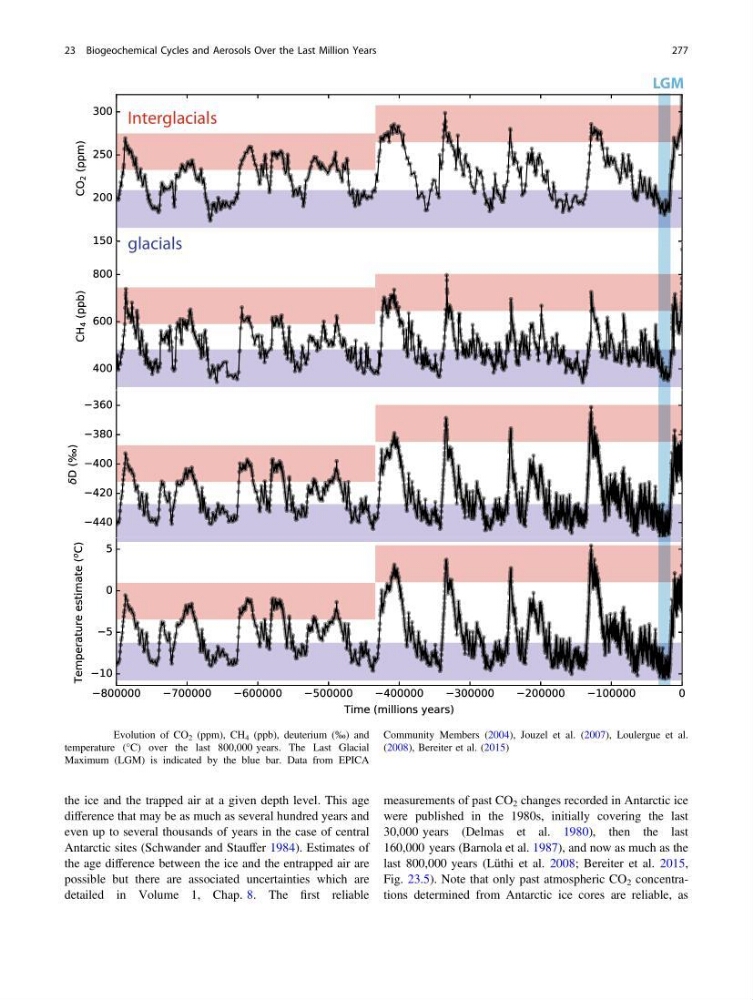
last 800,000 years (Lüthi et al. 2008; Bereiter et al. 2015,
Fig. 23.5). Note that only past atmospheric CO 2 concentrations determined from Antarctic ice cores are reliable, as
LGM
Interglacials
glacials
Fig. 23.5 Evolution of CO 2 (ppm), CH 4 (ppb), deuterium (‰) and
temperature (°C) over the last 800,000 years. The Last Glacial
Maximum (LGM) is indicated by the blue bar. Data from EPICA
Community Members (2004), Jouzel et al. (2007), Loulergue et al.
(2008), Bereiter et al. (2015)
23 Biogeochemical Cycles and Aerosols Over the Last Million Years
277
difference that may be as much as several hundred years and
even up to several thousands of years in the case of central
Antarctic sites (Schwander and Stauffer 1984). Estimates of
the age difference between the ice and the entrapped air are
possible but there are associated uncertainties which are
detailed in Volume 1, Chap. 8. The first reliable
measurements of past CO 2 changes recorded in Antarctic ice
were published in the 1980s, initially covering the last
30,000 years (Delmas et al. 1980), then the last
160,000 years (Barnola et al. 1987), and now as much as the
last 800,000 years (Lüthi et al. 2008; Bereiter et al. 2015,
Fig. 23.5). Note that only past atmospheric CO 2 concentrations determined from Antarctic ice cores are reliable, as
LGM
Interglacials
glacials
Fig. 23.5 Evolution of CO 2 (ppm), CH 4 (ppb), deuterium (‰) and
temperature (°C) over the last 800,000 years. The Last Glacial
Maximum (LGM) is indicated by the blue bar. Data from EPICA
Community Members (2004), Jouzel et al. (2007), Loulergue et al.
(2008), Bereiter et al. (2015)
23 Biogeochemical Cycles and Aerosols Over the Last Million Years
277