

temperature and the composition of the soil. Currently,
around three quarters of CH 4 production takes place in
tropical regions and a quarter in boreal regions. Animals also
produce CH 4 , in particular termites and ruminant animals. In
addition, vegetation is also involved in CH 4 emission.
Vegetation as a CH 4 producer is still debated, but it can
impact on the transport of CH 4 from the soil to the atmosphere. Permafrost can also be a source of CH 4 but related
uncertainties are high. Finally, CH 4 is also emitted by biomass burning. There is also a small continental sink of
atmospheric CH 4 : the oxidation by methanotrophic bacteria
in soils.
A smaller CH 4 source is from the ocean, with CH 4
coming mainly from coastal regions. However, the ocean
could contain large CH 4 quantities trapped as methane
clathrate in sediments, mainly on continental shelves.
Methane clathrate, or methane hydrate, is a compound in
which methane is trapped in a crystal of water. Clathrates are
stable at low temperature and high pressure. The size of this
reservoir is poorly constrained and could contain 500–2500
GtC, a smaller amount than the very high quantities suggested in the 1970s (Milkov 2004).
While the atmospheric CH 4 mixing ratio impacts on climate by modifying the atmospheric radiative balance, climate impacts on the sources and sinks of methane. In
particular, wetlands are very dependent on the hydrological
cycle and microbial activity, and thus the emission of
methane, is strongly dependent on temperature. In addition,
in the atmosphere, methane oxidation by OH radicals is one
of the most temperature-sensitive reactions.
Glacial-Interglacial Cycles
The main archives used to infer past changes in the carbon
cycle are ice cores and marine sediment cores (see
Volume 1). While ice cores provide an invaluable direct way
of assessing past changes in atmospheric CO 2 and CH 4 ,
there is no direct record of past ocean and land carbon
storage. Fortunately, the carbon element has three isotopes:
12 C,
13 C and
14
C, and their ratios, which can be measured
from foraminifera shells in the sediments, as well as in the
air in ice cores, provide clues to understand changes in past
carbon reservoirs.
Ice Cores
Ice cores recording glacial-interglacial changes are extracted
from the Greenland ice sheet in the Northern Hemisphere,
and the Antarctic ice sheet in the Southern Hemisphere
(Volume 1, Chap. 9). The oldest ice obtained from Greenland is *130,000 years old (NEEM Community Members
2013), much younger than the oldest ice from Antarctica
which is *800,000 years old (EPICA Community Members 2004). This age could be extended further and future
expeditions are planned to find and drill Antarctic ice older
than a million years (Dahl-Jensen 2018).
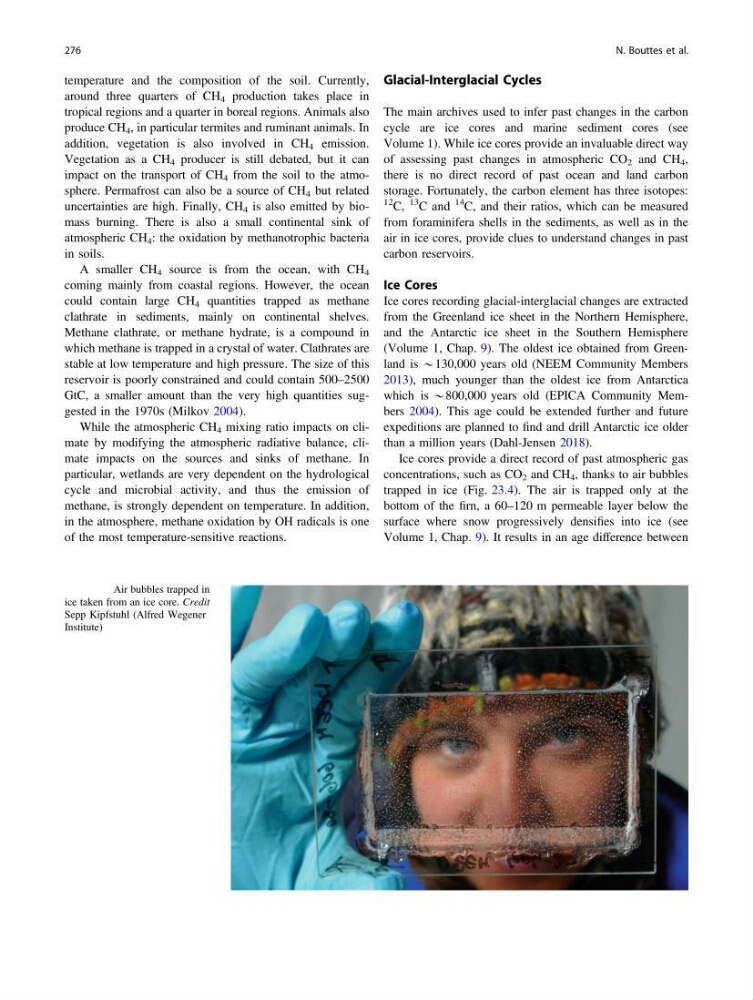
Ice cores provide a direct record of past atmospheric gas
concentrations, such as CO 2 and CH 4 , thanks to air bubbles
trapped in ice (Fig. 23.4). The air is trapped only at the
bottom of the firn, a 60–120 m permeable layer below the
surface where snow progressively densifies into ice (see
Volume 1, Chap. 9). It results in an age difference between
Fig. 23.4 Air bubbles trapped in
ice taken from an ice core. Credit
Sepp Kipfstuhl (Alfred Wegener
Institute)
276
N. Bouttes et al.
around three quarters of CH 4 production takes place in
tropical regions and a quarter in boreal regions. Animals also
produce CH 4 , in particular termites and ruminant animals. In
addition, vegetation is also involved in CH 4 emission.
Vegetation as a CH 4 producer is still debated, but it can
impact on the transport of CH 4 from the soil to the atmosphere. Permafrost can also be a source of CH 4 but related
uncertainties are high. Finally, CH 4 is also emitted by biomass burning. There is also a small continental sink of
atmospheric CH 4 : the oxidation by methanotrophic bacteria
in soils.
A smaller CH 4 source is from the ocean, with CH 4
coming mainly from coastal regions. However, the ocean
could contain large CH 4 quantities trapped as methane
clathrate in sediments, mainly on continental shelves.
Methane clathrate, or methane hydrate, is a compound in
which methane is trapped in a crystal of water. Clathrates are
stable at low temperature and high pressure. The size of this
reservoir is poorly constrained and could contain 500–2500
GtC, a smaller amount than the very high quantities suggested in the 1970s (Milkov 2004).
While the atmospheric CH 4 mixing ratio impacts on climate by modifying the atmospheric radiative balance, climate impacts on the sources and sinks of methane. In
particular, wetlands are very dependent on the hydrological
cycle and microbial activity, and thus the emission of
methane, is strongly dependent on temperature. In addition,
in the atmosphere, methane oxidation by OH radicals is one
of the most temperature-sensitive reactions.
Glacial-Interglacial Cycles
The main archives used to infer past changes in the carbon
cycle are ice cores and marine sediment cores (see
Volume 1). While ice cores provide an invaluable direct way
of assessing past changes in atmospheric CO 2 and CH 4 ,
there is no direct record of past ocean and land carbon
storage. Fortunately, the carbon element has three isotopes:
12 C,
13 C and
14
C, and their ratios, which can be measured
from foraminifera shells in the sediments, as well as in the
air in ice cores, provide clues to understand changes in past
carbon reservoirs.
Ice Cores
Ice cores recording glacial-interglacial changes are extracted
from the Greenland ice sheet in the Northern Hemisphere,
and the Antarctic ice sheet in the Southern Hemisphere
(Volume 1, Chap. 9). The oldest ice obtained from Greenland is *130,000 years old (NEEM Community Members
2013), much younger than the oldest ice from Antarctica
which is *800,000 years old (EPICA Community Members 2004). This age could be extended further and future
expeditions are planned to find and drill Antarctic ice older
than a million years (Dahl-Jensen 2018).
Ice cores provide a direct record of past atmospheric gas
concentrations, such as CO 2 and CH 4 , thanks to air bubbles
trapped in ice (Fig. 23.4). The air is trapped only at the
bottom of the firn, a 60–120 m permeable layer below the
surface where snow progressively densifies into ice (see
Volume 1, Chap. 9). It results in an age difference between
Fig. 23.4 Air bubbles trapped in
ice taken from an ice core. Credit
Sepp Kipfstuhl (Alfred Wegener
Institute)
276
N. Bouttes et al.