

CO 2 þ CO
2À
3 þ H 2 O 2HCO
À
3
Hence this process, called the carbonate pump, counteracts the two carbon pumps described above.
Finally, ocean circulation impacts on the carbon cycle in
the ocean by modifying the distribution of carbon and
nutrients, the latter modifying primary production and thus
the carbon distribution. Primary production is limited by
several nutrients such as nitrate (N), phosphorus (P) and iron
(Fe). The concentration of these nutrients mainly depends on
transport from the nutrient-rich deeper ocean layers to the
surface which is nutrient-depleted due to nutrient absorption
by marine biology. Hence, in upwelling zones where lots of
nutrients are brought to the surface primary production is
high. When deep convection is active, it also provides
important nutrient transport to the surface favouring
production. In the opposite, in low latitude gyres nutrients
are lacking and primary production is low. Some regions in
the North Pacific and in the Southern Ocean display low
productivity despite high nitrate concentrations (HNLC
regions for high nitrate low chlorophyll). This is due to the
lack of iron which limits production.
Methane (CH 4 )
Methane is the second most important greenhouse gas after
CO 2 . Discovered in 1976 by Wang et al., its capacity to
absorb infrared radiation is around 28 times more efficient
than CO 2 , over a time period of 100 years. Hence, although
the concentration of CH 4 is 20 times lower than CO 2 , it still
plays a crucial role as a greenhouse gas, with a radiative
forcing of around one third that of CO 2 . The natural sinks
and sources of CH 4 are different from those of CO 2 , yielding
a distinctly different—although often with some common
features—evolution over time as described in Sect. “Glacial-Interglacial Cycles”.
In the atmosphere, CH 4 , like CO 2 , is well mixed over a
year. However, while CO 2 stays around 100 years in the
atmosphere, CH 4 has a shorter lifetime of around 9 years.
This is because the main sink of CH 4 is in the atmosphere:
CH 4 is oxidized by the hydroxyl radical, OH. Oxidation by
OH, which is photochemically produced in the atmosphere,
takes place mainly in the troposphere, but also, to a lesser
extent, in the stratosphere, and depends on several parameters. First, it depends on the speed of the reaction with OH,
hence on temperature. Second, it depends on the quantity of
free OH, which itself, depends on other compounds reacting
with OH such as volatile organic compounds (VOCs) and
ozone. In addition, the reaction of CH 4 with OH produces
the CH 4 feedback effect: if CH 4 decreases, OH increases,
which in turn reduces even more the concentration of CH 4
(Prather 2007). Another smaller sink of CH 4 in the atmosphere is the reaction of CH 4 with chlorine gas.
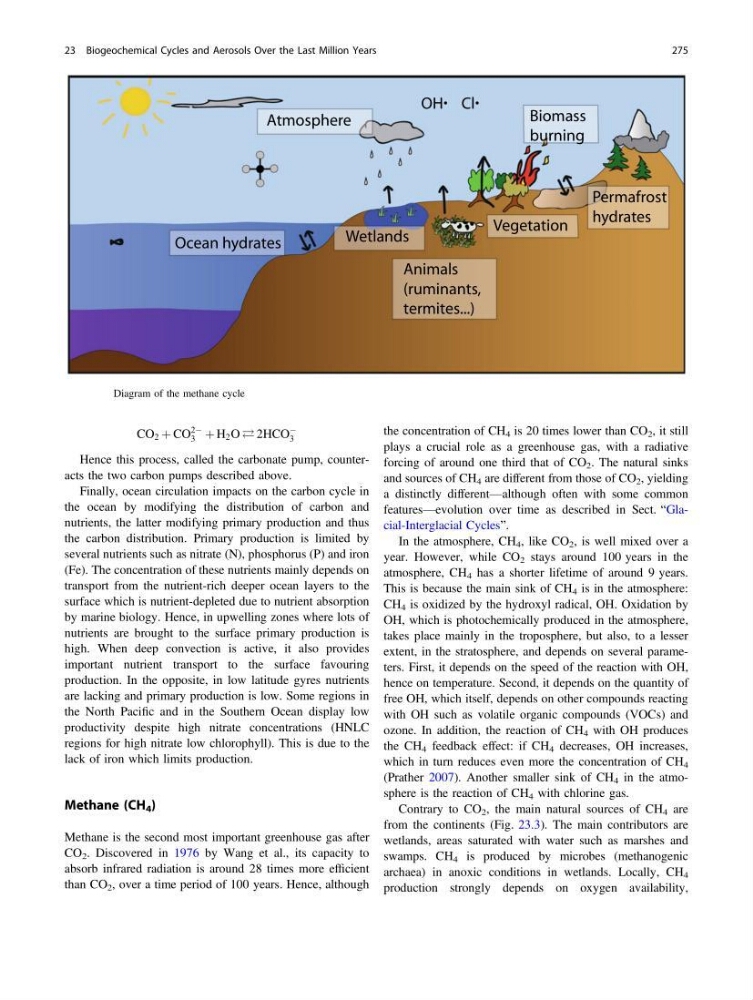
Contrary to CO 2 , the main natural sources of CH 4 are
from the continents (Fig. 23.3). The main contributors are
wetlands, areas saturated with water such as marshes and
swamps. CH 4 is produced by microbes (methanogenic
archaea) in anoxic conditions in wetlands. Locally, CH 4
production strongly depends on oxygen availability,
Ocean hydrates
Permafrost
hydrates
Atmosphere
OH . Cl .
Wetlands
Vegetation
Animals
(ruminants,
termites...)
Biomass
burning
Fig. 23.3 Diagram of the methane cycle
23 Biogeochemical Cycles and Aerosols Over the Last Million Years
275
2À
3 þ H 2 O 2HCO
À
3
Hence this process, called the carbonate pump, counteracts the two carbon pumps described above.
Finally, ocean circulation impacts on the carbon cycle in
the ocean by modifying the distribution of carbon and
nutrients, the latter modifying primary production and thus
the carbon distribution. Primary production is limited by
several nutrients such as nitrate (N), phosphorus (P) and iron
(Fe). The concentration of these nutrients mainly depends on
transport from the nutrient-rich deeper ocean layers to the
surface which is nutrient-depleted due to nutrient absorption
by marine biology. Hence, in upwelling zones where lots of
nutrients are brought to the surface primary production is
high. When deep convection is active, it also provides
important nutrient transport to the surface favouring
production. In the opposite, in low latitude gyres nutrients
are lacking and primary production is low. Some regions in
the North Pacific and in the Southern Ocean display low
productivity despite high nitrate concentrations (HNLC
regions for high nitrate low chlorophyll). This is due to the
lack of iron which limits production.
Methane (CH 4 )
Methane is the second most important greenhouse gas after
CO 2 . Discovered in 1976 by Wang et al., its capacity to
absorb infrared radiation is around 28 times more efficient
than CO 2 , over a time period of 100 years. Hence, although
the concentration of CH 4 is 20 times lower than CO 2 , it still
plays a crucial role as a greenhouse gas, with a radiative
forcing of around one third that of CO 2 . The natural sinks
and sources of CH 4 are different from those of CO 2 , yielding
a distinctly different—although often with some common
features—evolution over time as described in Sect. “Glacial-Interglacial Cycles”.
In the atmosphere, CH 4 , like CO 2 , is well mixed over a
year. However, while CO 2 stays around 100 years in the
atmosphere, CH 4 has a shorter lifetime of around 9 years.
This is because the main sink of CH 4 is in the atmosphere:
CH 4 is oxidized by the hydroxyl radical, OH. Oxidation by
OH, which is photochemically produced in the atmosphere,
takes place mainly in the troposphere, but also, to a lesser
extent, in the stratosphere, and depends on several parameters. First, it depends on the speed of the reaction with OH,
hence on temperature. Second, it depends on the quantity of
free OH, which itself, depends on other compounds reacting
with OH such as volatile organic compounds (VOCs) and
ozone. In addition, the reaction of CH 4 with OH produces
the CH 4 feedback effect: if CH 4 decreases, OH increases,
which in turn reduces even more the concentration of CH 4
(Prather 2007). Another smaller sink of CH 4 in the atmosphere is the reaction of CH 4 with chlorine gas.
Contrary to CO 2 , the main natural sources of CH 4 are
from the continents (Fig. 23.3). The main contributors are
wetlands, areas saturated with water such as marshes and
swamps. CH 4 is produced by microbes (methanogenic
archaea) in anoxic conditions in wetlands. Locally, CH 4
production strongly depends on oxygen availability,
Ocean hydrates
Permafrost
hydrates
Atmosphere
OH . Cl .
Wetlands
Vegetation
Animals
(ruminants,
termites...)
Biomass
burning
Fig. 23.3 Diagram of the methane cycle
23 Biogeochemical Cycles and Aerosols Over the Last Million Years
275