

reconstructions without fundamentally changing the principle. Still based on the comparison between fossil fauna and
modern reference fauna, they do not require the establishment of specific mathematical relationships, but establish
their own learning from available databases through minimization of the uncertainties (Malmgren et al. 2001).
These various methods, applied here to foraminifera,
have also been used for diatom flora, coccoliths, dinoflagellate cysts and radiolarians. Diatoms, dominant in cold
waters rich in silica, have been used in particular to reconstruct variations in sea ice cover in polar regions. The latest
LGM SST global distribution, as reconstructed within the
MARGO program, used several types of indicators and is
presented in Fig. 21.3.
Statistical methods have many limitations: (i) they can
only be used if the faunal assemblages are close to modern
assemblages; (ii) the genetic diversity of species among
different ocean regions may induce variations in their faunal
responses to temperature and the corresponding statistical
links; (iii) temperature reconstructions based on variations in
the abundance of fossil fauna or flora assume that other
factors, such as productivity for example, have no significant
influence on the relative abundances of the different species;
(iv) due to the activity of burrowing animals (bioturbation),
marine sediments are usually mixed over several centimeters, so that the same stratigraphic level of a sediment core
represents a mix of fauna that lived in different centuries (or
even several thousand years apart if the sedimentation rate is
low); (v) transfer function calibration is based on the
assumption that sediment core top assemblages reflect
modern hydrological conditions. This latest assumption
ignores in particular ocean and climate changes which
occurred over the last millennia, and that could have been
significant enough to bias calibrations. These limitations
have encouraged the development of new reconstruction
methods based on either biological or geochemical
mechanisms.
The biological approach is still in its infancy, and it is
derived from ecological studies of the requirements of the
different species in the modern ocean. A first approach
directly calibrates the proxies (foraminifera or others) from
controlled laboratory cultures with varying physiological
and geochemical constraints that duplicate those observed in
the marine environment. A more theoretical approach complements these calibrations by modeling the growth conditions within the natural environment, using the
experimentally calibrated variables. Using such methods, it
may be possible to obtain a reliable reconstruction of the
hydrology corresponding to the specific habitat of the different species of planktonic foraminifera (e.g., Lombard
et al. 2009).
Geochemical Methods
Organic Tracers
The organic geochemistry of marine sediments provides a
different set of tracers. The most common so-called ‘biomarker’ is based on the changes in the abundance ratio of diand tri-unsaturated alkenones (molecules with 37 carbon
atoms containing two or three double bonds). This ratio is a
function of the growth temperature of the synthesizing
organisms, a group of algae called coccolithophorids, and in
particular of the species Emiliania huxleyi for the modern
ocean. The number of double bonds is inversely related to
the temperature: the lower the temperature, the higher the
number of double bonds (Prahl and Wakeham 1987). The
abundance ratio of di- and tri-unsaturated alkenones is
conventionally expressed by the index U
k
0
37 :
U
k
0
37 ¼ C 37:2
½
= C 37:2 þ C 37:3
½
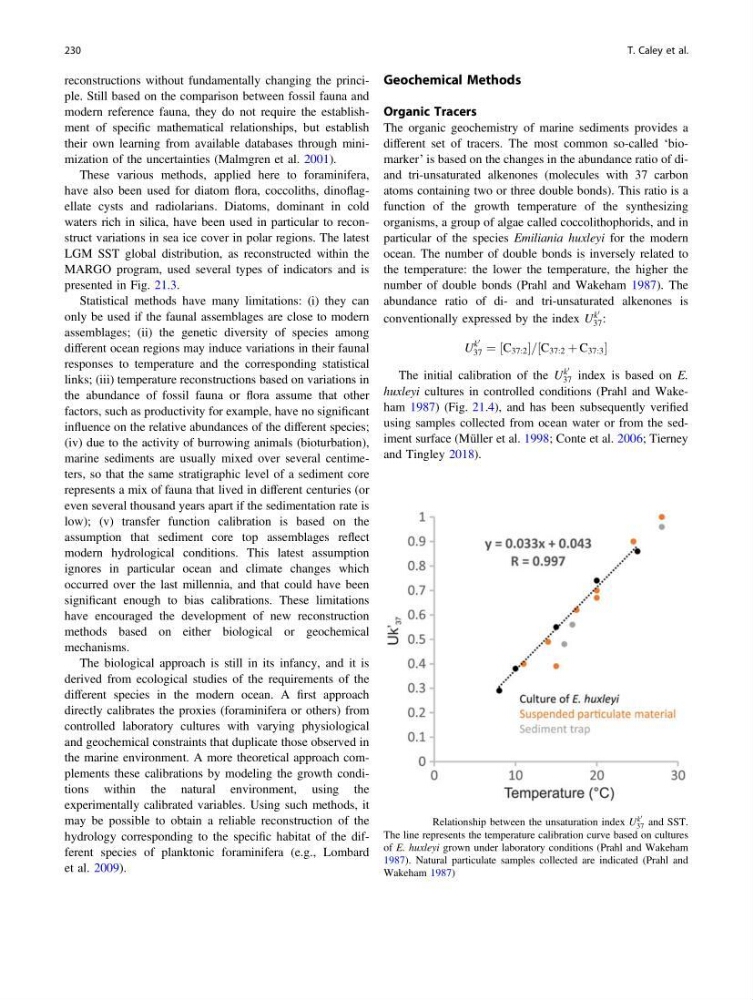
The initial calibration of the U
k
0
37 index is based on E.
huxleyi cultures in controlled conditions (Prahl and Wakeham 1987) (Fig. 21.4), and has been subsequently verified
using samples collected from ocean water or from the sediment surface (Müller et al. 1998; Conte et al. 2006; Tierney
and Tingley 2018).
Fig. 21.4 Relationship between the unsaturation index U
k
0
37 and SST.
The line represents the temperature calibration curve based on cultures
of E. huxleyi grown under laboratory conditions (Prahl and Wakeham
1987). Natural particulate samples collected are indicated (Prahl and
Wakeham 1987)
230
T. Caley et al.
modern reference fauna, they do not require the establishment of specific mathematical relationships, but establish
their own learning from available databases through minimization of the uncertainties (Malmgren et al. 2001).
These various methods, applied here to foraminifera,
have also been used for diatom flora, coccoliths, dinoflagellate cysts and radiolarians. Diatoms, dominant in cold
waters rich in silica, have been used in particular to reconstruct variations in sea ice cover in polar regions. The latest
LGM SST global distribution, as reconstructed within the
MARGO program, used several types of indicators and is
presented in Fig. 21.3.
Statistical methods have many limitations: (i) they can
only be used if the faunal assemblages are close to modern
assemblages; (ii) the genetic diversity of species among
different ocean regions may induce variations in their faunal
responses to temperature and the corresponding statistical
links; (iii) temperature reconstructions based on variations in
the abundance of fossil fauna or flora assume that other
factors, such as productivity for example, have no significant
influence on the relative abundances of the different species;
(iv) due to the activity of burrowing animals (bioturbation),
marine sediments are usually mixed over several centimeters, so that the same stratigraphic level of a sediment core
represents a mix of fauna that lived in different centuries (or
even several thousand years apart if the sedimentation rate is
low); (v) transfer function calibration is based on the
assumption that sediment core top assemblages reflect
modern hydrological conditions. This latest assumption
ignores in particular ocean and climate changes which
occurred over the last millennia, and that could have been
significant enough to bias calibrations. These limitations
have encouraged the development of new reconstruction
methods based on either biological or geochemical
mechanisms.
The biological approach is still in its infancy, and it is
derived from ecological studies of the requirements of the
different species in the modern ocean. A first approach
directly calibrates the proxies (foraminifera or others) from
controlled laboratory cultures with varying physiological
and geochemical constraints that duplicate those observed in
the marine environment. A more theoretical approach complements these calibrations by modeling the growth conditions within the natural environment, using the
experimentally calibrated variables. Using such methods, it
may be possible to obtain a reliable reconstruction of the
hydrology corresponding to the specific habitat of the different species of planktonic foraminifera (e.g., Lombard
et al. 2009).
Geochemical Methods
Organic Tracers
The organic geochemistry of marine sediments provides a
different set of tracers. The most common so-called ‘biomarker’ is based on the changes in the abundance ratio of diand tri-unsaturated alkenones (molecules with 37 carbon
atoms containing two or three double bonds). This ratio is a
function of the growth temperature of the synthesizing
organisms, a group of algae called coccolithophorids, and in
particular of the species Emiliania huxleyi for the modern
ocean. The number of double bonds is inversely related to
the temperature: the lower the temperature, the higher the
number of double bonds (Prahl and Wakeham 1987). The
abundance ratio of di- and tri-unsaturated alkenones is
conventionally expressed by the index U
k
0
37 :
U
k
0
37 ¼ C 37:2
½
= C 37:2 þ C 37:3
½
The initial calibration of the U
k
0
37 index is based on E.
huxleyi cultures in controlled conditions (Prahl and Wakeham 1987) (Fig. 21.4), and has been subsequently verified
using samples collected from ocean water or from the sediment surface (Müller et al. 1998; Conte et al. 2006; Tierney
and Tingley 2018).
Fig. 21.4 Relationship between the unsaturation index U
k
0
37 and SST.
The line represents the temperature calibration curve based on cultures
of E. huxleyi grown under laboratory conditions (Prahl and Wakeham
1987). Natural particulate samples collected are indicated (Prahl and
Wakeham 1987)
230
T. Caley et al.