

different from the modern ones, due to the development of
large ice sheets over Northern Europe and to a very different
hydrological cycle. In fact, the absence of direct analogs
becomes the rule rather than the exception for the distant
past: most fossil species from periods earlier than the Quaternary are not found in recently deposited sediments.
This is why the method used by Imbrie and Kipp (1971)
was gradually replaced by the best analogs method. Its
principle is simple: to compare the changes in fossil
assemblages to modern references, without a preconceived
idea of the origin of the observed changes. The closest
analogs are defined using a mathematical distance calculation. The method is based on the assumption that the closer a
fossil assemblage is to one or more modern references, the
more similar their optimal growth conditions are (temperature and nutrient supply, in particular). The distance to the
best analogs and the dispersion of associated environmental
conditions provide an estimate of the reconstruction uncertainties (Waelbroeck et al. 1998).
In parallel with these statistical developments, recent
advances in the field of artificial intelligence and neural
networks have helped to improve paleoceanographic
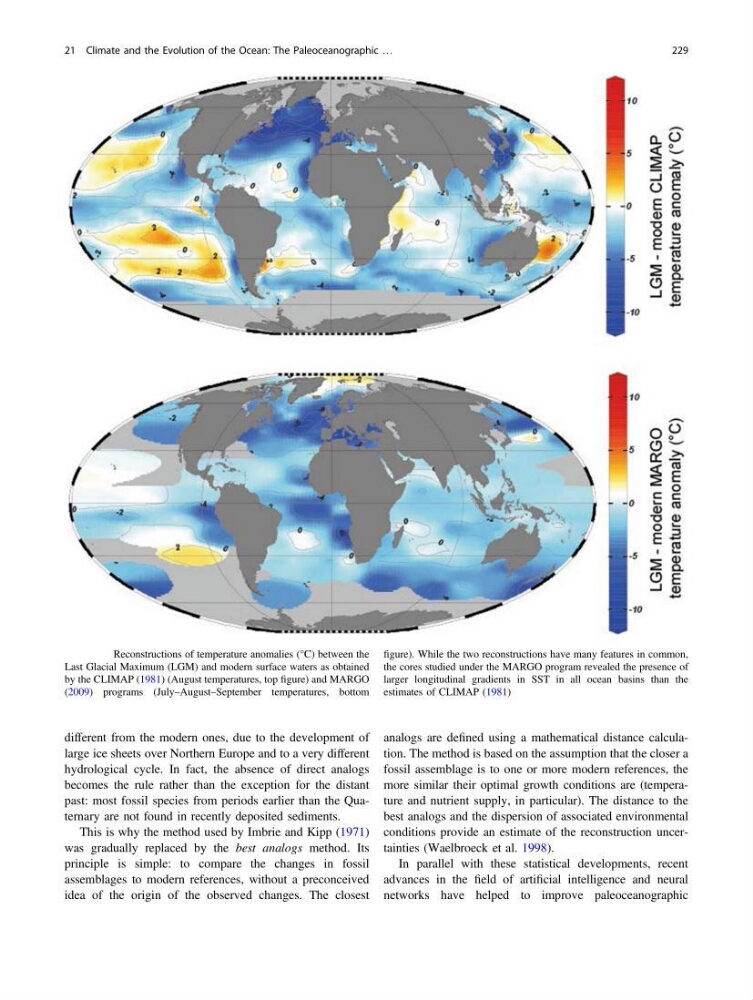
Fig. 21.3 Reconstructions of temperature anomalies (°C) between the
Last Glacial Maximum (LGM) and modern surface waters as obtained
by the CLIMAP (1981) (August temperatures, top figure) and MARGO
(2009) programs (July–August–September temperatures, bottom
figure). While the two reconstructions have many features in common,
the cores studied under the MARGO program revealed the presence of
larger longitudinal gradients in SST in all ocean basins than the
estimates of CLIMAP (1981)
21 Climate and the Evolution of the Ocean: The Paleoceanographic …
229
large ice sheets over Northern Europe and to a very different
hydrological cycle. In fact, the absence of direct analogs
becomes the rule rather than the exception for the distant
past: most fossil species from periods earlier than the Quaternary are not found in recently deposited sediments.
This is why the method used by Imbrie and Kipp (1971)
was gradually replaced by the best analogs method. Its
principle is simple: to compare the changes in fossil
assemblages to modern references, without a preconceived
idea of the origin of the observed changes. The closest
analogs are defined using a mathematical distance calculation. The method is based on the assumption that the closer a
fossil assemblage is to one or more modern references, the
more similar their optimal growth conditions are (temperature and nutrient supply, in particular). The distance to the
best analogs and the dispersion of associated environmental
conditions provide an estimate of the reconstruction uncertainties (Waelbroeck et al. 1998).
In parallel with these statistical developments, recent
advances in the field of artificial intelligence and neural
networks have helped to improve paleoceanographic
Fig. 21.3 Reconstructions of temperature anomalies (°C) between the
Last Glacial Maximum (LGM) and modern surface waters as obtained
by the CLIMAP (1981) (August temperatures, top figure) and MARGO
(2009) programs (July–August–September temperatures, bottom
figure). While the two reconstructions have many features in common,
the cores studied under the MARGO program revealed the presence of
larger longitudinal gradients in SST in all ocean basins than the
estimates of CLIMAP (1981)
21 Climate and the Evolution of the Ocean: The Paleoceanographic …
229