

species. These observations, along with the statistical method
of ‘transfer functions’ developed by Imbrie and Kipp, served
as a basis for the quantitative reconstruction of surface temperatures from fossil fauna found in marine sediments.
Transfer functions allow the estimation of seawater temperature during both the cold and warm seasons, when adequate
data is available. The basic principle for the reconstruction of
SST changes in the past is to assume that the ecological
requirements of the species present nowadays have not changed since the past period under consideration. The specific
abundance of planktonic foraminifera samples from recent
core tops may be expressed as a matrix (x species relative
distributions within each of n sampling stations) from which
the vectors corresponding to the main factors that describe the
specific faunal (or floral) variance can be extracted. The
method proposed by Imbrie and Kipp (1971) provides the best
correlation between changes in these factors and the associated
changes within the modern environmental parameters, systematically selected for the n stations (such as summer and
winter temperatures, or other parameters, provided they are
statistically independent). A similar factor analysis, when
applied to fossil assemblages down sediment cores, allows the
paleotemperature to be estimated using the ecological equations calculated from the modern core tops. This work led to
the great success of the CLIMAP group (Climate Long-range
Investigation, Mapping And Prediction), which reconstructed
the first global map of summer and winter SST distribution
during the Last Glacial Maximum (LGM) period, about 21 ka
ago (Fig. 21.3).
One of the main problems with this paleo-reconstruction
method is that it is based on the a priori stable statistical
correlation between changes in the specific factors defined
by the species distributions and the arbitrarily chosen environmental parameter, temperature, in this case. However,
other environmental factors, such as the availability of food
supply, may also be involved and change the sensitivity of
foraminifera to temperature from one region to another.
There is also another potential problem with the transfer
function approach: it will provide accurate estimates only if
modern conditions are good analogs of the past hydrological
conditions. This is not always necessarily the case. For
example, the fossil fauna of the eastern Mediterranean Sea
during the LGM period has no modern analogs. Indeed, this
basin experienced hydrological and climate conditions very
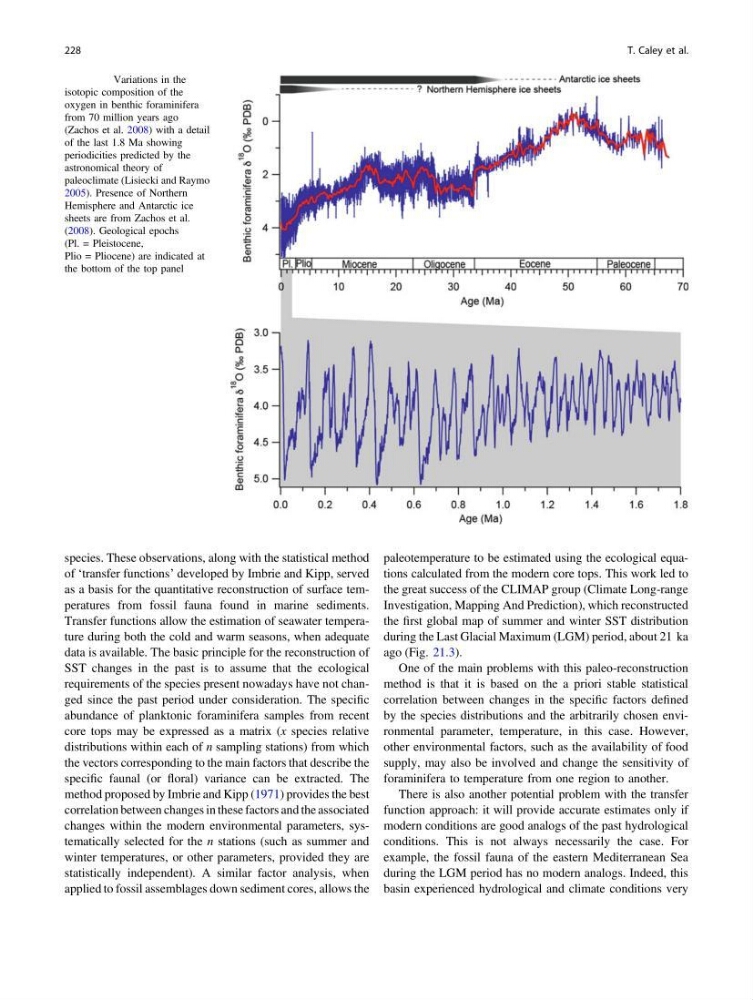
Fig. 21.2 Variations in the
isotopic composition of the
oxygen in benthic foraminifera
from 70 million years ago
(Zachos et al. 2008) with a detail
of the last 1.8 Ma showing
periodicities predicted by the
astronomical theory of
paleoclimate (Lisiecki and Raymo
2005). Presence of Northern
Hemisphere and Antarctic ice
sheets are from Zachos et al.
(2008). Geological epochs
(Pl. = Pleistocene,
Plio = Pliocene) are indicated at
the bottom of the top panel
228
T. Caley et al.
of ‘transfer functions’ developed by Imbrie and Kipp, served
as a basis for the quantitative reconstruction of surface temperatures from fossil fauna found in marine sediments.
Transfer functions allow the estimation of seawater temperature during both the cold and warm seasons, when adequate
data is available. The basic principle for the reconstruction of
SST changes in the past is to assume that the ecological
requirements of the species present nowadays have not changed since the past period under consideration. The specific
abundance of planktonic foraminifera samples from recent
core tops may be expressed as a matrix (x species relative
distributions within each of n sampling stations) from which
the vectors corresponding to the main factors that describe the
specific faunal (or floral) variance can be extracted. The
method proposed by Imbrie and Kipp (1971) provides the best
correlation between changes in these factors and the associated
changes within the modern environmental parameters, systematically selected for the n stations (such as summer and
winter temperatures, or other parameters, provided they are
statistically independent). A similar factor analysis, when
applied to fossil assemblages down sediment cores, allows the
paleotemperature to be estimated using the ecological equations calculated from the modern core tops. This work led to
the great success of the CLIMAP group (Climate Long-range
Investigation, Mapping And Prediction), which reconstructed
the first global map of summer and winter SST distribution
during the Last Glacial Maximum (LGM) period, about 21 ka
ago (Fig. 21.3).
One of the main problems with this paleo-reconstruction
method is that it is based on the a priori stable statistical
correlation between changes in the specific factors defined
by the species distributions and the arbitrarily chosen environmental parameter, temperature, in this case. However,
other environmental factors, such as the availability of food
supply, may also be involved and change the sensitivity of
foraminifera to temperature from one region to another.
There is also another potential problem with the transfer
function approach: it will provide accurate estimates only if
modern conditions are good analogs of the past hydrological
conditions. This is not always necessarily the case. For
example, the fossil fauna of the eastern Mediterranean Sea
during the LGM period has no modern analogs. Indeed, this
basin experienced hydrological and climate conditions very
Fig. 21.2 Variations in the
isotopic composition of the
oxygen in benthic foraminifera
from 70 million years ago
(Zachos et al. 2008) with a detail
of the last 1.8 Ma showing
periodicities predicted by the
astronomical theory of
paleoclimate (Lisiecki and Raymo
2005). Presence of Northern
Hemisphere and Antarctic ice
sheets are from Zachos et al.
(2008). Geological epochs
(Pl. = Pleistocene,
Plio = Pliocene) are indicated at
the bottom of the top panel
228
T. Caley et al.