

Farquhar 1982). In most cases, the isotopic compositions of
the oxygen and hydrogen in the cellulose are not affected by
the juvenile effect, which makes these parameters particular
interesting for the reconstruction of low-frequency climate
variations.
Isotopic Reconstruction of the Variations
in Climate Parameters Over Time
The variations in the isotopic compositions of the cellulose
in rings are interpreted in different ways. Indeed, the
reconstructed climate parameters are, depending on the case:
temperature, relative humidity, sunshine, the amount of
summer or winter rainfall, the average isotopic composition
of this rainfall. The isotopic fractionations during the manufacture of cellulose are determined, as we have seen, by
several factors. The conditions under which the growth takes
place will determine which factor is dominant. For example,
for trees in areas experiencing drought, stomatal conductance tends to dominate the carbon isotope fractionation
processes. In this case, the environmental control factors are
the relative humidity of the air and soil moisture; when, on
the contrary, trees are growing in conditions where water is
not limited, the fractionations are instead conditioned by the
rate of photosynthesis which itself depends on the incident
radiation and, to a lesser extent, by the temperature. The
disparity in the reconstructions mentioned earlier, is a
reflection of environmental disparities. The possibility of
changes in the dominant factor over time must be contemplated when reconstructing temporal variations in the climate parameters.
Two reconstructions of atmospheric temperature are
presented below, one from the d
13 C of the cellulose in
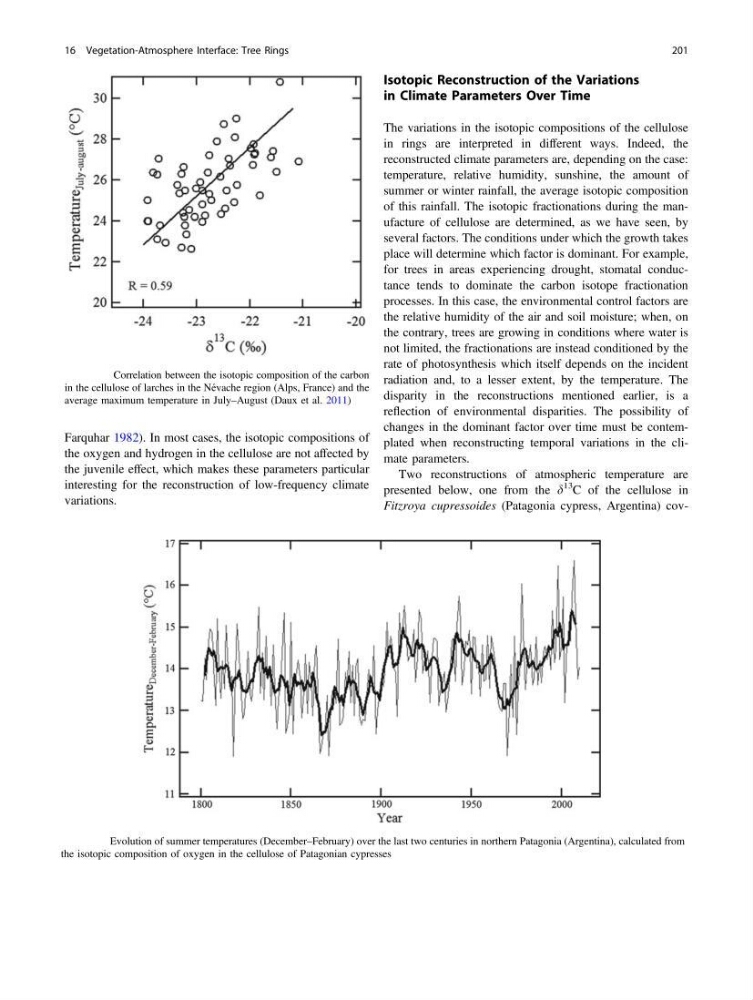
Fitzroya cupressoides (Patagonia cypress, Argentina) covFig. 16.5 Correlation between the isotopic composition of the carbon
in the cellulose of larches in the Névache region (Alps, France) and the
average maximum temperature in July–August (Daux et al. 2011)
Fig. 16.6 Evolution of summer temperatures (December–February) over the last two centuries in northern Patagonia (Argentina), calculated from
the isotopic composition of oxygen in the cellulose of Patagonian cypresses
16 Vegetation-Atmosphere Interface: Tree Rings
201
the oxygen and hydrogen in the cellulose are not affected by
the juvenile effect, which makes these parameters particular
interesting for the reconstruction of low-frequency climate
variations.
Isotopic Reconstruction of the Variations
in Climate Parameters Over Time
The variations in the isotopic compositions of the cellulose
in rings are interpreted in different ways. Indeed, the
reconstructed climate parameters are, depending on the case:
temperature, relative humidity, sunshine, the amount of
summer or winter rainfall, the average isotopic composition
of this rainfall. The isotopic fractionations during the manufacture of cellulose are determined, as we have seen, by
several factors. The conditions under which the growth takes
place will determine which factor is dominant. For example,
for trees in areas experiencing drought, stomatal conductance tends to dominate the carbon isotope fractionation
processes. In this case, the environmental control factors are
the relative humidity of the air and soil moisture; when, on
the contrary, trees are growing in conditions where water is
not limited, the fractionations are instead conditioned by the
rate of photosynthesis which itself depends on the incident
radiation and, to a lesser extent, by the temperature. The
disparity in the reconstructions mentioned earlier, is a
reflection of environmental disparities. The possibility of
changes in the dominant factor over time must be contemplated when reconstructing temporal variations in the climate parameters.
Two reconstructions of atmospheric temperature are
presented below, one from the d
13 C of the cellulose in
Fitzroya cupressoides (Patagonia cypress, Argentina) covFig. 16.5 Correlation between the isotopic composition of the carbon
in the cellulose of larches in the Névache region (Alps, France) and the
average maximum temperature in July–August (Daux et al. 2011)
Fig. 16.6 Evolution of summer temperatures (December–February) over the last two centuries in northern Patagonia (Argentina), calculated from
the isotopic composition of oxygen in the cellulose of Patagonian cypresses
16 Vegetation-Atmosphere Interface: Tree Rings
201