

of the water in the xylem and in the ambient vapor, as well
as on the difference between the vapor pressure inside and
outside the leaf. As a result of the evaporative fractionations,
the isotopic composition of the glucose produced in the leaf
is enriched by 27‰ compared to the water in the leaf.
During synthesis of cellulose from glucose, about 40% of the
oxygen atoms are exchanged with the xylem water. Consequently, the isotopic composition of the cellulose in tree
rings reflects that of the source (soil water is more or less
equivalent isotopically to precipitations) and the degree of
enrichment by evaporation in the leaf. The link between the
isotopic compositions of cellulose and rainfall is complex.
Nevertheless, a growing number of studies have reported
statistically significant correlations between the d
18 O of the
cellulose in tree rings (oak, pine, larch, cedar) and that of the
rainfall during the growing season, as well as certain other
climate parameters (atmospheric temperature, relative
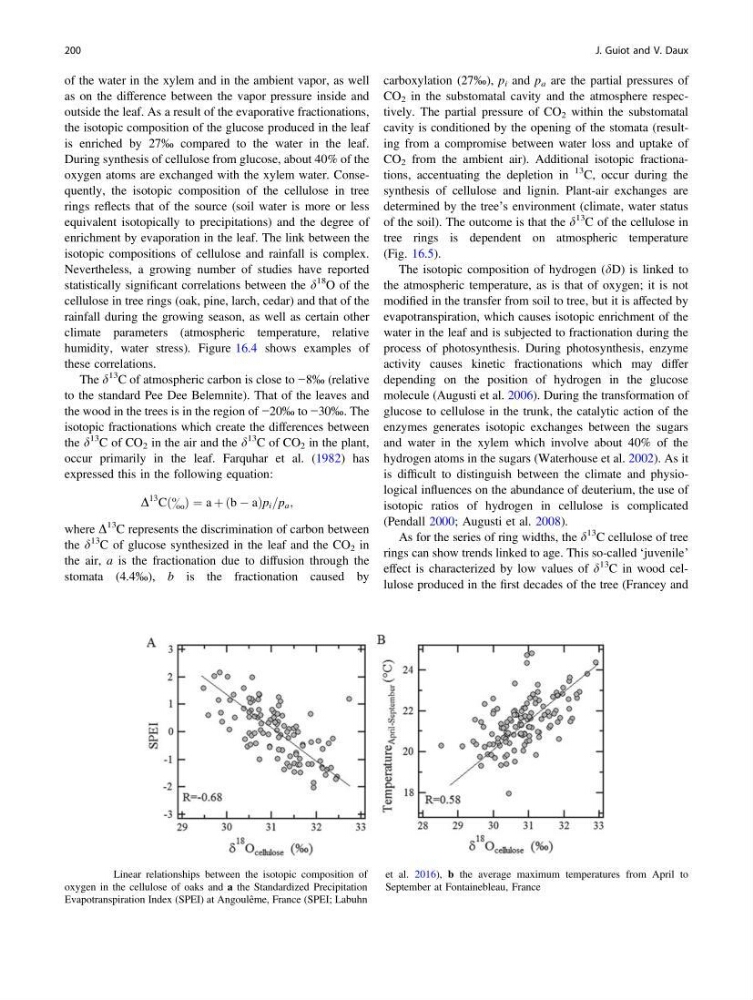
humidity, water stress). Figure 16.4 shows examples of
these correlations.
The d
13 C of atmospheric carbon is close to −8‰ (relative
to the standard Pee Dee Belemnite). That of the leaves and
the wood in the trees is in the region of −20‰ to −30‰. The
isotopic fractionations which create the differences between
the d
13 C of CO 2 in the air and the d
13 C of CO 2 in the plant,
occur primarily in the leaf. Farquhar et al. (1982) has
expressed this in the following equation:
D
13
C &
ð Þ ¼ a þ b À a
ð
Þp i =p a ;
where D
13 C represents the discrimination of carbon between
the d
13 C of glucose synthesized in the leaf and the CO 2 in
the air, a is the fractionation due to diffusion through the
stomata (4.4‰), b is the fractionation caused by
carboxylation (27‰), p i and p a are the partial pressures of
CO 2 in the substomatal cavity and the atmosphere respectively. The partial pressure of CO 2 within the substomatal
cavity is conditioned by the opening of the stomata (resulting from a compromise between water loss and uptake of
CO 2 from the ambient air). Additional isotopic fractionations, accentuating the depletion in
13 C, occur during the
synthesis of cellulose and lignin. Plant-air exchanges are
determined by the tree’s environment (climate, water status
of the soil). The outcome is that the d
13 C of the cellulose in
tree rings is dependent on atmospheric temperature
(Fig. 16.5).
The isotopic composition of hydrogen (dD) is linked to
the atmospheric temperature, as is that of oxygen; it is not
modified in the transfer from soil to tree, but it is affected by
evapotranspiration, which causes isotopic enrichment of the
water in the leaf and is subjected to fractionation during the
process of photosynthesis. During photosynthesis, enzyme
activity causes kinetic fractionations which may differ
depending on the position of hydrogen in the glucose
molecule (Augusti et al. 2006). During the transformation of
glucose to cellulose in the trunk, the catalytic action of the
enzymes generates isotopic exchanges between the sugars
and water in the xylem which involve about 40% of the
hydrogen atoms in the sugars (Waterhouse et al. 2002). As it
is difficult to distinguish between the climate and physiological influences on the abundance of deuterium, the use of
isotopic ratios of hydrogen in cellulose is complicated
(Pendall 2000; Augusti et al. 2008).
As for the series of ring widths, the d
13 C cellulose of tree
rings can show trends linked to age. This so-called ‘juvenile’
effect is characterized by low values of d
13 C in wood cellulose produced in the first decades of the tree (Francey and
Fig. 16.4 Linear relationships between the isotopic composition of
oxygen in the cellulose of oaks and a the Standardized Precipitation
Evapotranspiration Index (SPEI) at Angoulême, France (SPEI; Labuhn
et al. 2016), b the average maximum temperatures from April to
September at Fontainebleau, France
200
J. Guiot and V. Daux
as on the difference between the vapor pressure inside and
outside the leaf. As a result of the evaporative fractionations,
the isotopic composition of the glucose produced in the leaf
is enriched by 27‰ compared to the water in the leaf.
During synthesis of cellulose from glucose, about 40% of the
oxygen atoms are exchanged with the xylem water. Consequently, the isotopic composition of the cellulose in tree
rings reflects that of the source (soil water is more or less
equivalent isotopically to precipitations) and the degree of
enrichment by evaporation in the leaf. The link between the
isotopic compositions of cellulose and rainfall is complex.
Nevertheless, a growing number of studies have reported
statistically significant correlations between the d
18 O of the
cellulose in tree rings (oak, pine, larch, cedar) and that of the
rainfall during the growing season, as well as certain other
climate parameters (atmospheric temperature, relative
humidity, water stress). Figure 16.4 shows examples of
these correlations.
The d
13 C of atmospheric carbon is close to −8‰ (relative
to the standard Pee Dee Belemnite). That of the leaves and
the wood in the trees is in the region of −20‰ to −30‰. The
isotopic fractionations which create the differences between
the d
13 C of CO 2 in the air and the d
13 C of CO 2 in the plant,
occur primarily in the leaf. Farquhar et al. (1982) has
expressed this in the following equation:
D
13
C &
ð Þ ¼ a þ b À a
ð
Þp i =p a ;
where D
13 C represents the discrimination of carbon between
the d
13 C of glucose synthesized in the leaf and the CO 2 in
the air, a is the fractionation due to diffusion through the
stomata (4.4‰), b is the fractionation caused by
carboxylation (27‰), p i and p a are the partial pressures of
CO 2 in the substomatal cavity and the atmosphere respectively. The partial pressure of CO 2 within the substomatal
cavity is conditioned by the opening of the stomata (resulting from a compromise between water loss and uptake of
CO 2 from the ambient air). Additional isotopic fractionations, accentuating the depletion in
13 C, occur during the
synthesis of cellulose and lignin. Plant-air exchanges are
determined by the tree’s environment (climate, water status
of the soil). The outcome is that the d
13 C of the cellulose in
tree rings is dependent on atmospheric temperature
(Fig. 16.5).
The isotopic composition of hydrogen (dD) is linked to
the atmospheric temperature, as is that of oxygen; it is not
modified in the transfer from soil to tree, but it is affected by
evapotranspiration, which causes isotopic enrichment of the
water in the leaf and is subjected to fractionation during the
process of photosynthesis. During photosynthesis, enzyme
activity causes kinetic fractionations which may differ
depending on the position of hydrogen in the glucose
molecule (Augusti et al. 2006). During the transformation of
glucose to cellulose in the trunk, the catalytic action of the
enzymes generates isotopic exchanges between the sugars
and water in the xylem which involve about 40% of the
hydrogen atoms in the sugars (Waterhouse et al. 2002). As it
is difficult to distinguish between the climate and physiological influences on the abundance of deuterium, the use of
isotopic ratios of hydrogen in cellulose is complicated
(Pendall 2000; Augusti et al. 2008).
As for the series of ring widths, the d
13 C cellulose of tree
rings can show trends linked to age. This so-called ‘juvenile’
effect is characterized by low values of d
13 C in wood cellulose produced in the first decades of the tree (Francey and
Fig. 16.4 Linear relationships between the isotopic composition of
oxygen in the cellulose of oaks and a the Standardized Precipitation
Evapotranspiration Index (SPEI) at Angoulême, France (SPEI; Labuhn
et al. 2016), b the average maximum temperatures from April to
September at Fontainebleau, France
200
J. Guiot and V. Daux