

The isotopic composition of oxygen in precipitations is a
function of temperature at high and middle latitudes. Water
from precipitation infiltrates the soil. In the superficial levels,
evaporation can result in oxygen enrichment of the infiltrated
water compared to the original precipitation. Trees take most
of their water from the superficial soil levels. Therefore, the
water they draw can be enriched to some extent in heavy
isotopes compared to the precipitation. Nevertheless, there is
little or no enrichment in wooded areas where the soils are
covered by thick litter that limits evaporation. The isotopic
composition of the oxygen in the water of the xylem,
through which water and mineral nutrients are transported, is
the same as that of the soil water absorbed by the root
system. Significant fractionation occurs before the water
isotopes are fixed in the wood structure (for a summary of
the isotopic composition of wood constituents see Gessler
et al. 2014). The critical phase occurs in the leaves where
evapotranspiration results in a loss of light isotopes. The
extent to which the leaf is enriched with heavy isotopes
depends on the difference between the isotopic compositions
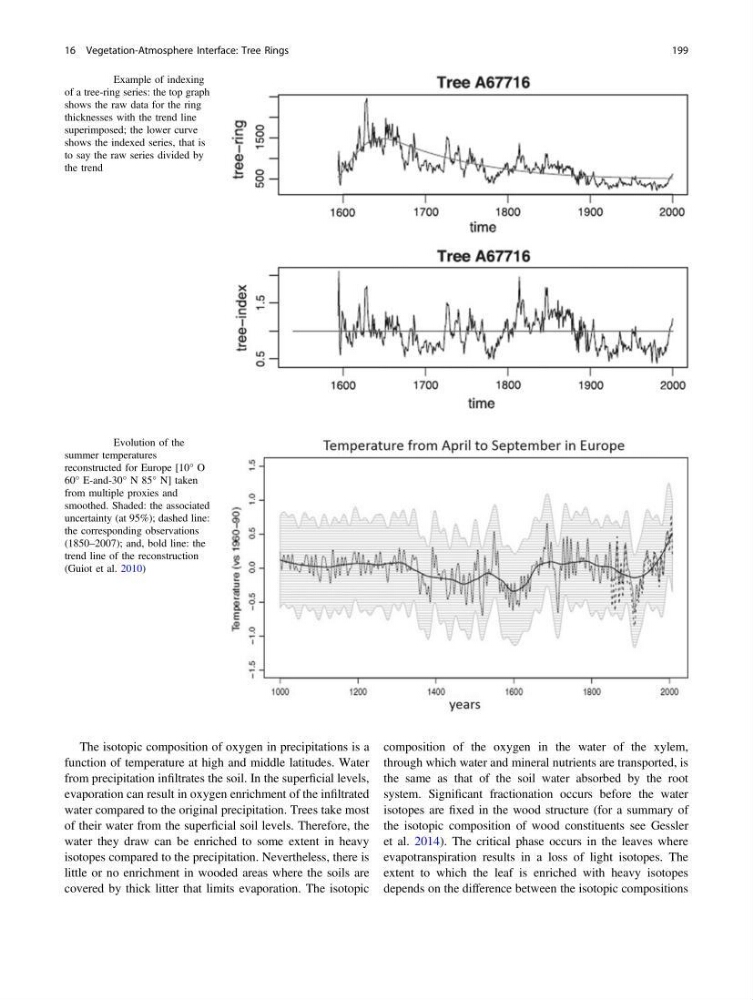
Fig. 16.2 Example of indexing
of a tree-ring series: the top graph
shows the raw data for the ring
thicknesses with the trend line
superimposed; the lower curve
shows the indexed series, that is
to say the raw series divided by
the trend
Fig. 16.3 Evolution of the
summer temperatures
reconstructed for Europe [10° O
60° E-and-30° N 85° N] taken
from multiple proxies and
smoothed. Shaded: the associated
uncertainty (at 95%); dashed line:
the corresponding observations
(1850–2007); and, bold line: the
trend line of the reconstruction
(Guiot et al. 2010)
16 Vegetation-Atmosphere Interface: Tree Rings
199
function of temperature at high and middle latitudes. Water
from precipitation infiltrates the soil. In the superficial levels,
evaporation can result in oxygen enrichment of the infiltrated
water compared to the original precipitation. Trees take most
of their water from the superficial soil levels. Therefore, the
water they draw can be enriched to some extent in heavy
isotopes compared to the precipitation. Nevertheless, there is
little or no enrichment in wooded areas where the soils are
covered by thick litter that limits evaporation. The isotopic
composition of the oxygen in the water of the xylem,
through which water and mineral nutrients are transported, is
the same as that of the soil water absorbed by the root
system. Significant fractionation occurs before the water
isotopes are fixed in the wood structure (for a summary of
the isotopic composition of wood constituents see Gessler
et al. 2014). The critical phase occurs in the leaves where
evapotranspiration results in a loss of light isotopes. The
extent to which the leaf is enriched with heavy isotopes
depends on the difference between the isotopic compositions
Fig. 16.2 Example of indexing
of a tree-ring series: the top graph
shows the raw data for the ring
thicknesses with the trend line
superimposed; the lower curve
shows the indexed series, that is
to say the raw series divided by
the trend
Fig. 16.3 Evolution of the
summer temperatures
reconstructed for Europe [10° O
60° E-and-30° N 85° N] taken
from multiple proxies and
smoothed. Shaded: the associated
uncertainty (at 95%); dashed line:
the corresponding observations
(1850–2007); and, bold line: the
trend line of the reconstruction
(Guiot et al. 2010)
16 Vegetation-Atmosphere Interface: Tree Rings
199