

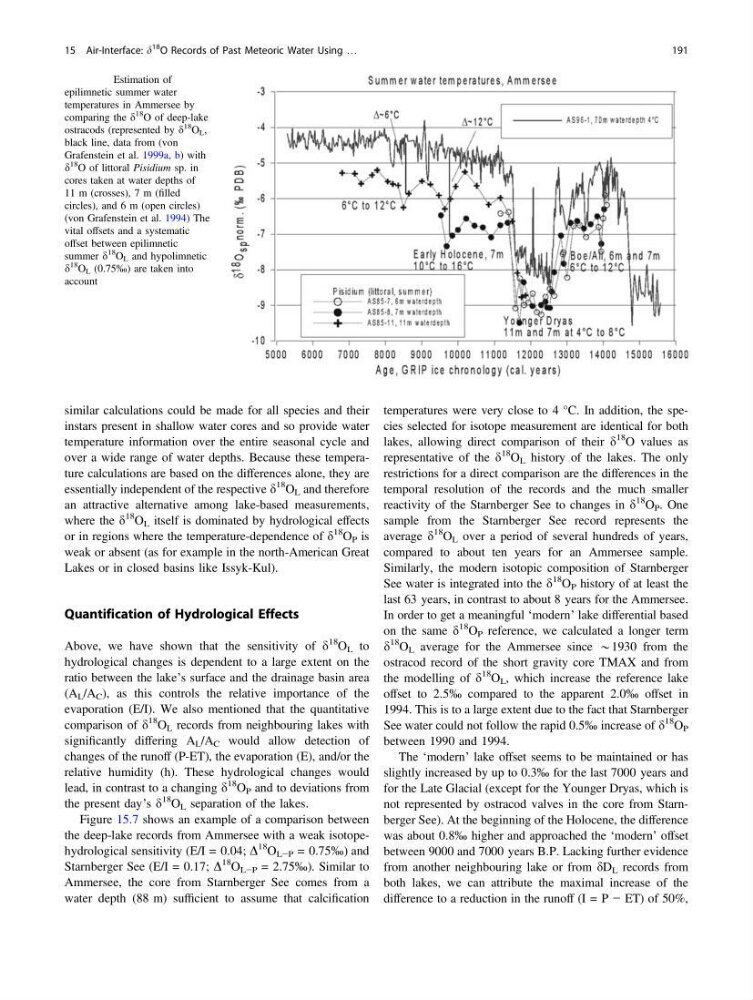
similar calculations could be made for all species and their
instars present in shallow water cores and so provide water
temperature information over the entire seasonal cycle and
over a wide range of water depths. Because these temperature calculations are based on the differences alone, they are
essentially independent of the respective d
18 O L and therefore
an attractive alternative among lake-based measurements,
where the d
18 O L itself is dominated by hydrological effects
or in regions where the temperature-dependence of d
18 O P is
weak or absent (as for example in the north-American Great
Lakes or in closed basins like Issyk-Kul).
Quantification of Hydrological Effects
Above, we have shown that the sensitivity of d
18
O L to
hydrological changes is dependent to a large extent on the
ratio between the lake’s surface and the drainage basin area
(A L /A C ), as this controls the relative importance of the
evaporation (E/I). We also mentioned that the quantitative
comparison of d
18 O L records from neighbouring lakes with
significantly differing A L /A C would allow detection of
changes of the runoff (P-ET), the evaporation (E), and/or the
relative humidity (h). These hydrological changes would
lead, in contrast to a changing d
18 O P and to deviations from
the present day’s d
18 O L separation of the lakes.
Figure 15.7 shows an example of a comparison between
the deep-lake records from Ammersee with a weak isotopehydrological sensitivity (E/I = 0.04; D
18 O L−P = 0.75‰) and
Starnberger See (E/I = 0.17; D
18
O L−P = 2.75‰). Similar to
Ammersee, the core from Starnberger See comes from a
water depth (88 m) sufficient to assume that calcification
temperatures were very close to 4 °C. In addition, the species selected for isotope measurement are identical for both
lakes, allowing direct comparison of their d
18
O values as
representative of the d
18 O L history of the lakes. The only
restrictions for a direct comparison are the differences in the
temporal resolution of the records and the much smaller
reactivity of the Starnberger See to changes in d
18 O P . One
sample from the Starnberger See record represents the
average d
18
O L over a period of several hundreds of years,
compared to about ten years for an Ammersee sample.
Similarly, the modern isotopic composition of Starnberger
See water is integrated into the d
18 O P history of at least the
last 63 years, in contrast to about 8 years for the Ammersee.
In order to get a meaningful ‘modern’ lake differential based
on the same d
18 O P reference, we calculated a longer term
d
18 O L average for the Ammersee since *1930 from the
ostracod record of the short gravity core TMAX and from
the modelling of d
18 O L , which increase the reference lake
offset to 2.5‰ compared to the apparent 2.0‰ offset in
1994. This is to a large extent due to the fact that Starnberger
See water could not follow the rapid 0.5‰ increase of d
18 O P
between 1990 and 1994.
The ‘modern’ lake offset seems to be maintained or has
slightly increased by up to 0.3‰ for the last 7000 years and
for the Late Glacial (except for the Younger Dryas, which is
not represented by ostracod valves in the core from Starnberger See). At the beginning of the Holocene, the difference
was about 0.8‰ higher and approached the ‘modern’ offset
between 9000 and 7000 years B.P. Lacking further evidence
from another neighbouring lake or from dD L records from
both lakes, we can attribute the maximal increase of the
difference to a reduction in the runoff (I = P − ET) of 50%,
Fig. 15.6 Estimation of
epilimnetic summer water
temperatures in Ammersee by
comparing the d
18
O of deep-lake
ostracods (represented by d
18
O L ,
black line, data from (von
Grafenstein et al. 1999a, b) with
d
18
O of littoral Pisidium sp. in
cores taken at water depths of
11 m (crosses), 7 m (filled
circles), and 6 m (open circles)
(von Grafenstein et al. 1994) The
vital offsets and a systematic
offset between epilimnetic
summer d
18
O L and hypolimnetic
d
18
O L (0.75‰) are taken into
account
15 Air-Interface: d
18 O Records of Past Meteoric Water Using …
191
instars present in shallow water cores and so provide water
temperature information over the entire seasonal cycle and
over a wide range of water depths. Because these temperature calculations are based on the differences alone, they are
essentially independent of the respective d
18 O L and therefore
an attractive alternative among lake-based measurements,
where the d
18 O L itself is dominated by hydrological effects
or in regions where the temperature-dependence of d
18 O P is
weak or absent (as for example in the north-American Great
Lakes or in closed basins like Issyk-Kul).
Quantification of Hydrological Effects
Above, we have shown that the sensitivity of d
18
O L to
hydrological changes is dependent to a large extent on the
ratio between the lake’s surface and the drainage basin area
(A L /A C ), as this controls the relative importance of the
evaporation (E/I). We also mentioned that the quantitative
comparison of d
18 O L records from neighbouring lakes with
significantly differing A L /A C would allow detection of
changes of the runoff (P-ET), the evaporation (E), and/or the
relative humidity (h). These hydrological changes would
lead, in contrast to a changing d
18 O P and to deviations from
the present day’s d
18 O L separation of the lakes.
Figure 15.7 shows an example of a comparison between
the deep-lake records from Ammersee with a weak isotopehydrological sensitivity (E/I = 0.04; D
18 O L−P = 0.75‰) and
Starnberger See (E/I = 0.17; D
18
O L−P = 2.75‰). Similar to
Ammersee, the core from Starnberger See comes from a
water depth (88 m) sufficient to assume that calcification
temperatures were very close to 4 °C. In addition, the species selected for isotope measurement are identical for both
lakes, allowing direct comparison of their d
18
O values as
representative of the d
18 O L history of the lakes. The only
restrictions for a direct comparison are the differences in the
temporal resolution of the records and the much smaller
reactivity of the Starnberger See to changes in d
18 O P . One
sample from the Starnberger See record represents the
average d
18
O L over a period of several hundreds of years,
compared to about ten years for an Ammersee sample.
Similarly, the modern isotopic composition of Starnberger
See water is integrated into the d
18 O P history of at least the
last 63 years, in contrast to about 8 years for the Ammersee.
In order to get a meaningful ‘modern’ lake differential based
on the same d
18 O P reference, we calculated a longer term
d
18 O L average for the Ammersee since *1930 from the
ostracod record of the short gravity core TMAX and from
the modelling of d
18 O L , which increase the reference lake
offset to 2.5‰ compared to the apparent 2.0‰ offset in
1994. This is to a large extent due to the fact that Starnberger
See water could not follow the rapid 0.5‰ increase of d
18 O P
between 1990 and 1994.
The ‘modern’ lake offset seems to be maintained or has
slightly increased by up to 0.3‰ for the last 7000 years and
for the Late Glacial (except for the Younger Dryas, which is
not represented by ostracod valves in the core from Starnberger See). At the beginning of the Holocene, the difference
was about 0.8‰ higher and approached the ‘modern’ offset
between 9000 and 7000 years B.P. Lacking further evidence
from another neighbouring lake or from dD L records from
both lakes, we can attribute the maximal increase of the
difference to a reduction in the runoff (I = P − ET) of 50%,
Fig. 15.6 Estimation of
epilimnetic summer water
temperatures in Ammersee by
comparing the d
18
O of deep-lake
ostracods (represented by d
18
O L ,
black line, data from (von
Grafenstein et al. 1999a, b) with
d
18
O of littoral Pisidium sp. in
cores taken at water depths of
11 m (crosses), 7 m (filled
circles), and 6 m (open circles)
(von Grafenstein et al. 1994) The
vital offsets and a systematic
offset between epilimnetic
summer d
18
O L and hypolimnetic
d
18
O L (0.75‰) are taken into
account
15 Air-Interface: d
18 O Records of Past Meteoric Water Using …
191