

reconstruction of the isotopic composition of former lake
water. However, at present, studies have been restricted to
valves of ostracods and small bivalve molluscs belonging to
the genus Pisidium. One reason for this choice is that these
organisms build protective shells or valves from CaCO 3 ,
which are relatively easy to separate from the rest of the
sediment. In addition, we now have the capacity to measure
oxygen and carbon isotope ratios in quantities of carbonate
as small as 10 lg (Chivas et al. 1993; von Grafenstein et al.
1992). Contamination by littoral fauna are also detectable
through the occurrence of species typically restricted to
shallow water. The existence of fossil fauna representing the
former life assemblage (De Deckker 2002) is itself an
excellent paleolimnological indicator of sufficient oxygen in
the hypolimnion and thus for a regular winter overturn of the
water column, which is needed for the transfer of the d
18 O P
signal into the hypolimnion.
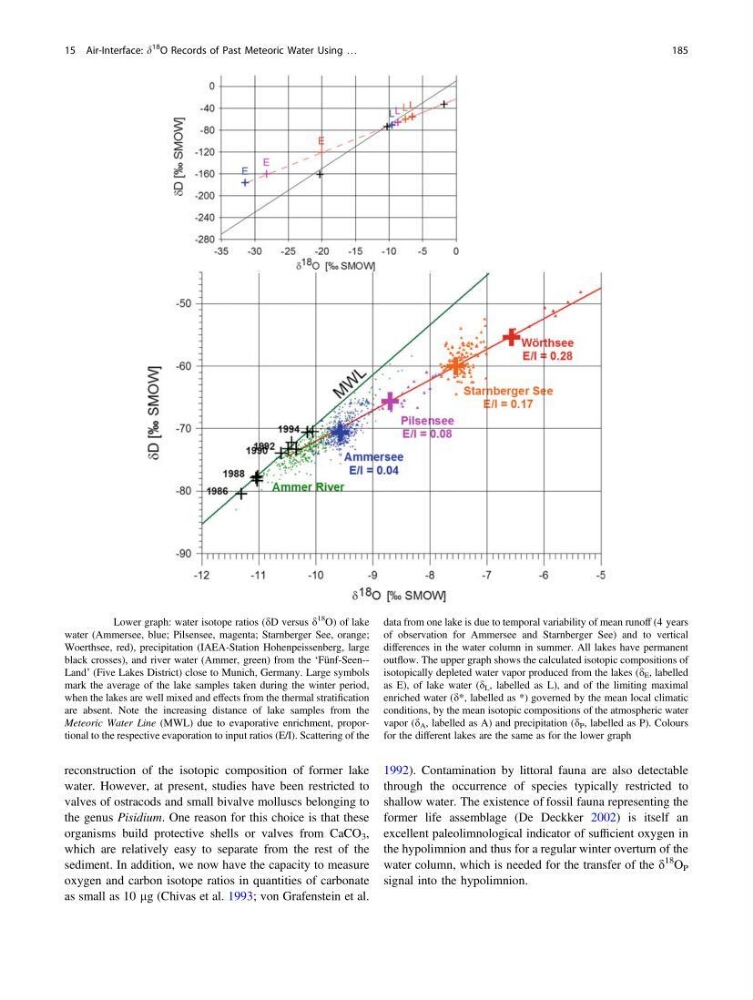
Fig. 15.2 Lower graph: water isotope ratios (dD versus d
18
O) of lake
water (Ammersee, blue; Pilsensee, magenta; Starnberger See, orange;
Woerthsee, red), precipitation (IAEA-Station Hohenpeissenberg, large
black crosses), and river water (Ammer, green) from the ‘Fünf-Seen-Land’ (Five Lakes District) close to Munich, Germany. Large symbols
mark the average of the lake samples taken during the winter period,
when the lakes are well mixed and effects from the thermal stratification
are absent. Note the increasing distance of lake samples from the
Meteoric Water Line (MWL) due to evaporative enrichment, proportional to the respective evaporation to input ratios (E/I). Scattering of the
data from one lake is due to temporal variability of mean runoff (4 years
of observation for Ammersee and Starnberger See) and to vertical
differences in the water column in summer. All lakes have permanent
outflow. The upper graph shows the calculated isotopic compositions of
isotopically depleted water vapor produced from the lakes (d E , labelled
as E), of lake water (d L , labelled as L), and of the limiting maximal
enriched water (d*, labelled as *) governed by the mean local climatic
conditions, by the mean isotopic compositions of the atmospheric water
vapor (d A , labelled as A) and precipitation (d P , labelled as P). Colours
for the different lakes are the same as for the lower graph
15 Air-Interface: d
18 O Records of Past Meteoric Water Using …
185
water. However, at present, studies have been restricted to
valves of ostracods and small bivalve molluscs belonging to
the genus Pisidium. One reason for this choice is that these
organisms build protective shells or valves from CaCO 3 ,
which are relatively easy to separate from the rest of the
sediment. In addition, we now have the capacity to measure
oxygen and carbon isotope ratios in quantities of carbonate
as small as 10 lg (Chivas et al. 1993; von Grafenstein et al.
1992). Contamination by littoral fauna are also detectable
through the occurrence of species typically restricted to
shallow water. The existence of fossil fauna representing the
former life assemblage (De Deckker 2002) is itself an
excellent paleolimnological indicator of sufficient oxygen in
the hypolimnion and thus for a regular winter overturn of the
water column, which is needed for the transfer of the d
18 O P
signal into the hypolimnion.
Fig. 15.2 Lower graph: water isotope ratios (dD versus d
18
O) of lake
water (Ammersee, blue; Pilsensee, magenta; Starnberger See, orange;
Woerthsee, red), precipitation (IAEA-Station Hohenpeissenberg, large
black crosses), and river water (Ammer, green) from the ‘Fünf-Seen-Land’ (Five Lakes District) close to Munich, Germany. Large symbols
mark the average of the lake samples taken during the winter period,
when the lakes are well mixed and effects from the thermal stratification
are absent. Note the increasing distance of lake samples from the
Meteoric Water Line (MWL) due to evaporative enrichment, proportional to the respective evaporation to input ratios (E/I). Scattering of the
data from one lake is due to temporal variability of mean runoff (4 years
of observation for Ammersee and Starnberger See) and to vertical
differences in the water column in summer. All lakes have permanent
outflow. The upper graph shows the calculated isotopic compositions of
isotopically depleted water vapor produced from the lakes (d E , labelled
as E), of lake water (d L , labelled as L), and of the limiting maximal
enriched water (d*, labelled as *) governed by the mean local climatic
conditions, by the mean isotopic compositions of the atmospheric water
vapor (d A , labelled as A) and precipitation (d P , labelled as P). Colours
for the different lakes are the same as for the lower graph
15 Air-Interface: d
18 O Records of Past Meteoric Water Using …
185