

d L from three neighbouring lakes with differing A L /A C
should allow quantification of the evaporative enrichment
and, in consequence, of D P−I , P − ET, E, and h, if one stable
water isotope is used (d
18 O or dD), and from two lakes if both
d
18 O L and dD L are available.
Figure 15.2 gives an example of such a set of lakes
(which in part are also used below for d P reconstruction).
These four lakes are fed today by surface water of almost
identical composition and are sufficiently close to assume
that P − ET, h, d A , and evaporation from a surface unit are
equal. Individual water samples, taken within the period
from 1989 to 1994 in a dD–d
18
O diagram scatter around
mean values from a lake, are clearly separated from the local
meteoric precipitation and from lake to lake. Averages of the
samples taken in the winter, when the lakes are well mixed,
are plotted on a line with a slope of 4.9, indicating that the
distance from the long-term average of the precipitation is
due to the relative importance of evaporation from the
individual lake surface. Using Eqs. 1 and 2, d
18 O L measurements of the four lakes can be reproduced using mean
climatic conditions for the region and assuming that the
isotopic composition of atmospheric water vapor (d A ) is in
equilibrium with the long term mean of the isotopic composition of the precipitation (d
18 O P ). Evaporation from a
surface unit, as calculated from the isotope balances, is
535 mm, close to independent estimates from the water
balances (ca. 600 mm) and from energy balance modelling
(580 mm).
Figure 15.3 gives an example of a sensitivity test
exploiting how the d L of the lakes in Fig. 15.2 will change if
hydrologic conditions change (without a change of d P ), such
as a doubling of the input (I) or a doubling of the evaporation (E). Evidently, the lake with the lowest modern evaporative offset is also the least sensitive to changing
hydrology, and therefore should give the most accurate
estimate of d P from reconstructed d L .
Transient Changes and Dynamic Effects
The scatter of d
18 O L of individual lake water samples in
Fig. 15.2 is the result of temperature stratification, which
leads to short-term deviations from the ‘steady state.’ In
summer, the warm epilimnic water body, which is efficiently
separated from the much larger hypolimnion, is both evaporatively enriched and fed by isotopically-enriched summer
precipitation and river runoff. The first effect leads to systematic shifts parallel to the local evaporation line, whereas
the second leads to less systematic scatter along lines connection the prevailing L with the respective isotopic composition of the precipitation and river water. Under present
day conditions, these seasonal deviations of epilimnetic
water in our examples can add up to at least 1.5‰ and are
subject to significant inter-annual variability as shown in
Fig. 15.1c. Hypolimnetic water, in consequence, is the better
representation of the lake’s reaction to the long-term
development, being ‘updated’ once a year during the lake
overturn in autumn, winter, and/or spring.
With respect to dynamic effects, the selection of the
‘ideal’ lake for d P reconstruction is a trade-off between a
short residence time (I/V), which ensures an optimal
response of d L to a change in d P , on the one hand, and a
residence time that is long enough to efficiently suppress the
seasonal variability of d I , on the other hand. A theoretical
residence time of 2.7 years (as for the Ammersee) seems to
be sufficiently long to suppress the present-day seasonal
variability of d I . The reactivity of a lake to a change in P can
be described by
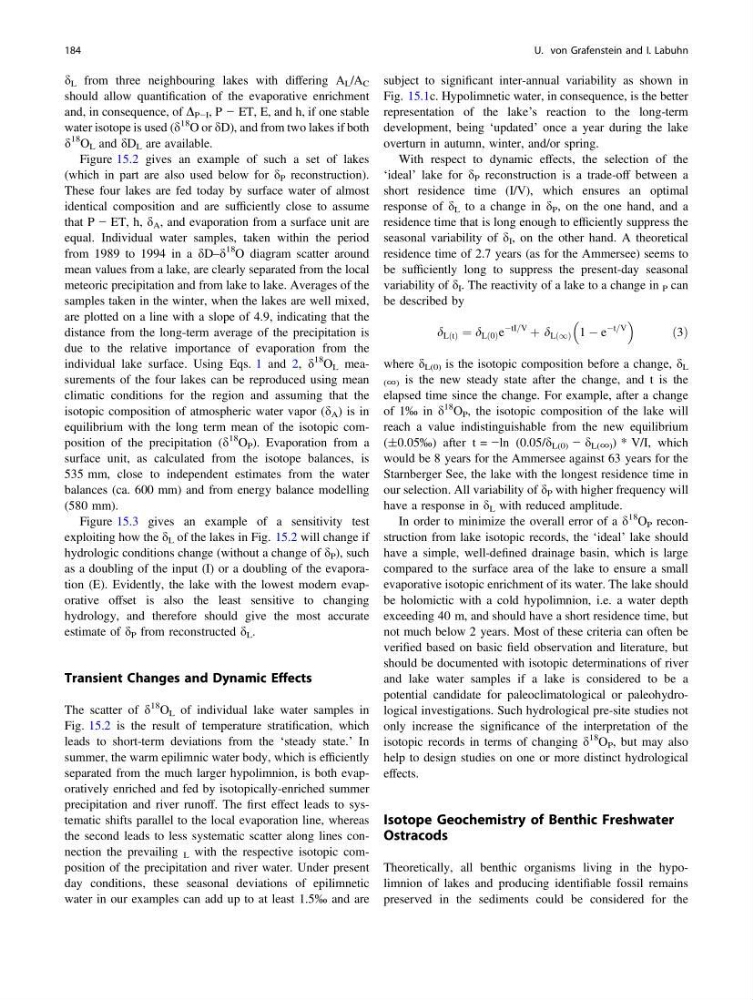
d LðtÞ ¼ d Lð0Þ e
ÀtI=V
þ d Lð1Þ 1 À e
Àt=V
ð3Þ
where d L(0) is the isotopic composition before a change, d L
(∞) is the new steady state after the change, and t is the
elapsed time since the change. For example, after a change
of 1‰ in d
18 O P , the isotopic composition of the lake will
reach a value indistinguishable from the new equilibrium
(±0.05‰) after t = −ln (0.05/d L(0) − d L(∞) ) * V/I, which
would be 8 years for the Ammersee against 63 years for the
Starnberger See, the lake with the longest residence time in
our selection. All variability of d P with higher frequency will
have a response in d L with reduced amplitude.
In order to minimize the overall error of a d
18 O P reconstruction from lake isotopic records, the ‘ideal’ lake should
have a simple, well-defined drainage basin, which is large
compared to the surface area of the lake to ensure a small
evaporative isotopic enrichment of its water. The lake should
be holomictic with a cold hypolimnion, i.e. a water depth
exceeding 40 m, and should have a short residence time, but
not much below 2 years. Most of these criteria can often be
verified based on basic field observation and literature, but
should be documented with isotopic determinations of river
and lake water samples if a lake is considered to be a
potential candidate for paleoclimatological or paleohydrological investigations. Such hydrological pre-site studies not
only increase the significance of the interpretation of the
isotopic records in terms of changing d
18 O P , but may also
help to design studies on one or more distinct hydrological
effects.
Isotope Geochemistry of Benthic Freshwater
Ostracods
Theoretically, all benthic organisms living in the hypolimnion of lakes and producing identifiable fossil remains
preserved in the sediments could be considered for the
184
U. von Grafenstein and I. Labuhn
should allow quantification of the evaporative enrichment
and, in consequence, of D P−I , P − ET, E, and h, if one stable
water isotope is used (d
18 O or dD), and from two lakes if both
d
18 O L and dD L are available.
Figure 15.2 gives an example of such a set of lakes
(which in part are also used below for d P reconstruction).
These four lakes are fed today by surface water of almost
identical composition and are sufficiently close to assume
that P − ET, h, d A , and evaporation from a surface unit are
equal. Individual water samples, taken within the period
from 1989 to 1994 in a dD–d
18
O diagram scatter around
mean values from a lake, are clearly separated from the local
meteoric precipitation and from lake to lake. Averages of the
samples taken in the winter, when the lakes are well mixed,
are plotted on a line with a slope of 4.9, indicating that the
distance from the long-term average of the precipitation is
due to the relative importance of evaporation from the
individual lake surface. Using Eqs. 1 and 2, d
18 O L measurements of the four lakes can be reproduced using mean
climatic conditions for the region and assuming that the
isotopic composition of atmospheric water vapor (d A ) is in
equilibrium with the long term mean of the isotopic composition of the precipitation (d
18 O P ). Evaporation from a
surface unit, as calculated from the isotope balances, is
535 mm, close to independent estimates from the water
balances (ca. 600 mm) and from energy balance modelling
(580 mm).
Figure 15.3 gives an example of a sensitivity test
exploiting how the d L of the lakes in Fig. 15.2 will change if
hydrologic conditions change (without a change of d P ), such
as a doubling of the input (I) or a doubling of the evaporation (E). Evidently, the lake with the lowest modern evaporative offset is also the least sensitive to changing
hydrology, and therefore should give the most accurate
estimate of d P from reconstructed d L .
Transient Changes and Dynamic Effects
The scatter of d
18 O L of individual lake water samples in
Fig. 15.2 is the result of temperature stratification, which
leads to short-term deviations from the ‘steady state.’ In
summer, the warm epilimnic water body, which is efficiently
separated from the much larger hypolimnion, is both evaporatively enriched and fed by isotopically-enriched summer
precipitation and river runoff. The first effect leads to systematic shifts parallel to the local evaporation line, whereas
the second leads to less systematic scatter along lines connection the prevailing L with the respective isotopic composition of the precipitation and river water. Under present
day conditions, these seasonal deviations of epilimnetic
water in our examples can add up to at least 1.5‰ and are
subject to significant inter-annual variability as shown in
Fig. 15.1c. Hypolimnetic water, in consequence, is the better
representation of the lake’s reaction to the long-term
development, being ‘updated’ once a year during the lake
overturn in autumn, winter, and/or spring.
With respect to dynamic effects, the selection of the
‘ideal’ lake for d P reconstruction is a trade-off between a
short residence time (I/V), which ensures an optimal
response of d L to a change in d P , on the one hand, and a
residence time that is long enough to efficiently suppress the
seasonal variability of d I , on the other hand. A theoretical
residence time of 2.7 years (as for the Ammersee) seems to
be sufficiently long to suppress the present-day seasonal
variability of d I . The reactivity of a lake to a change in P can
be described by
d LðtÞ ¼ d Lð0Þ e
ÀtI=V
þ d Lð1Þ 1 À e
Àt=V
ð3Þ
where d L(0) is the isotopic composition before a change, d L
(∞) is the new steady state after the change, and t is the
elapsed time since the change. For example, after a change
of 1‰ in d
18 O P , the isotopic composition of the lake will
reach a value indistinguishable from the new equilibrium
(±0.05‰) after t = −ln (0.05/d L(0) − d L(∞) ) * V/I, which
would be 8 years for the Ammersee against 63 years for the
Starnberger See, the lake with the longest residence time in
our selection. All variability of d P with higher frequency will
have a response in d L with reduced amplitude.
In order to minimize the overall error of a d
18 O P reconstruction from lake isotopic records, the ‘ideal’ lake should
have a simple, well-defined drainage basin, which is large
compared to the surface area of the lake to ensure a small
evaporative isotopic enrichment of its water. The lake should
be holomictic with a cold hypolimnion, i.e. a water depth
exceeding 40 m, and should have a short residence time, but
not much below 2 years. Most of these criteria can often be
verified based on basic field observation and literature, but
should be documented with isotopic determinations of river
and lake water samples if a lake is considered to be a
potential candidate for paleoclimatological or paleohydrological investigations. Such hydrological pre-site studies not
only increase the significance of the interpretation of the
isotopic records in terms of changing d
18 O P , but may also
help to design studies on one or more distinct hydrological
effects.
Isotope Geochemistry of Benthic Freshwater
Ostracods
Theoretically, all benthic organisms living in the hypolimnion of lakes and producing identifiable fossil remains
preserved in the sediments could be considered for the
184
U. von Grafenstein and I. Labuhn