

Vital Effects
However, the formation of the protective calcitic ostracod
valves is a physiological process, which may affect the
oxygen isotopic composition of the valves through systematic differences compared to an inorganic calcite formed in
isotopic equilibrium. Indeed, such ‘vital effects’ have been
postulated based on evidence from constant differences in
valve d
18 O between different taxa in deep lake cores from
Starnberger See and Ammersee (von Grafenstein et al.
1992). These effects have been quantified for some common
European freshwater species by systematic field observation
and collection (von Grafenstein et al. 1999a, b), and by
laboratory cultivation for the North American species Candona rawsoni (Xia et al. 1997) and the Australian euryhaline
nectic ostracod Australocypris robusta (Chivas et al. 2002).
The result of the field observations in Ammersee and
Starnberger See have been confirmed by a similar one-year
observation in Lake Geneva (Decrouy et al. 2011). However,
field and laboratory studies on ostracods from sites with
variable salinity (Li and Liu 2010) and host water pH
reporting (Chivas et al. 2002; Marco-Barba et al. 2012)
indicate that the ‘vital effect’ might be influenced by host
water conditions. Devriendt et al. (2017) therefore compiled
all data from published ‘calibration’ studies (Chivas et al.
2002; Xia et al. 1997; von Grafenstein et al. 1999a, b;
Decrouy et al. 2011; Li and Liu 2010; Didié and Bauch
2002; Keatings et al. 2002; Van der Meeren et al. 2011;
Bornemann et al. 2012) and suggested that ostracod calcite
reflects the oxygen isotopic composition of the sum of
[HCO 3
− ] and [CO 3
2− ]. For carbonate-dominated freshwater
lakes with a pH of around 8.3 the contribution of [CO 3
2− ] to
this sum is negligible. The isotopic composition of ostracods
valves in these lakes therefore reflects almost exclusively the
isotopic composition of [HCO 3 -] which in turn depends
solely on d
18 O L and the water temperatures, whereas, in
waters with high and variable salinity, the variable contribution of [CO 3
2− ] leads to significant negative excursions in
the d
18 O of the ostracod calcite, thus possibly influencing the
reconstruction of the host water d
18 O. This new calcification
model nicely explains the apparent and up-to-now still
enigmatic, positive offset of valve d
18 O with respect to an
‘equilibrium calcite’ in almost all freshwater settings. It
could also be the key to understanding the significant differences of ‘vital offsets’ within taxonomic groups. For the
deep freshwater lake situation, the correction for the
empirical ‘vital offset’ and for the temperature-dependent
fractionation between the d
18 O of ambient water and a calcite in isotopic equilibrium should still give an excellent
measure of the d
18 O L , if the water temperature during the
formation of the valve is known, or can be established.
Water Temperature Effects
Holomixis (the full overturn of the water column) of deep
freshwater lakes occurs when the temperature of the entire
water column approaches the density maximum of
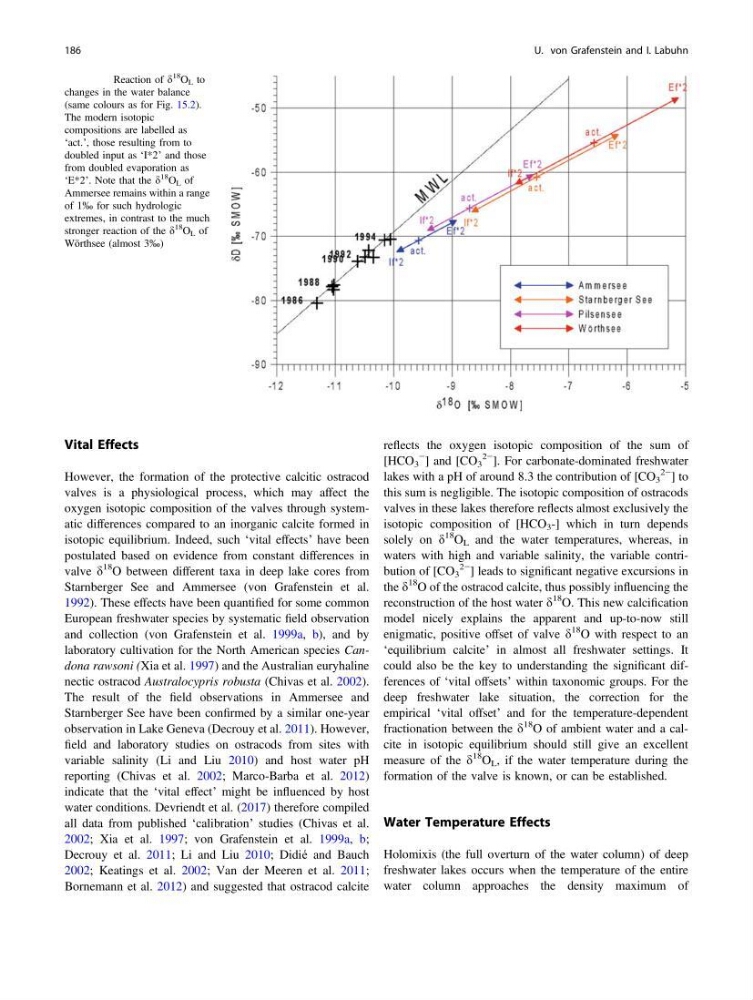
Fig. 15.3 Reaction of d
18
O L to
changes in the water balance
(same colours as for Fig. 15.2).
The modern isotopic
compositions are labelled as
‘act.’, those resulting from to
doubled input as ‘I*2’ and those
from doubled evaporation as
‘E*2’. Note that the d
18
O L of
Ammersee remains within a range
of 1‰ for such hydrologic
extremes, in contrast to the much
stronger reaction of the d
18
O L of
Wörthsee (almost 3‰)
186
U. von Grafenstein and I. Labuhn
However, the formation of the protective calcitic ostracod
valves is a physiological process, which may affect the
oxygen isotopic composition of the valves through systematic differences compared to an inorganic calcite formed in
isotopic equilibrium. Indeed, such ‘vital effects’ have been
postulated based on evidence from constant differences in
valve d
18 O between different taxa in deep lake cores from
Starnberger See and Ammersee (von Grafenstein et al.
1992). These effects have been quantified for some common
European freshwater species by systematic field observation
and collection (von Grafenstein et al. 1999a, b), and by
laboratory cultivation for the North American species Candona rawsoni (Xia et al. 1997) and the Australian euryhaline
nectic ostracod Australocypris robusta (Chivas et al. 2002).
The result of the field observations in Ammersee and
Starnberger See have been confirmed by a similar one-year
observation in Lake Geneva (Decrouy et al. 2011). However,
field and laboratory studies on ostracods from sites with
variable salinity (Li and Liu 2010) and host water pH
reporting (Chivas et al. 2002; Marco-Barba et al. 2012)
indicate that the ‘vital effect’ might be influenced by host
water conditions. Devriendt et al. (2017) therefore compiled
all data from published ‘calibration’ studies (Chivas et al.
2002; Xia et al. 1997; von Grafenstein et al. 1999a, b;
Decrouy et al. 2011; Li and Liu 2010; Didié and Bauch
2002; Keatings et al. 2002; Van der Meeren et al. 2011;
Bornemann et al. 2012) and suggested that ostracod calcite
reflects the oxygen isotopic composition of the sum of
[HCO 3
− ] and [CO 3
2− ]. For carbonate-dominated freshwater
lakes with a pH of around 8.3 the contribution of [CO 3
2− ] to
this sum is negligible. The isotopic composition of ostracods
valves in these lakes therefore reflects almost exclusively the
isotopic composition of [HCO 3 -] which in turn depends
solely on d
18 O L and the water temperatures, whereas, in
waters with high and variable salinity, the variable contribution of [CO 3
2− ] leads to significant negative excursions in
the d
18 O of the ostracod calcite, thus possibly influencing the
reconstruction of the host water d
18 O. This new calcification
model nicely explains the apparent and up-to-now still
enigmatic, positive offset of valve d
18 O with respect to an
‘equilibrium calcite’ in almost all freshwater settings. It
could also be the key to understanding the significant differences of ‘vital offsets’ within taxonomic groups. For the
deep freshwater lake situation, the correction for the
empirical ‘vital offset’ and for the temperature-dependent
fractionation between the d
18 O of ambient water and a calcite in isotopic equilibrium should still give an excellent
measure of the d
18 O L , if the water temperature during the
formation of the valve is known, or can be established.
Water Temperature Effects
Holomixis (the full overturn of the water column) of deep
freshwater lakes occurs when the temperature of the entire
water column approaches the density maximum of
Fig. 15.3 Reaction of d
18
O L to
changes in the water balance
(same colours as for Fig. 15.2).
The modern isotopic
compositions are labelled as
‘act.’, those resulting from to
doubled input as ‘I*2’ and those
from doubled evaporation as
‘E*2’. Note that the d
18
O L of
Ammersee remains within a range
of 1‰ for such hydrologic
extremes, in contrast to the much
stronger reaction of the d
18
O L of
Wörthsee (almost 3‰)
186
U. von Grafenstein and I. Labuhn