

search for the origin of the transported matter, using samples
taken from potential source areas, and thus, to estimate the
transport-related mechanisms (Rousseau et al. (2014); Gallet
et al. (1996); Guo et al. (2002)).
Tracing past precipitation and past temperature
At the same time as the abundance count of earthworm
calcitic granules emerged as a paleoclimate proxy, study of
their isotopic properties has also developed (Prud’homme
et al. (2016), (2018)). The d
18 O granules and interlinked
transfer functions between water cycle, air and soil temperatures allow the estimation of air temperatures. In Nussloch,
the mean summer air temperature during Greenland
interstadial has been estimated to have been 10–12 ± 4 °C
(Prud’homme et al. (2016)). In line with loess organic d
13 C
interpretation, d
13 C of earthworm granules has been interpreted as a proxy of paleoprecipitation. Thanks to transfer
functions, the past precipitation in Nussloch during the
Greenland interstadial has been estimated at about 159–
574 mm/yr (Prud’homme et al. (2018)).
Loess Chronology
Loess chronology remains a major challenge since OSL
returns a wide range of value depending on the choice of the
mineral (type and grain size), the choice of light ray (IRSL,
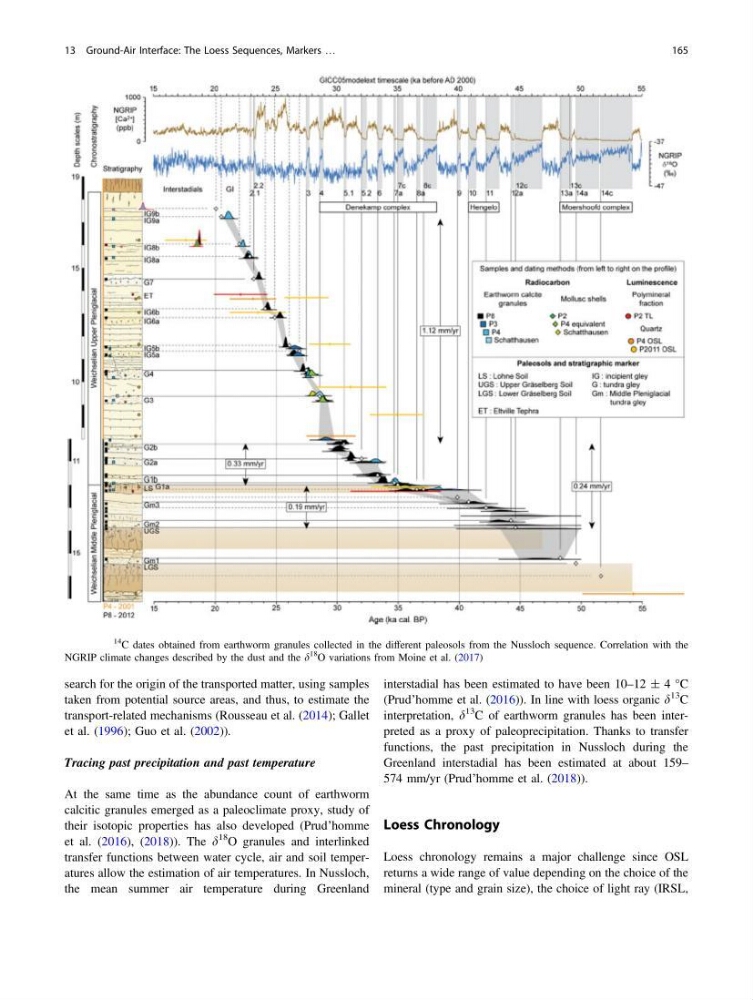
Fig. 13.8
14
C dates obtained from earthworm granules collected in the different paleosols from the Nussloch sequence. Correlation with the
NGRIP climate changes described by the dust and the d
18
O variations from Moine et al. (2017)
13 Ground-Air Interface: The Loess Sequences, Markers …
165
taken from potential source areas, and thus, to estimate the
transport-related mechanisms (Rousseau et al. (2014); Gallet
et al. (1996); Guo et al. (2002)).
Tracing past precipitation and past temperature
At the same time as the abundance count of earthworm
calcitic granules emerged as a paleoclimate proxy, study of
their isotopic properties has also developed (Prud’homme
et al. (2016), (2018)). The d
18 O granules and interlinked
transfer functions between water cycle, air and soil temperatures allow the estimation of air temperatures. In Nussloch,
the mean summer air temperature during Greenland
interstadial has been estimated to have been 10–12 ± 4 °C
(Prud’homme et al. (2016)). In line with loess organic d
13 C
interpretation, d
13 C of earthworm granules has been interpreted as a proxy of paleoprecipitation. Thanks to transfer
functions, the past precipitation in Nussloch during the
Greenland interstadial has been estimated at about 159–
574 mm/yr (Prud’homme et al. (2018)).
Loess Chronology
Loess chronology remains a major challenge since OSL
returns a wide range of value depending on the choice of the
mineral (type and grain size), the choice of light ray (IRSL,
Fig. 13.8
14
C dates obtained from earthworm granules collected in the different paleosols from the Nussloch sequence. Correlation with the
NGRIP climate changes described by the dust and the d
18
O variations from Moine et al. (2017)
13 Ground-Air Interface: The Loess Sequences, Markers …
165