

regarded as source tracers. A recent study has been performed on loess samples, dated from the Last Glacial
Maximum, located along a 50° N transect (from English
Channel to Ukraine), chosen to represent the geographic and
petrographic variability of the European loess belt. Geochemical results combined with dust emission simulations
revealed that the dust was transported only over a few
hundred kilometers. Moreover, the results highlighted that
the sources were regional and that distinct sources prevailed
within the European continent (Rousseau et al. (2014)).
Tracing past precipitation and seasonality
The analysis of d
13 C from organic matter preserved in very
small quantities in the loess sediment indicates the presence
of vegetation; this can also be observed through the presence
of carbonated concretions developed around herbaceous
rootlets (for example, Wang and Follmer (1998); Hatté et al.
(2001a)). The values of this isotopic ratio also allow the
characterization of the type of vegetation which trapped the
dust during its deposition, and therefore the associated
environmental and climatic conditions. Distinctions may be
made at the level of the photosynthetic cycle (plants in C3
compared to those in C4) or within a similar photosynthetic
type through the definition of seasonal variations in temperature or precipitation.
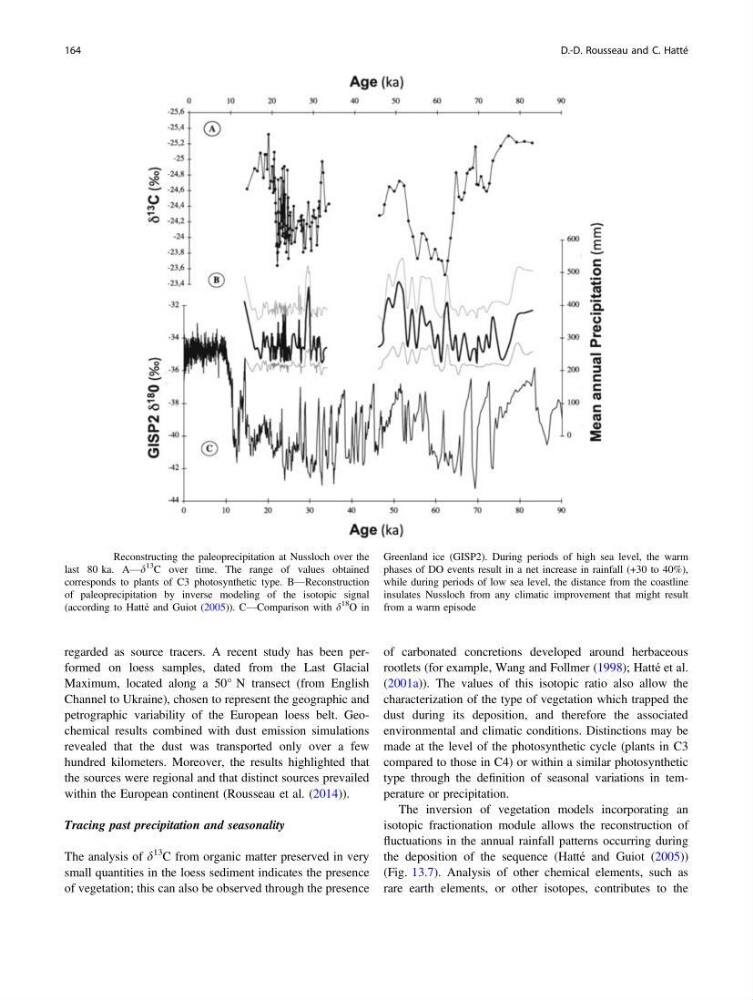
The inversion of vegetation models incorporating an
isotopic fractionation module allows the reconstruction of
fluctuations in the annual rainfall patterns occurring during
the deposition of the sequence (Hatté and Guiot (2005))
(Fig. 13.7). Analysis of other chemical elements, such as
rare earth elements, or other isotopes, contributes to the
Fig. 13.7 Reconstructing the paleoprecipitation at Nussloch over the
last 80 ka. A—d
13
C over time. The range of values obtained
corresponds to plants of C3 photosynthetic type. B—Reconstruction
of paleoprecipitation by inverse modeling of the isotopic signal
(according to Hatté and Guiot (2005)). C—Comparison with d
18
O in
Greenland ice (GISP2). During periods of high sea level, the warm
phases of DO events result in a net increase in rainfall (+30 to 40%),
while during periods of low sea level, the distance from the coastline
insulates Nussloch from any climatic improvement that might result
from a warm episode
164
D.-D. Rousseau and C. Hatté
Maximum, located along a 50° N transect (from English
Channel to Ukraine), chosen to represent the geographic and
petrographic variability of the European loess belt. Geochemical results combined with dust emission simulations
revealed that the dust was transported only over a few
hundred kilometers. Moreover, the results highlighted that
the sources were regional and that distinct sources prevailed
within the European continent (Rousseau et al. (2014)).
Tracing past precipitation and seasonality
The analysis of d
13 C from organic matter preserved in very
small quantities in the loess sediment indicates the presence
of vegetation; this can also be observed through the presence
of carbonated concretions developed around herbaceous
rootlets (for example, Wang and Follmer (1998); Hatté et al.
(2001a)). The values of this isotopic ratio also allow the
characterization of the type of vegetation which trapped the
dust during its deposition, and therefore the associated
environmental and climatic conditions. Distinctions may be
made at the level of the photosynthetic cycle (plants in C3
compared to those in C4) or within a similar photosynthetic
type through the definition of seasonal variations in temperature or precipitation.
The inversion of vegetation models incorporating an
isotopic fractionation module allows the reconstruction of
fluctuations in the annual rainfall patterns occurring during
the deposition of the sequence (Hatté and Guiot (2005))
(Fig. 13.7). Analysis of other chemical elements, such as
rare earth elements, or other isotopes, contributes to the
Fig. 13.7 Reconstructing the paleoprecipitation at Nussloch over the
last 80 ka. A—d
13
C over time. The range of values obtained
corresponds to plants of C3 photosynthetic type. B—Reconstruction
of paleoprecipitation by inverse modeling of the isotopic signal
(according to Hatté and Guiot (2005)). C—Comparison with d
18
O in
Greenland ice (GISP2). During periods of high sea level, the warm
phases of DO events result in a net increase in rainfall (+30 to 40%),
while during periods of low sea level, the distance from the coastline
insulates Nussloch from any climatic improvement that might result
from a warm episode
164
D.-D. Rousseau and C. Hatté