

for the first time in the Chinese loess sequences, this method
has helped to clarify the origin of the quartz grains transported to the Loess Plateau (the Gobi desert during stadial
periods, deserts of northern China during the warmer periods) (Sun (2008)). More recently, the study of the mineral
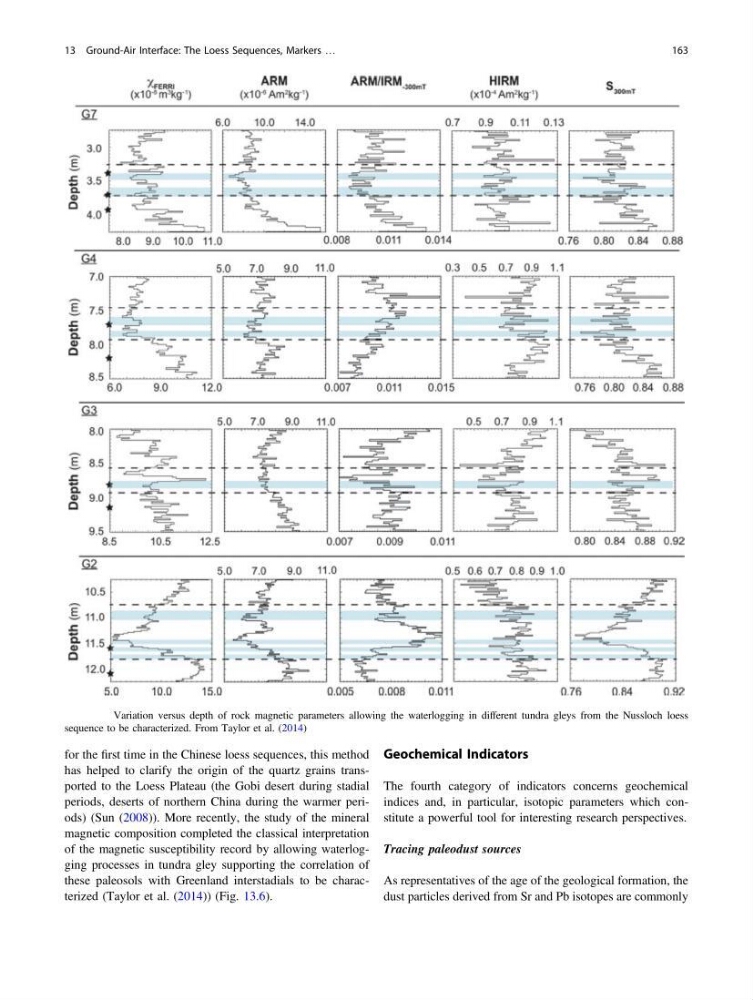
magnetic composition completed the classical interpretation
of the magnetic susceptibility record by allowing waterlogging processes in tundra gley supporting the correlation of
these paleosols with Greenland interstadials to be characterized (Taylor et al. (2014)) (Fig. 13.6).
Geochemical Indicators
The fourth category of indicators concerns geochemical
indices and, in particular, isotopic parameters which constitute a powerful tool for interesting research perspectives.
Tracing paleodust sources
As representatives of the age of the geological formation, the
dust particles derived from Sr and Pb isotopes are commonly
Fig. 13.6 Variation versus depth of rock magnetic parameters allowing the waterlogging in different tundra gleys from the Nussloch loess
sequence to be characterized. From Taylor et al. (2014)
13 Ground-Air Interface: The Loess Sequences, Markers …
163
has helped to clarify the origin of the quartz grains transported to the Loess Plateau (the Gobi desert during stadial
periods, deserts of northern China during the warmer periods) (Sun (2008)). More recently, the study of the mineral
magnetic composition completed the classical interpretation
of the magnetic susceptibility record by allowing waterlogging processes in tundra gley supporting the correlation of
these paleosols with Greenland interstadials to be characterized (Taylor et al. (2014)) (Fig. 13.6).
Geochemical Indicators
The fourth category of indicators concerns geochemical
indices and, in particular, isotopic parameters which constitute a powerful tool for interesting research perspectives.
Tracing paleodust sources
As representatives of the age of the geological formation, the
dust particles derived from Sr and Pb isotopes are commonly
Fig. 13.6 Variation versus depth of rock magnetic parameters allowing the waterlogging in different tundra gleys from the Nussloch loess
sequence to be characterized. From Taylor et al. (2014)
13 Ground-Air Interface: The Loess Sequences, Markers …
163