

frequent. Among these, terrestrial mollusks form populations
typical of diverse environments (Wu (2001); Rousseau
(1987)).
Mollusk assemblages
Usually identified at the species level, these organisms have
the advantage of persisting to the present day. In accordance
with the principle of actualism, it is possible to apply modern
requirements and ecological characteristics to individual
fossils. Multivariate statistical analyses are used to reconstruct the environment in which a fossil community
developed (Rousseau (1987)). Two examples follow: the
first, in China, illustrates the long-term variations that can be
correlated to terrestrial orbital frequencies and the second
shows the short-term variation relating to the internal variability of the climate.
The long-term variability
Using the ecological requirements of taxa identified in the
Chinese loess, it was possible to define environmental groups
that have proven to be reliable indicators of the summer and
winter monsoons through the ages (Fig. 13.5). Transfer
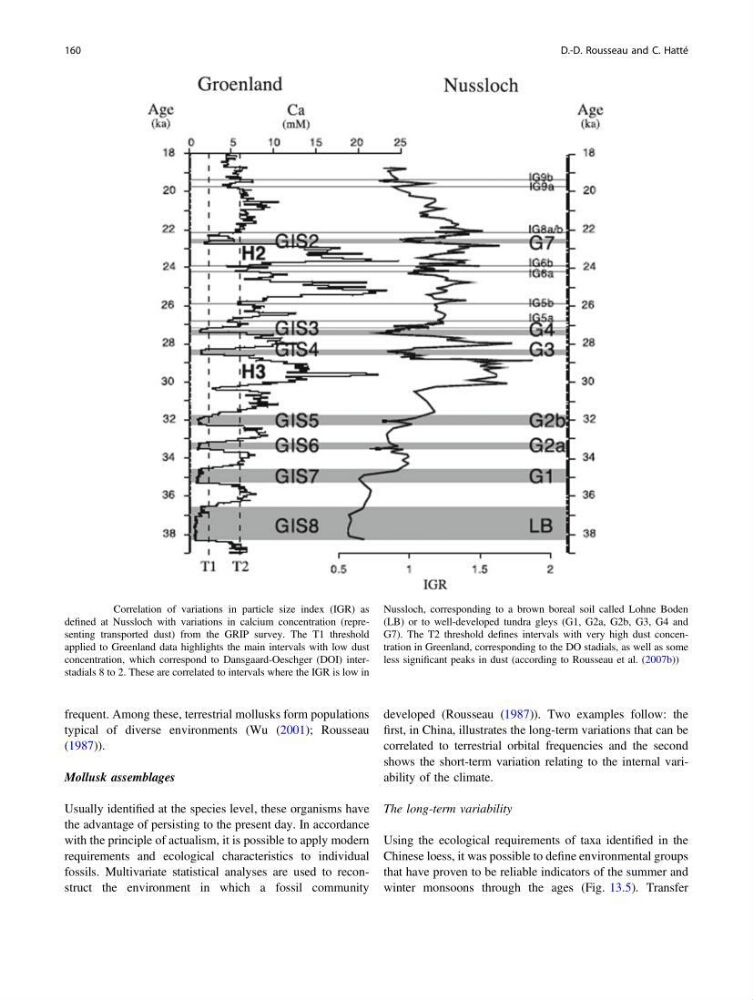
Fig. 13.3 Correlation of variations in particle size index (IGR) as
defined at Nussloch with variations in calcium concentration (representing transported dust) from the GRIP survey. The T1 threshold
applied to Greenland data highlights the main intervals with low dust
concentration, which correspond to Dansgaard-Oeschger (DOI) interstadials 8 to 2. These are correlated to intervals where the IGR is low in
Nussloch, corresponding to a brown boreal soil called Lohne Boden
(LB) or to well-developed tundra gleys (G1, G2a, G2b, G3, G4 and
G7). The T2 threshold defines intervals with very high dust concentration in Greenland, corresponding to the DO stadials, as well as some
less significant peaks in dust (according to Rousseau et al. (2007b))
160
D.-D. Rousseau and C. Hatté
typical of diverse environments (Wu (2001); Rousseau
(1987)).
Mollusk assemblages
Usually identified at the species level, these organisms have
the advantage of persisting to the present day. In accordance
with the principle of actualism, it is possible to apply modern
requirements and ecological characteristics to individual
fossils. Multivariate statistical analyses are used to reconstruct the environment in which a fossil community
developed (Rousseau (1987)). Two examples follow: the
first, in China, illustrates the long-term variations that can be
correlated to terrestrial orbital frequencies and the second
shows the short-term variation relating to the internal variability of the climate.
The long-term variability
Using the ecological requirements of taxa identified in the
Chinese loess, it was possible to define environmental groups
that have proven to be reliable indicators of the summer and
winter monsoons through the ages (Fig. 13.5). Transfer
Fig. 13.3 Correlation of variations in particle size index (IGR) as
defined at Nussloch with variations in calcium concentration (representing transported dust) from the GRIP survey. The T1 threshold
applied to Greenland data highlights the main intervals with low dust
concentration, which correspond to Dansgaard-Oeschger (DOI) interstadials 8 to 2. These are correlated to intervals where the IGR is low in
Nussloch, corresponding to a brown boreal soil called Lohne Boden
(LB) or to well-developed tundra gleys (G1, G2a, G2b, G3, G4 and
G7). The T2 threshold defines intervals with very high dust concentration in Greenland, corresponding to the DO stadials, as well as some
less significant peaks in dust (according to Rousseau et al. (2007b))
160
D.-D. Rousseau and C. Hatté