

The link between f 230 and f 234 (Eq. 6.6) is the difference of
kinetic energy injected into the crystal lattice following the
decay of
238
U and
234 U. The process of an a particle emission
is the same with only the kinetic energy being different.
f 234 ¼ 1:157 Á 1 À f 230
ð
Þð Villemant and Feuillet 2003Þ
ð6:6Þ
The definition of the redistribution factor f is purely
mathematical, so gains and depletions in an open system for
uranium are expressed as f > 1 and f < 1. Up to this point,
the two calculations of Villemant and Feuillet (2003), and of
Thompson et al. (2003) are identical. Assuming that the
measured ratios can be used to determine f as defined above,
it is possible to estimate the age of the coral in an open
system (Eq. 6.4). This approach assumes that only the uranium and thorium in the coral are at the origin of the recoil
process. However, this assumption is not always correct. In
fact, the process of nuclear recoil, and thus the possible
ejection of nuclei over time, does not allow a gain of either
234 U or
230 Th; the coral can only lose radionuclides.
Therefore, a value of f > 1 is not expected. But the reality is
quite different, because most of the corals show an increase
(f > 1), and only very few corals show a depletion of
radionuclides (f < 1).
Thompson and his colleagues considered this obstacle to
be theoretical and therefore introduced further complexity in
their approach. The gain of radionuclides can be explained,
either by direct exchange of nuclei between corals very close
to each other, or by fluids circulating in the reef, in other
words, from an external source. Consequently, f is
always < 1 and the gain in
234 U and
230 Th is the sum of the
depletions over time and of the gain due to the retention of
radionuclides ejected and/or transported in the reef. To
account for this phenomenon, Thompson and his colleagues
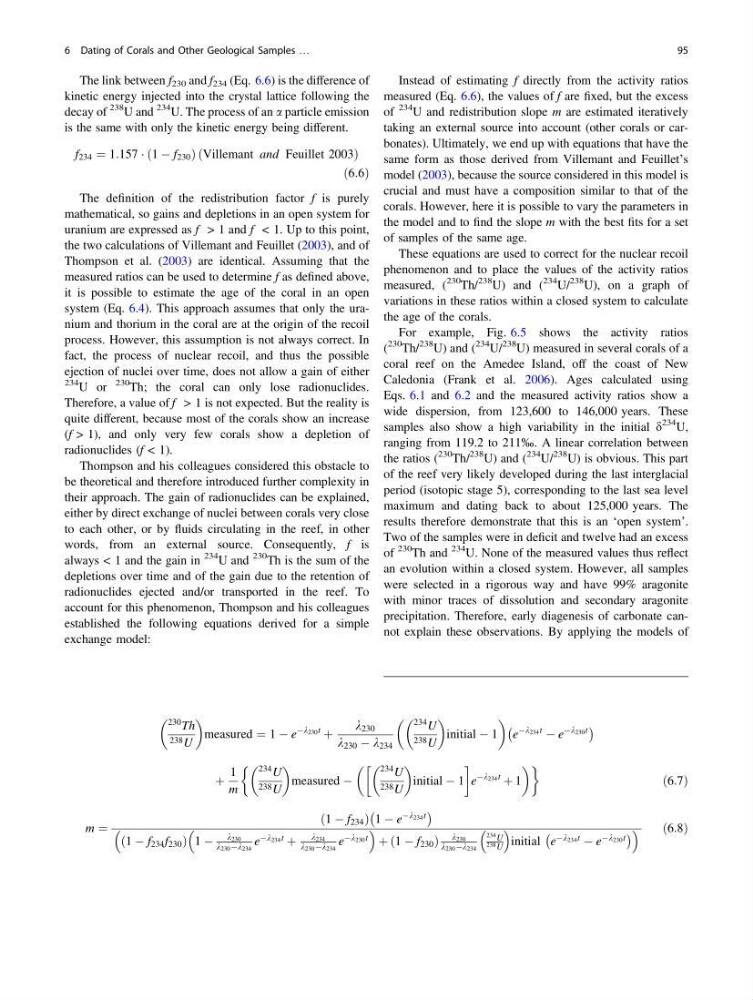
established the following equations derived for a simple
exchange model:
Instead of estimating f directly from the activity ratios
measured (Eq. 6.6), the values of f are fixed, but the excess
of
234 U and redistribution slope m are estimated iteratively
taking an external source into account (other corals or carbonates). Ultimately, we end up with equations that have the
same form as those derived from Villemant and Feuillet’s
model (2003), because the source considered in this model is
crucial and must have a composition similar to that of the
corals. However, here it is possible to vary the parameters in
the model and to find the slope m with the best fits for a set
of samples of the same age.
These equations are used to correct for the nuclear recoil
phenomenon and to place the values of the activity ratios
measured, (
230
Th/
238
U) and (
234 U/
238 U), on a graph of
variations in these ratios within a closed system to calculate
the age of the corals.
For example, Fig. 6.5 shows the activity ratios
(
230 Th/
238 U) and (
234 U/
238
U) measured in several corals of a
coral reef on the Amedee Island, off the coast of New
Caledonia (Frank et al. 2006). Ages calculated using
Eqs. 6.1 and 6.2 and the measured activity ratios show a
wide dispersion, from 123,600 to 146,000 years. These
samples also show a high variability in the initial d
234
U,
ranging from 119.2 to 211‰. A linear correlation between
the ratios (
230 Th/
238 U) and (
234 U/
238 U) is obvious. This part
of the reef very likely developed during the last interglacial
period (isotopic stage 5), corresponding to the last sea level
maximum and dating back to about 125,000 years. The
results therefore demonstrate that this is an ‘open system’.
Two of the samples were in deficit and twelve had an excess
of
230
Th and
234 U. None of the measured values thus reflect
an evolution within a closed system. However, all samples
were selected in a rigorous way and have 99% aragonite
with minor traces of dissolution and secondary aragonite
precipitation. Therefore, early diagenesis of carbonate cannot explain these observations. By applying the models of
230 Th
238 U
measured ¼ 1 À e
Àk 230 t
þ
k 230
k 230 À k 234
234 U
238 U
initial À 1
e
Àk 234 t
À e
Àk 230 t
À
Á
þ
1
m
234 U
238 U
measured À
234 U
238 U
initial À 1
!
e
Àk 234 t
þ 1
&
'
ð6:7Þ
m ¼
1 À f 234
ð
Þ 1 À e
Àk 234 t
À
Á
1 À f 234 f 230
ð
Þ 1 À
k 230
k 230 Àk 234
e
Àk 234 t
þ
k 234
k 230 Àk 234
e
Àk 230 t
þ 1 À f 230
ð
Þ
k 230
k 230 Àk 234
234 U
238 U
initial e
Àk 234 t
À e
Àk 230 t
À
Á
ð6:8Þ
6 Dating of Corals and Other Geological Samples …
95
kinetic energy injected into the crystal lattice following the
decay of
238
U and
234 U. The process of an a particle emission
is the same with only the kinetic energy being different.
f 234 ¼ 1:157 Á 1 À f 230
ð
Þð Villemant and Feuillet 2003Þ
ð6:6Þ
The definition of the redistribution factor f is purely
mathematical, so gains and depletions in an open system for
uranium are expressed as f > 1 and f < 1. Up to this point,
the two calculations of Villemant and Feuillet (2003), and of
Thompson et al. (2003) are identical. Assuming that the
measured ratios can be used to determine f as defined above,
it is possible to estimate the age of the coral in an open
system (Eq. 6.4). This approach assumes that only the uranium and thorium in the coral are at the origin of the recoil
process. However, this assumption is not always correct. In
fact, the process of nuclear recoil, and thus the possible
ejection of nuclei over time, does not allow a gain of either
234 U or
230 Th; the coral can only lose radionuclides.
Therefore, a value of f > 1 is not expected. But the reality is
quite different, because most of the corals show an increase
(f > 1), and only very few corals show a depletion of
radionuclides (f < 1).
Thompson and his colleagues considered this obstacle to
be theoretical and therefore introduced further complexity in
their approach. The gain of radionuclides can be explained,
either by direct exchange of nuclei between corals very close
to each other, or by fluids circulating in the reef, in other
words, from an external source. Consequently, f is
always < 1 and the gain in
234 U and
230 Th is the sum of the
depletions over time and of the gain due to the retention of
radionuclides ejected and/or transported in the reef. To
account for this phenomenon, Thompson and his colleagues
established the following equations derived for a simple
exchange model:
Instead of estimating f directly from the activity ratios
measured (Eq. 6.6), the values of f are fixed, but the excess
of
234 U and redistribution slope m are estimated iteratively
taking an external source into account (other corals or carbonates). Ultimately, we end up with equations that have the
same form as those derived from Villemant and Feuillet’s
model (2003), because the source considered in this model is
crucial and must have a composition similar to that of the
corals. However, here it is possible to vary the parameters in
the model and to find the slope m with the best fits for a set
of samples of the same age.
These equations are used to correct for the nuclear recoil
phenomenon and to place the values of the activity ratios
measured, (
230
Th/
238
U) and (
234 U/
238 U), on a graph of
variations in these ratios within a closed system to calculate
the age of the corals.
For example, Fig. 6.5 shows the activity ratios
(
230 Th/
238 U) and (
234 U/
238
U) measured in several corals of a
coral reef on the Amedee Island, off the coast of New
Caledonia (Frank et al. 2006). Ages calculated using
Eqs. 6.1 and 6.2 and the measured activity ratios show a
wide dispersion, from 123,600 to 146,000 years. These
samples also show a high variability in the initial d
234
U,
ranging from 119.2 to 211‰. A linear correlation between
the ratios (
230 Th/
238 U) and (
234 U/
238 U) is obvious. This part
of the reef very likely developed during the last interglacial
period (isotopic stage 5), corresponding to the last sea level
maximum and dating back to about 125,000 years. The
results therefore demonstrate that this is an ‘open system’.
Two of the samples were in deficit and twelve had an excess
of
230
Th and
234 U. None of the measured values thus reflect
an evolution within a closed system. However, all samples
were selected in a rigorous way and have 99% aragonite
with minor traces of dissolution and secondary aragonite
precipitation. Therefore, early diagenesis of carbonate cannot explain these observations. By applying the models of
230 Th
238 U
measured ¼ 1 À e
Àk 230 t
þ
k 230
k 230 À k 234
234 U
238 U
initial À 1
e
Àk 234 t
À e
Àk 230 t
À
Á
þ
1
m
234 U
238 U
measured À
234 U
238 U
initial À 1
!
e
Àk 234 t
þ 1
&
'
ð6:7Þ
m ¼
1 À f 234
ð
Þ 1 À e
Àk 234 t
À
Á
1 À f 234 f 230
ð
Þ 1 À
k 230
k 230 Àk 234
e
Àk 234 t
þ
k 234
k 230 Àk 234
e
Àk 230 t
þ 1 À f 230
ð
Þ
k 230
k 230 Àk 234
234 U
238 U
initial e
Àk 234 t
À e
Àk 230 t
À
Á
ð6:8Þ
6 Dating of Corals and Other Geological Samples …
95