

addition, this dating method is based on the assumption that
the activity ratio
234 U/
238 U of sea water (equal to 1.1468)
was constant over the last 500,000 years. For practical reasons, this ratio is commonly expressed as the relative deviation (in ‰) from radioactive equilibrium and is denoted
d
234 U (Eq. 6.3).
Thus, today’s d
234 U of seawater is 146.8 ± 0.1‰
(Andersen et al. 2010). Given the conditions mentioned
above, using Eq. 6.2, we would expect to find an initial ratio
of
234 U/
238 U for the coral similar to that of seawater.
However, it was observed that many corals more than
80,000 years old had a wide range of values for this ratio,
and often values exceed the current value for seawater
(Fig. 6.4). For example, a sample 125,000 years old, divided
into several small pieces, can present age differences
between its various fragments of more than 10,000 years,
even though the measurement accuracy is ± 1000 years for
each subsample. Variability of age within the same sample
can be ten times larger than the measurement precision. In
addition, the sub-samples of the same specimen can also
show significant variability in their
234 U/
238 U ratio over
time. This highlights the crucial role of the
234 U/
238
U ratio
(or d
234 U) in the U/Th dating method for tropical corals.
Henderson and Slowey (2000) and Gallup et al. (1994)
were the first to realize that the increase of
234 U and of
230 Th
in ancient marine carbonates are often correlated (Fig. 6.4).
This proved to be a very important observation because
diagenesis, such as the dissolution of the skeleton or precipitation of secondary aragonitic fibers, cannot explain this
correlation. For example, the dissolution of the coral skeleton during diagenesis will return uranium to pore waters, but
the thorium will be quickly re-precipitated because of its
inability to remain in solution. Consequently, the
230
Th/
238
U
ratio of the coral will increase and the age calculated will be
overstated. This process does not involve a significant
change in the isotopes of uranium, so it is expected that
sub-samples of the same coral will have variable
230
Th/
238
U
ratios but a constant d
234 U. This equilibrium is reversed with
the precipitation of secondary aragonitic fibers, as the fibers
contain uranium but no thorium, leading to a reduction in the
230 Th/
238 U ratio of a coral and an underestimate of age.
Since these secondary fibers are younger than the skeleton
and they supply uranium taken from seawater, the d
234 U of
coral increases slightly but cannot exceed the d
234 U of
seawater, i.e. 146.8‰ in total. It is clear that the disturbance
in the dating system cannot be entirely attributed to these
processes. In particular, this does not explain the observed
depletion of
234 U and
230 Th.
With these points in mind, Henderson and Slowey (2000)
and Gallup et al. (1994) proposed that the nuclear recoil
effect resulting from the radioactive decay of
238 U and
234
U
is responsible for the disturbance and developed a method to
take this into account.
The Nuclear Recoil Effect and the ‘Open’ Dating
System
During the radioactive decay of uranium isotopes, an a
particle is ejected from the nucleus. The balance of kinetic
energy requires that the nucleus produced (
234 Th or
230 Th)
recoils and therefore moves backward. In both cases, a
thorium isotope is produced. The
234
Th in
234
U decays
quickly (T 1/2 = 24.1 days) by emitting an electron. This
process is not responsible for the movement of the nucleus,
because the recoil energy is too low. Therefore, the backwards movement of the nucleus affects
234
U (which occupies
the position of
234 Th) and
230 Th. The mobile nucleus can
remain inside the crystal lattice but can also be ejected and
pass through the pore fluids, or even into another neighboring crystal lattice (coral or sediment). This process,
which occurs in both carbonates and sediments, or in organic
matter present in a coral reef, is time-dependent: the more
time has elapsed, the more the nuclei will have moved.
Obviously, this action is on a very small scale as displacement of the nucleus occurs over less than 20 nm.
Therefore, it cannot be measured directly, but observed
variations in concentration of the isotopes
234 U (
234 Th) and
230 Th likely reflect the overall redistribution of radionuclides
over the entire time elapsed since coral formation.
Thompson et al. (2003) and Villemant and Feuillet (2003)
were the first to incorporate this process into the equation for
dating (Eq. 6.1). Here, we restrict ourselves to the theoretical
approach of Thompson and his colleagues, because, on the
purely mathematical level, the two models of radionuclide
redistribution are the same. The idea is simply to add a term
to the laws of decay (Eqs. 6.1 and 6.2), that takes the recoil
effect for
234 U and
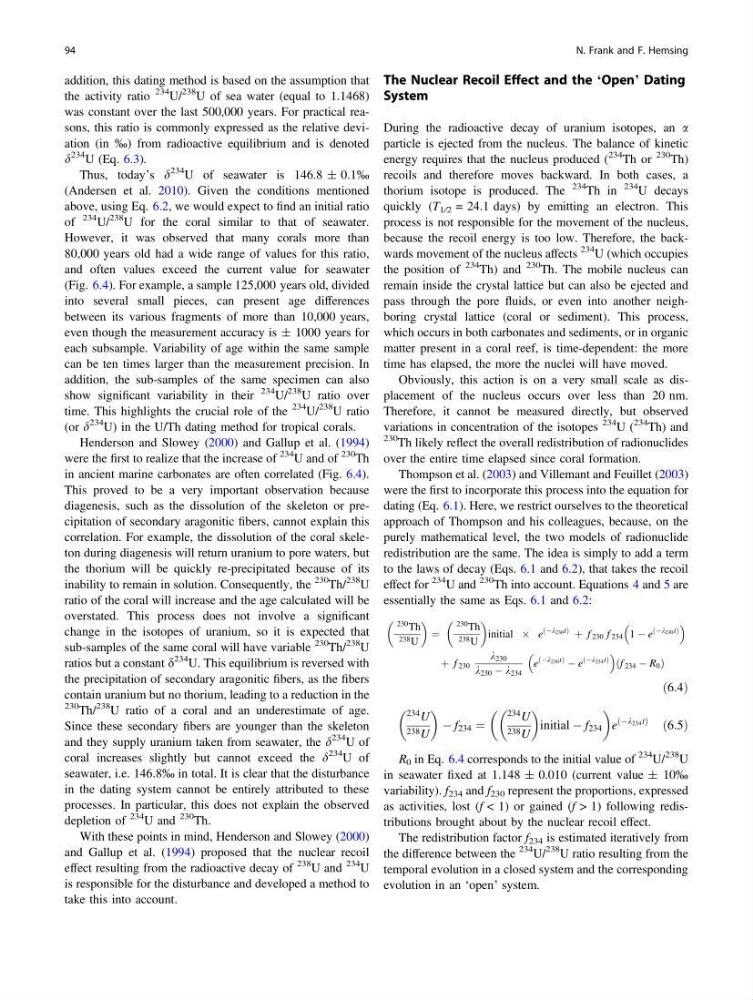
230 Th into account. Equations 4 and 5 are
essentially the same as Eqs. 6.1 and 6.2:
230 Th
238 U
¼
230 Th
238 U
initial  e
Àk230t
ð
Þ þ f 230 f 234 1 À e
Àk230t
ð
Þ
þ f 230
k 230
k 230 À k 234
e
Àk230t
ð
Þ À e
Àk234t
ð
Þ
f 234 À R 0
ð
Þ
ð6:4Þ
234 U
238 U
À f 234 ¼
234 U
238 U
initial À f 234
e
Àk 234 t
ð
Þ
ð6:5Þ
R 0 in Eq. 6.4 corresponds to the initial value of
234 U/
238
U
in seawater fixed at 1.148 ± 0.010 (current value ± 10‰
variability). f 234 and f 230 represent the proportions, expressed
as activities, lost (f < 1) or gained (f > 1) following redistributions brought about by the nuclear recoil effect.
The redistribution factor f 234 is estimated iteratively from
the difference between the
234 U/
238 U ratio resulting from the
temporal evolution in a closed system and the corresponding
evolution in an ‘open’ system.
94
N. Frank and F. Hemsing
the activity ratio
234 U/
238 U of sea water (equal to 1.1468)
was constant over the last 500,000 years. For practical reasons, this ratio is commonly expressed as the relative deviation (in ‰) from radioactive equilibrium and is denoted
d
234 U (Eq. 6.3).
Thus, today’s d
234 U of seawater is 146.8 ± 0.1‰
(Andersen et al. 2010). Given the conditions mentioned
above, using Eq. 6.2, we would expect to find an initial ratio
of
234 U/
238 U for the coral similar to that of seawater.
However, it was observed that many corals more than
80,000 years old had a wide range of values for this ratio,
and often values exceed the current value for seawater
(Fig. 6.4). For example, a sample 125,000 years old, divided
into several small pieces, can present age differences
between its various fragments of more than 10,000 years,
even though the measurement accuracy is ± 1000 years for
each subsample. Variability of age within the same sample
can be ten times larger than the measurement precision. In
addition, the sub-samples of the same specimen can also
show significant variability in their
234 U/
238 U ratio over
time. This highlights the crucial role of the
234 U/
238
U ratio
(or d
234 U) in the U/Th dating method for tropical corals.
Henderson and Slowey (2000) and Gallup et al. (1994)
were the first to realize that the increase of
234 U and of
230 Th
in ancient marine carbonates are often correlated (Fig. 6.4).
This proved to be a very important observation because
diagenesis, such as the dissolution of the skeleton or precipitation of secondary aragonitic fibers, cannot explain this
correlation. For example, the dissolution of the coral skeleton during diagenesis will return uranium to pore waters, but
the thorium will be quickly re-precipitated because of its
inability to remain in solution. Consequently, the
230
Th/
238
U
ratio of the coral will increase and the age calculated will be
overstated. This process does not involve a significant
change in the isotopes of uranium, so it is expected that
sub-samples of the same coral will have variable
230
Th/
238
U
ratios but a constant d
234 U. This equilibrium is reversed with
the precipitation of secondary aragonitic fibers, as the fibers
contain uranium but no thorium, leading to a reduction in the
230 Th/
238 U ratio of a coral and an underestimate of age.
Since these secondary fibers are younger than the skeleton
and they supply uranium taken from seawater, the d
234 U of
coral increases slightly but cannot exceed the d
234 U of
seawater, i.e. 146.8‰ in total. It is clear that the disturbance
in the dating system cannot be entirely attributed to these
processes. In particular, this does not explain the observed
depletion of
234 U and
230 Th.
With these points in mind, Henderson and Slowey (2000)
and Gallup et al. (1994) proposed that the nuclear recoil
effect resulting from the radioactive decay of
238 U and
234
U
is responsible for the disturbance and developed a method to
take this into account.
The Nuclear Recoil Effect and the ‘Open’ Dating
System
During the radioactive decay of uranium isotopes, an a
particle is ejected from the nucleus. The balance of kinetic
energy requires that the nucleus produced (
234 Th or
230 Th)
recoils and therefore moves backward. In both cases, a
thorium isotope is produced. The
234
Th in
234
U decays
quickly (T 1/2 = 24.1 days) by emitting an electron. This
process is not responsible for the movement of the nucleus,
because the recoil energy is too low. Therefore, the backwards movement of the nucleus affects
234
U (which occupies
the position of
234 Th) and
230 Th. The mobile nucleus can
remain inside the crystal lattice but can also be ejected and
pass through the pore fluids, or even into another neighboring crystal lattice (coral or sediment). This process,
which occurs in both carbonates and sediments, or in organic
matter present in a coral reef, is time-dependent: the more
time has elapsed, the more the nuclei will have moved.
Obviously, this action is on a very small scale as displacement of the nucleus occurs over less than 20 nm.
Therefore, it cannot be measured directly, but observed
variations in concentration of the isotopes
234 U (
234 Th) and
230 Th likely reflect the overall redistribution of radionuclides
over the entire time elapsed since coral formation.
Thompson et al. (2003) and Villemant and Feuillet (2003)
were the first to incorporate this process into the equation for
dating (Eq. 6.1). Here, we restrict ourselves to the theoretical
approach of Thompson and his colleagues, because, on the
purely mathematical level, the two models of radionuclide
redistribution are the same. The idea is simply to add a term
to the laws of decay (Eqs. 6.1 and 6.2), that takes the recoil
effect for
234 U and
230 Th into account. Equations 4 and 5 are
essentially the same as Eqs. 6.1 and 6.2:
230 Th
238 U
¼
230 Th
238 U
initial  e
Àk230t
ð
Þ þ f 230 f 234 1 À e
Àk230t
ð
Þ
þ f 230
k 230
k 230 À k 234
e
Àk230t
ð
Þ À e
Àk234t
ð
Þ
f 234 À R 0
ð
Þ
ð6:4Þ
234 U
238 U
À f 234 ¼
234 U
238 U
initial À f 234
e
Àk 234 t
ð
Þ
ð6:5Þ
R 0 in Eq. 6.4 corresponds to the initial value of
234 U/
238
U
in seawater fixed at 1.148 ± 0.010 (current value ± 10‰
variability). f 234 and f 230 represent the proportions, expressed
as activities, lost (f < 1) or gained (f > 1) following redistributions brought about by the nuclear recoil effect.
The redistribution factor f 234 is estimated iteratively from
the difference between the
234 U/
238 U ratio resulting from the
temporal evolution in a closed system and the corresponding
evolution in an ‘open’ system.
94
N. Frank and F. Hemsing