

3 N nitric acid (10 column volumes), then uranium and thorium are extracted with hydrochloric acid at different molarities (9–1 N) Douville et al (2010). This technique of
chemical separation can be used to purify the uranium and
thorium of any other component of the coral with an
approximated yield of 100%. The entire chemical procedure
can be done in approximately two days for about fifteen
samples. For physical measurements, a similar time is
required using the most effective tools, such as the
MC-ICPMS described below. More recently it has become
feasible to extract and purify uranium and thorium using
automated extraction systems Wefing et al. (2017), but currently these tools remain the exception in the chemical
preparation for U/Th dating. Lastly, the use of laser ablation
systems has allowed for the direct extraction of material from
samples, which are carried with a gas stream to the source of a
mass spectrometer to detect the abundance of uranium and
thorium isotopes. However, those techniques allow for
rapid-age screening, but remain insufficiently precise for high
precision age determination (Spooner et al. 2016).
Physical Measurement by Mass Spectrometry
After chemical purification, the fractions of uranium and
thorium are deposited on a pure rhenium filament if analysis is
performed on a mass spectrometer with a thermal source. For
inductively coupled plasma mass spectrometry, the final
solutions are diluted so that each sample has a similar concentration. The uranium and thorium atoms are ionized in the
source of a mass spectrometer. Formerly thermal ionization of
a solid sample from a heated filament was performed in
thermal ionization mass spectrometry (TIMS) at temperatures
of up to 1650 to 1800 °C. Most recent generations of mass
spectrometers (MC-ICPMS) have substantially improved the
ionization yield and hence the analytical accuracy due to their
detection of the ions by simultaneous multi-collection and due
to ionization temperatures in an Ar plasma of up to 8000 °C.
Ions are accelerated by a high voltage and subsequently
energy-filtered in an electrostatic filter and deflected by a
magnet according to their mass to charge ratio. The ions are
ultimately collected in a multi-collection system composed of
several faraday cups and electron multipliers. With the advent
of novel ultra-high resistances, faraday cups become available
for low ion intensities otherwise typically measured on electron multipliers. The MC-ICPMS technology now makes it
possible to determine isotopic ratios of uranium with an
accuracy of less than 1‰, and of thorium with an accuracy
of ± 1‰. This progress has resulted in a U/Th dating with a
much higher analytical precision and accuracy than that
obtained by TIMS.
Measurement routines using these complex instruments
vary and require rigorous data processing. Data processing
must, among other things, correct for the effects of mass
fractionation related to the measurement, perform
comparisons between standards and samples, and consider
the impact of background noise from the instruments and
from the chemical process (chemical blanks) on the measurements. Uranium standards, HU1 or NBL 112, with
known isotopic ratios, are generally used to determine the
reproducibility of physical measurements.
Overall, cutting edge mass spectrometry can achieve a
dating with a higher precision than 100 years on corals of
around 100,000 years. This possibility remains, however,
theoretical due to the fact that the error on the final age not
only depends on the quality of the physical measurement,
but also, and above all, on the sample quality.
Once the isotopic ratios are measured, Eqs. 6.1 and 6.2
shown above are used to estimate the age of the coral and its
initial
234 U/
238 U ratio.
Limitations of the Method
Theoretically, the accuracy of U/Th dating is determined by
the precision of the measurements by mass spectrometry of
the isotopic ratios
230 Th/
238 U and
234 U/
238 U. For this, it is
assumed that the coral being studied was perfectly preserved
and that the basic conditions mentioned above were
respected. Therefore, the assumptions are that only uranium
was incorporated into the aragonite skeleton at the time of its
formation, that the system remained closed to any exchange
of uranium and thorium with the sedimentary environment
after the formation of aragonite, and finally, that the coral
skeleton contained no
230 Th at the time of its formation. In
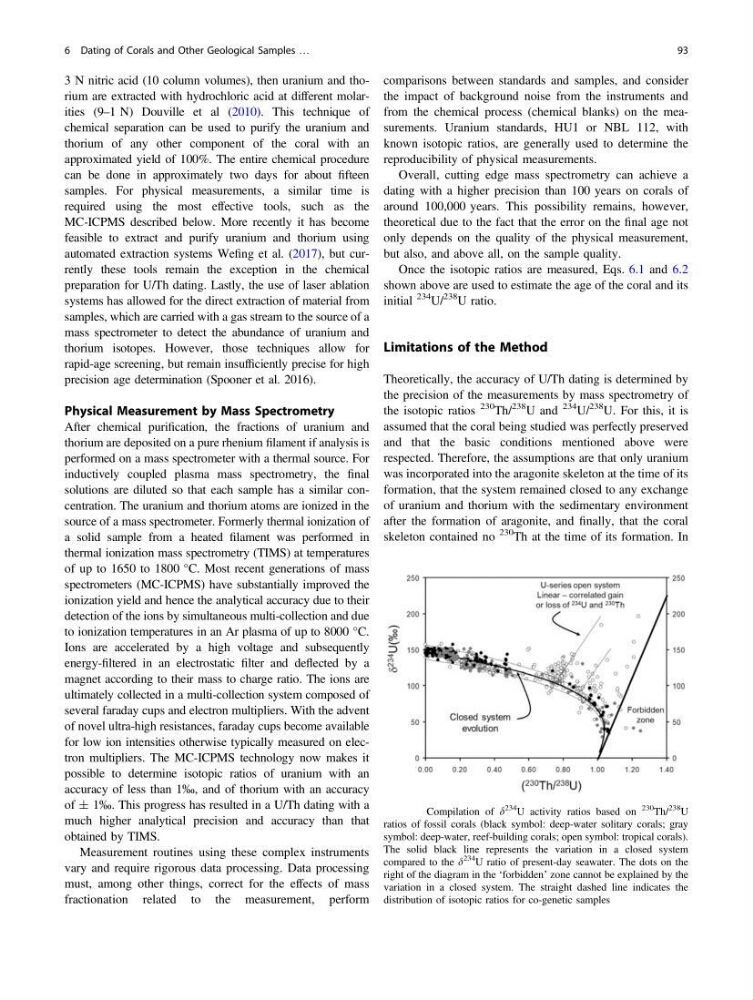
Fig. 6.4 Compilation of d
234 U activity ratios based on
230
Th/
238
U
ratios of fossil corals (black symbol: deep-water solitary corals; gray
symbol: deep-water, reef-building corals; open symbol: tropical corals).
The solid black line represents the variation in a closed system
compared to the d
234
U ratio of present-day seawater. The dots on the
right of the diagram in the ‘forbidden’ zone cannot be explained by the
variation in a closed system. The straight dashed line indicates the
distribution of isotopic ratios for co-genetic samples
6 Dating of Corals and Other Geological Samples …
93
chemical separation can be used to purify the uranium and
thorium of any other component of the coral with an
approximated yield of 100%. The entire chemical procedure
can be done in approximately two days for about fifteen
samples. For physical measurements, a similar time is
required using the most effective tools, such as the
MC-ICPMS described below. More recently it has become
feasible to extract and purify uranium and thorium using
automated extraction systems Wefing et al. (2017), but currently these tools remain the exception in the chemical
preparation for U/Th dating. Lastly, the use of laser ablation
systems has allowed for the direct extraction of material from
samples, which are carried with a gas stream to the source of a
mass spectrometer to detect the abundance of uranium and
thorium isotopes. However, those techniques allow for
rapid-age screening, but remain insufficiently precise for high
precision age determination (Spooner et al. 2016).
Physical Measurement by Mass Spectrometry
After chemical purification, the fractions of uranium and
thorium are deposited on a pure rhenium filament if analysis is
performed on a mass spectrometer with a thermal source. For
inductively coupled plasma mass spectrometry, the final
solutions are diluted so that each sample has a similar concentration. The uranium and thorium atoms are ionized in the
source of a mass spectrometer. Formerly thermal ionization of
a solid sample from a heated filament was performed in
thermal ionization mass spectrometry (TIMS) at temperatures
of up to 1650 to 1800 °C. Most recent generations of mass
spectrometers (MC-ICPMS) have substantially improved the
ionization yield and hence the analytical accuracy due to their
detection of the ions by simultaneous multi-collection and due
to ionization temperatures in an Ar plasma of up to 8000 °C.
Ions are accelerated by a high voltage and subsequently
energy-filtered in an electrostatic filter and deflected by a
magnet according to their mass to charge ratio. The ions are
ultimately collected in a multi-collection system composed of
several faraday cups and electron multipliers. With the advent
of novel ultra-high resistances, faraday cups become available
for low ion intensities otherwise typically measured on electron multipliers. The MC-ICPMS technology now makes it
possible to determine isotopic ratios of uranium with an
accuracy of less than 1‰, and of thorium with an accuracy
of ± 1‰. This progress has resulted in a U/Th dating with a
much higher analytical precision and accuracy than that
obtained by TIMS.
Measurement routines using these complex instruments
vary and require rigorous data processing. Data processing
must, among other things, correct for the effects of mass
fractionation related to the measurement, perform
comparisons between standards and samples, and consider
the impact of background noise from the instruments and
from the chemical process (chemical blanks) on the measurements. Uranium standards, HU1 or NBL 112, with
known isotopic ratios, are generally used to determine the
reproducibility of physical measurements.
Overall, cutting edge mass spectrometry can achieve a
dating with a higher precision than 100 years on corals of
around 100,000 years. This possibility remains, however,
theoretical due to the fact that the error on the final age not
only depends on the quality of the physical measurement,
but also, and above all, on the sample quality.
Once the isotopic ratios are measured, Eqs. 6.1 and 6.2
shown above are used to estimate the age of the coral and its
initial
234 U/
238 U ratio.
Limitations of the Method
Theoretically, the accuracy of U/Th dating is determined by
the precision of the measurements by mass spectrometry of
the isotopic ratios
230 Th/
238 U and
234 U/
238 U. For this, it is
assumed that the coral being studied was perfectly preserved
and that the basic conditions mentioned above were
respected. Therefore, the assumptions are that only uranium
was incorporated into the aragonite skeleton at the time of its
formation, that the system remained closed to any exchange
of uranium and thorium with the sedimentary environment
after the formation of aragonite, and finally, that the coral
skeleton contained no
230 Th at the time of its formation. In
Fig. 6.4 Compilation of d
234 U activity ratios based on
230
Th/
238
U
ratios of fossil corals (black symbol: deep-water solitary corals; gray
symbol: deep-water, reef-building corals; open symbol: tropical corals).
The solid black line represents the variation in a closed system
compared to the d
234
U ratio of present-day seawater. The dots on the
right of the diagram in the ‘forbidden’ zone cannot be explained by the
variation in a closed system. The straight dashed line indicates the
distribution of isotopic ratios for co-genetic samples
6 Dating of Corals and Other Geological Samples …
93