

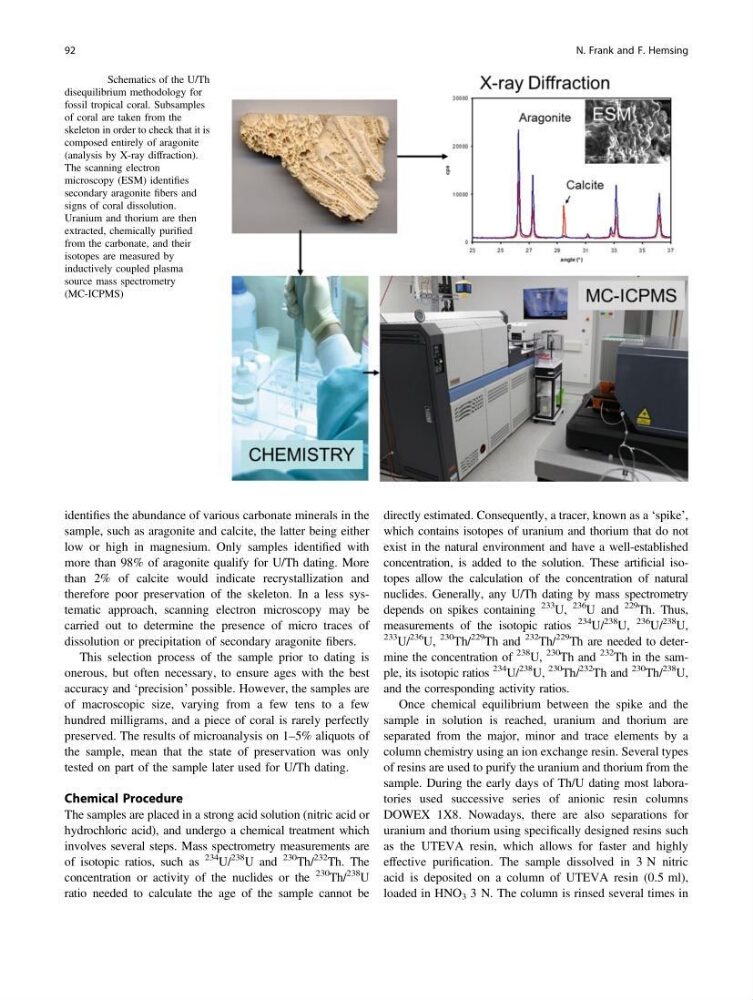
identifies the abundance of various carbonate minerals in the
sample, such as aragonite and calcite, the latter being either
low or high in magnesium. Only samples identified with
more than 98% of aragonite qualify for U/Th dating. More
than 2% of calcite would indicate recrystallization and
therefore poor preservation of the skeleton. In a less systematic approach, scanning electron microscopy may be
carried out to determine the presence of micro traces of
dissolution or precipitation of secondary aragonite fibers.
This selection process of the sample prior to dating is
onerous, but often necessary, to ensure ages with the best
accuracy and ‘precision’ possible. However, the samples are
of macroscopic size, varying from a few tens to a few
hundred milligrams, and a piece of coral is rarely perfectly
preserved. The results of microanalysis on 1–5% aliquots of
the sample, mean that the state of preservation was only
tested on part of the sample later used for U/Th dating.
Chemical Procedure
The samples are placed in a strong acid solution (nitric acid or
hydrochloric acid), and undergo a chemical treatment which
involves several steps. Mass spectrometry measurements are
of isotopic ratios, such as
234
U/
238
U and
230
Th/
232
Th. The
concentration or activity of the nuclides or the
230
Th/
238
U
ratio needed to calculate the age of the sample cannot be
directly estimated. Consequently, a tracer, known as a ‘spike’,
which contains isotopes of uranium and thorium that do not
exist in the natural environment and have a well-established
concentration, is added to the solution. These artificial isotopes allow the calculation of the concentration of natural
nuclides. Generally, any U/Th dating by mass spectrometry
depends on spikes containing
233
U,
236
U and
229
Th. Thus,
measurements of the isotopic ratios
234
U/
238
U,
236
U/
238
U,
233
U/
236
U,
230
Th/
229
Th and
232
Th/
229
Th are needed to determine the concentration of
238
U,
230
Th and
232
Th in the sample, its isotopic ratios
234
U/
238
U,
230
Th/
232
Th and
230
Th/
238
U,
and the corresponding activity ratios.
Once chemical equilibrium between the spike and the
sample in solution is reached, uranium and thorium are
separated from the major, minor and trace elements by a
column chemistry using an ion exchange resin. Several types
of resins are used to purify the uranium and thorium from the
sample. During the early days of Th/U dating most laboratories used successive series of anionic resin columns
DOWEX 1X8. Nowadays, there are also separations for
uranium and thorium using specifically designed resins such
as the UTEVA resin, which allows for faster and highly
effective purification. The sample dissolved in 3 N nitric
acid is deposited on a column of UTEVA resin (0.5 ml),
loaded in HNO 3 3 N. The column is rinsed several times in
Fig. 6.3 Schematics of the U/Th
disequilibrium methodology for
fossil tropical coral. Subsamples
of coral are taken from the
skeleton in order to check that it is
composed entirely of aragonite
(analysis by X-ray diffraction).
The scanning electron
microscopy (ESM) identifies
secondary aragonite fibers and
signs of coral dissolution.
Uranium and thorium are then
extracted, chemically purified
from the carbonate, and their
isotopes are measured by
inductively coupled plasma
source mass spectrometry
(MC-ICPMS)
92
N. Frank and F. Hemsing
sample, such as aragonite and calcite, the latter being either
low or high in magnesium. Only samples identified with
more than 98% of aragonite qualify for U/Th dating. More
than 2% of calcite would indicate recrystallization and
therefore poor preservation of the skeleton. In a less systematic approach, scanning electron microscopy may be
carried out to determine the presence of micro traces of
dissolution or precipitation of secondary aragonite fibers.
This selection process of the sample prior to dating is
onerous, but often necessary, to ensure ages with the best
accuracy and ‘precision’ possible. However, the samples are
of macroscopic size, varying from a few tens to a few
hundred milligrams, and a piece of coral is rarely perfectly
preserved. The results of microanalysis on 1–5% aliquots of
the sample, mean that the state of preservation was only
tested on part of the sample later used for U/Th dating.
Chemical Procedure
The samples are placed in a strong acid solution (nitric acid or
hydrochloric acid), and undergo a chemical treatment which
involves several steps. Mass spectrometry measurements are
of isotopic ratios, such as
234
U/
238
U and
230
Th/
232
Th. The
concentration or activity of the nuclides or the
230
Th/
238
U
ratio needed to calculate the age of the sample cannot be
directly estimated. Consequently, a tracer, known as a ‘spike’,
which contains isotopes of uranium and thorium that do not
exist in the natural environment and have a well-established
concentration, is added to the solution. These artificial isotopes allow the calculation of the concentration of natural
nuclides. Generally, any U/Th dating by mass spectrometry
depends on spikes containing
233
U,
236
U and
229
Th. Thus,
measurements of the isotopic ratios
234
U/
238
U,
236
U/
238
U,
233
U/
236
U,
230
Th/
229
Th and
232
Th/
229
Th are needed to determine the concentration of
238
U,
230
Th and
232
Th in the sample, its isotopic ratios
234
U/
238
U,
230
Th/
232
Th and
230
Th/
238
U,
and the corresponding activity ratios.
Once chemical equilibrium between the spike and the
sample in solution is reached, uranium and thorium are
separated from the major, minor and trace elements by a
column chemistry using an ion exchange resin. Several types
of resins are used to purify the uranium and thorium from the
sample. During the early days of Th/U dating most laboratories used successive series of anionic resin columns
DOWEX 1X8. Nowadays, there are also separations for
uranium and thorium using specifically designed resins such
as the UTEVA resin, which allows for faster and highly
effective purification. The sample dissolved in 3 N nitric
acid is deposited on a column of UTEVA resin (0.5 ml),
loaded in HNO 3 3 N. The column is rinsed several times in
Fig. 6.3 Schematics of the U/Th
disequilibrium methodology for
fossil tropical coral. Subsamples
of coral are taken from the
skeleton in order to check that it is
composed entirely of aragonite
(analysis by X-ray diffraction).
The scanning electron
microscopy (ESM) identifies
secondary aragonite fibers and
signs of coral dissolution.
Uranium and thorium are then
extracted, chemically purified
from the carbonate, and their
isotopes are measured by
inductively coupled plasma
source mass spectrometry
(MC-ICPMS)
92
N. Frank and F. Hemsing