

For the method to be applicable, two basic conditions
need to hold:
1. During the formation of the aragonitic skeleton, only
uranium is incorporated, and therefore
230 Th is absent.
2. The system remains closed to any exchange of uranium
and thorium with the sedimentary environment after the
aragonite is formed.
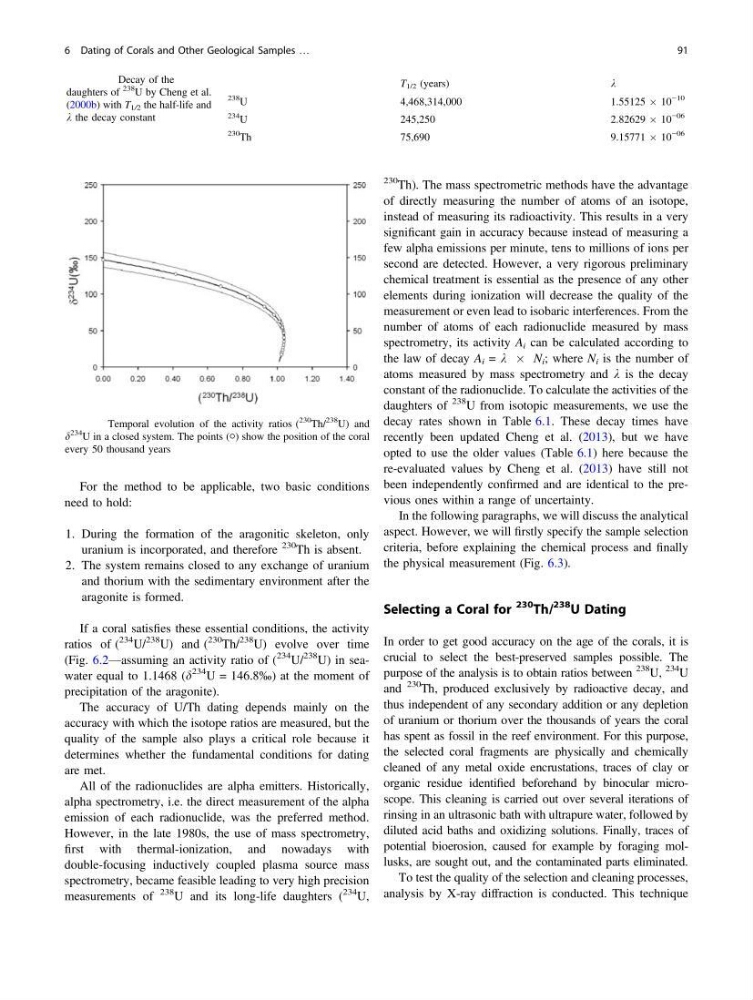
If a coral satisfies these essential conditions, the activity
ratios of (
234 U/
238 U) and (
230
Th/
238
U) evolve over time
(Fig. 6.2—assuming an activity ratio of (
234 U/
238 U) in seawater equal to 1.1468 (d
234 U = 146.8‰) at the moment of
precipitation of the aragonite).
The accuracy of U/Th dating depends mainly on the
accuracy with which the isotope ratios are measured, but the
quality of the sample also plays a critical role because it
determines whether the fundamental conditions for dating
are met.
All of the radionuclides are alpha emitters. Historically,
alpha spectrometry, i.e. the direct measurement of the alpha
emission of each radionuclide, was the preferred method.
However, in the late 1980s, the use of mass spectrometry,
first with thermal-ionization, and nowadays with
double-focusing inductively coupled plasma source mass
spectrometry, became feasible leading to very high precision
measurements of
238 U and its long-life daughters (
234
U,
230 Th). The mass spectrometric methods have the advantage
of directly measuring the number of atoms of an isotope,
instead of measuring its radioactivity. This results in a very
significant gain in accuracy because instead of measuring a
few alpha emissions per minute, tens to millions of ions per
second are detected. However, a very rigorous preliminary
chemical treatment is essential as the presence of any other
elements during ionization will decrease the quality of the
measurement or even lead to isobaric interferences. From the
number of atoms of each radionuclide measured by mass
spectrometry, its activity A i can be calculated according to
the law of decay A i = k  N i ; where N i is the number of
atoms measured by mass spectrometry and k is the decay
constant of the radionuclide. To calculate the activities of the
daughters of
238 U from isotopic measurements, we use the
decay rates shown in Table 6.1. These decay times have
recently been updated Cheng et al. (2013), but we have
opted to use the older values (Table 6.1) here because the
re-evaluated values by Cheng et al. (2013) have still not
been independently confirmed and are identical to the previous ones within a range of uncertainty.
In the following paragraphs, we will discuss the analytical
aspect. However, we will firstly specify the sample selection
criteria, before explaining the chemical process and finally
the physical measurement (Fig. 6.3).
Selecting a Coral for
230 Th/
238
U Dating
In order to get good accuracy on the age of the corals, it is
crucial to select the best-preserved samples possible. The
purpose of the analysis is to obtain ratios between
238
U,
234
U
and
230
Th, produced exclusively by radioactive decay, and
thus independent of any secondary addition or any depletion
of uranium or thorium over the thousands of years the coral
has spent as fossil in the reef environment. For this purpose,
the selected coral fragments are physically and chemically
cleaned of any metal oxide encrustations, traces of clay or
organic residue identified beforehand by binocular microscope. This cleaning is carried out over several iterations of
rinsing in an ultrasonic bath with ultrapure water, followed by
diluted acid baths and oxidizing solutions. Finally, traces of
potential bioerosion, caused for example by foraging mollusks, are sought out, and the contaminated parts eliminated.
To test the quality of the selection and cleaning processes,
analysis by X-ray diffraction is conducted. This technique
Table 6.1 Decay of the
daughters of
238
U by Cheng et al.
(2000b) with T 1/2 the half-life and
k the decay constant
T 1/2 (years)
k
238
U
4,468,314,000
1.55125 Â 10
−10
234
U
245,250
2.82629 Â 10
−06
230
Th
75,690
9.15771 Â 10
−06
Fig. 6.2 Temporal evolution of the activity ratios (
230
Th/
238
U) and
d
234
U in a closed system. The points (◦) show the position of the coral
every 50 thousand years
6 Dating of Corals and Other Geological Samples …
91
need to hold:
1. During the formation of the aragonitic skeleton, only
uranium is incorporated, and therefore
230 Th is absent.
2. The system remains closed to any exchange of uranium
and thorium with the sedimentary environment after the
aragonite is formed.
If a coral satisfies these essential conditions, the activity
ratios of (
234 U/
238 U) and (
230
Th/
238
U) evolve over time
(Fig. 6.2—assuming an activity ratio of (
234 U/
238 U) in seawater equal to 1.1468 (d
234 U = 146.8‰) at the moment of
precipitation of the aragonite).
The accuracy of U/Th dating depends mainly on the
accuracy with which the isotope ratios are measured, but the
quality of the sample also plays a critical role because it
determines whether the fundamental conditions for dating
are met.
All of the radionuclides are alpha emitters. Historically,
alpha spectrometry, i.e. the direct measurement of the alpha
emission of each radionuclide, was the preferred method.
However, in the late 1980s, the use of mass spectrometry,
first with thermal-ionization, and nowadays with
double-focusing inductively coupled plasma source mass
spectrometry, became feasible leading to very high precision
measurements of
238 U and its long-life daughters (
234
U,
230 Th). The mass spectrometric methods have the advantage
of directly measuring the number of atoms of an isotope,
instead of measuring its radioactivity. This results in a very
significant gain in accuracy because instead of measuring a
few alpha emissions per minute, tens to millions of ions per
second are detected. However, a very rigorous preliminary
chemical treatment is essential as the presence of any other
elements during ionization will decrease the quality of the
measurement or even lead to isobaric interferences. From the
number of atoms of each radionuclide measured by mass
spectrometry, its activity A i can be calculated according to
the law of decay A i = k  N i ; where N i is the number of
atoms measured by mass spectrometry and k is the decay
constant of the radionuclide. To calculate the activities of the
daughters of
238 U from isotopic measurements, we use the
decay rates shown in Table 6.1. These decay times have
recently been updated Cheng et al. (2013), but we have
opted to use the older values (Table 6.1) here because the
re-evaluated values by Cheng et al. (2013) have still not
been independently confirmed and are identical to the previous ones within a range of uncertainty.
In the following paragraphs, we will discuss the analytical
aspect. However, we will firstly specify the sample selection
criteria, before explaining the chemical process and finally
the physical measurement (Fig. 6.3).
Selecting a Coral for
230 Th/
238
U Dating
In order to get good accuracy on the age of the corals, it is
crucial to select the best-preserved samples possible. The
purpose of the analysis is to obtain ratios between
238
U,
234
U
and
230
Th, produced exclusively by radioactive decay, and
thus independent of any secondary addition or any depletion
of uranium or thorium over the thousands of years the coral
has spent as fossil in the reef environment. For this purpose,
the selected coral fragments are physically and chemically
cleaned of any metal oxide encrustations, traces of clay or
organic residue identified beforehand by binocular microscope. This cleaning is carried out over several iterations of
rinsing in an ultrasonic bath with ultrapure water, followed by
diluted acid baths and oxidizing solutions. Finally, traces of
potential bioerosion, caused for example by foraging mollusks, are sought out, and the contaminated parts eliminated.
To test the quality of the selection and cleaning processes,
analysis by X-ray diffraction is conducted. This technique
Table 6.1 Decay of the
daughters of
238
U by Cheng et al.
(2000b) with T 1/2 the half-life and
k the decay constant
T 1/2 (years)
k
238
U
4,468,314,000
1.55125 Â 10
−10
234
U
245,250
2.82629 Â 10
−06
230
Th
75,690
9.15771 Â 10
−06
Fig. 6.2 Temporal evolution of the activity ratios (
230
Th/
238
U) and
d
234
U in a closed system. The points (◦) show the position of the coral
every 50 thousand years
6 Dating of Corals and Other Geological Samples …
91