

allows the dating range to be extended from a few years to a
few hundred thousand years (>500,000 years). As a result,
U/Th dating has now become an indispensable tool for
precision geochronology and research on the environmental
and climate changes in the late Quaternary.
Undoubtedly, one of the greatest successes of this
chronometer is the precise reconstruction of sea levels
throughout the climate cycles from growth series of corals
(Thompson and Goldstein 2006). This geochronological
technique also permits the determination of subsidence or
elevation of reefs caused by tectonic movements over time
(Frank et al. 2006). Significant progress has also been made
on the calibration of
14 C ages by combined
230 Th/U and
14 C
analysis (Reimer et al. 2013).
Over the past decade, it has become clear that the mineral
system of a coral is not a completely closed system but
sometimes uranium and thorium exchanges with its sedimentary environment occur. This conclusion was reached
from the observation that uranium
234 U and
230 Th are often
in excess of the theoretical levels of the activity ratios
(
234 U/
238 U and
230 Th/
238 U) that would be expected from
radioactive decay. These inconsistencies are the result of
recrystallization, early diagenesis, and radioactive decay of
uranium. This makes the dating less precise than the analysis
might indicate and makes it necessary to apply corrections to
the estimated ages.
In light of these observations, correction models, categorized as ‘open’ system models were developed which take
account of the influence of such disturbances on tropical
corals. (Scholz et al. 2004, Szabo et al. 1994)
The focus of this chapter is to explore the dating of
tropical corals and other carbonate climate archives using the
U/Th method including open-system models, but excluding
microstructure and biomineralization. We will examine the
methodology in detail including the relevance of the open
system and also some applications to geology and
paleoclimatology.
This principle of dating by radioactive disequilibrium in the
decay chain of uranium applies to many sources of climate
records, such as deep-water corals, mollusk shells, and secondary carbonate precipitations on land (stalagmites and
travertine). In each case, the formation process of these minerals favors the incorporation of uranium over its radioactive
daughters. However, each mineral deposit has its own characteristics with regard to the incorporation of uranium and
thorium and open system behavior Cheng et al. (2000a),
Mallick and Frank (2002). Here, we will focus on one particular archive: tropical corals. At the end of the chapter, the
possibility of dating other geological samples through uranium
series disequilibrium will be analyzed briefly.
Methodology of
230
Th/
238 U Dating
Principle of
230
Th/
238
U Dating
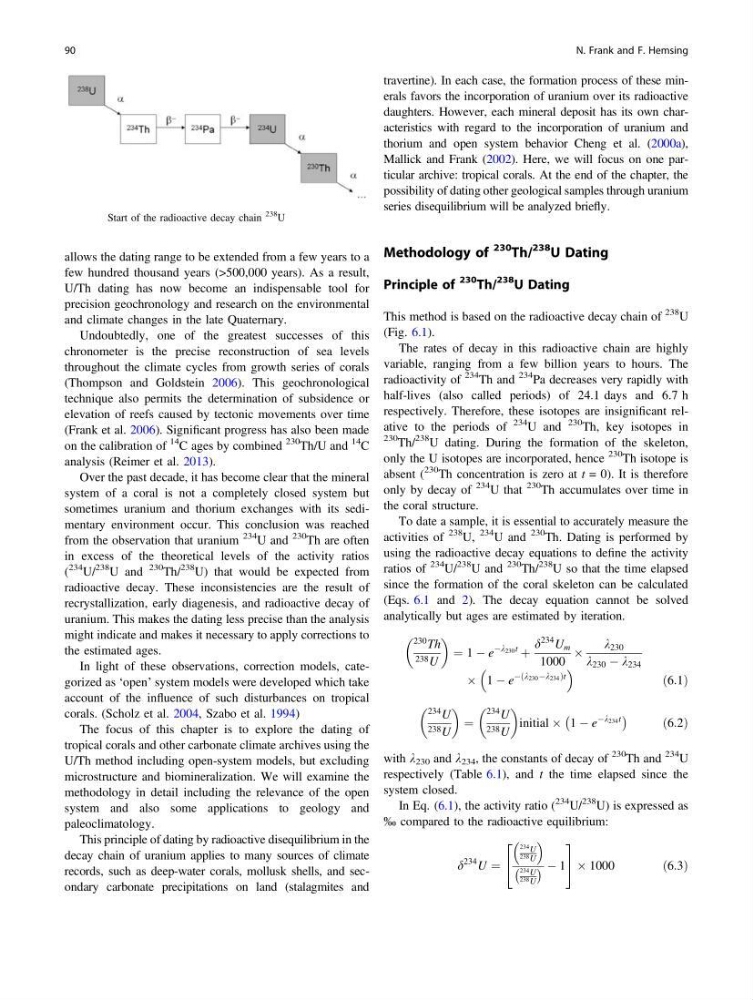
This method is based on the radioactive decay chain of
238
U
(Fig. 6.1).
The rates of decay in this radioactive chain are highly
variable, ranging from a few billion years to hours. The
radioactivity of
234 Th and
234 Pa decreases very rapidly with
half-lives (also called periods) of 24.1 days and 6.7 h
respectively. Therefore, these isotopes are insignificant relative to the periods of
234 U and
230 Th, key isotopes in
230 Th/
238 U dating. During the formation of the skeleton,
only the U isotopes are incorporated, hence
230 Th isotope is
absent (
230 Th concentration is zero at t = 0). It is therefore
only by decay of
234 U that
230 Th accumulates over time in
the coral structure.
To date a sample, it is essential to accurately measure the
activities of
238 U,
234 U and
230 Th. Dating is performed by
using the radioactive decay equations to define the activity
ratios of
234 U/
238 U and
230 Th/
238 U so that the time elapsed
since the formation of the coral skeleton can be calculated
(Eqs. 6.1 and 2). The decay equation cannot be solved
analytically but ages are estimated by iteration.
230 Th
238 U
¼ 1 À e
Àk 230 t
þ
d
234 U m
1000
Â
k 230
k 230 À k 234
 1 À e
À k 230 Àk 234
ð
Þ t
ð6:1Þ
234 U
238 U
¼
234 U
238 U
initial  1 À e
Àk 234 t
À
Á
ð6:2Þ
with k 230 and k 234 , the constants of decay of
230
Th and
234
U
respectively (Table 6.1), and t the time elapsed since the
system closed.
In Eq. (6.1), the activity ratio (
234 U/
238 U) is expressed as
‰ compared to the radioactive equilibrium:
d
234 U ¼
234 U
238 U
234 U
238 U
À Á À 1
2
4
3
5 Â 1000
ð6:3Þ
Fig. 6.1 Start of the radioactive decay chain
238
U
90
N. Frank and F. Hemsing
few hundred thousand years (>500,000 years). As a result,
U/Th dating has now become an indispensable tool for
precision geochronology and research on the environmental
and climate changes in the late Quaternary.
Undoubtedly, one of the greatest successes of this
chronometer is the precise reconstruction of sea levels
throughout the climate cycles from growth series of corals
(Thompson and Goldstein 2006). This geochronological
technique also permits the determination of subsidence or
elevation of reefs caused by tectonic movements over time
(Frank et al. 2006). Significant progress has also been made
on the calibration of
14 C ages by combined
230 Th/U and
14 C
analysis (Reimer et al. 2013).
Over the past decade, it has become clear that the mineral
system of a coral is not a completely closed system but
sometimes uranium and thorium exchanges with its sedimentary environment occur. This conclusion was reached
from the observation that uranium
234 U and
230 Th are often
in excess of the theoretical levels of the activity ratios
(
234 U/
238 U and
230 Th/
238 U) that would be expected from
radioactive decay. These inconsistencies are the result of
recrystallization, early diagenesis, and radioactive decay of
uranium. This makes the dating less precise than the analysis
might indicate and makes it necessary to apply corrections to
the estimated ages.
In light of these observations, correction models, categorized as ‘open’ system models were developed which take
account of the influence of such disturbances on tropical
corals. (Scholz et al. 2004, Szabo et al. 1994)
The focus of this chapter is to explore the dating of
tropical corals and other carbonate climate archives using the
U/Th method including open-system models, but excluding
microstructure and biomineralization. We will examine the
methodology in detail including the relevance of the open
system and also some applications to geology and
paleoclimatology.
This principle of dating by radioactive disequilibrium in the
decay chain of uranium applies to many sources of climate
records, such as deep-water corals, mollusk shells, and secondary carbonate precipitations on land (stalagmites and
travertine). In each case, the formation process of these minerals favors the incorporation of uranium over its radioactive
daughters. However, each mineral deposit has its own characteristics with regard to the incorporation of uranium and
thorium and open system behavior Cheng et al. (2000a),
Mallick and Frank (2002). Here, we will focus on one particular archive: tropical corals. At the end of the chapter, the
possibility of dating other geological samples through uranium
series disequilibrium will be analyzed briefly.
Methodology of
230
Th/
238 U Dating
Principle of
230
Th/
238
U Dating
This method is based on the radioactive decay chain of
238
U
(Fig. 6.1).
The rates of decay in this radioactive chain are highly
variable, ranging from a few billion years to hours. The
radioactivity of
234 Th and
234 Pa decreases very rapidly with
half-lives (also called periods) of 24.1 days and 6.7 h
respectively. Therefore, these isotopes are insignificant relative to the periods of
234 U and
230 Th, key isotopes in
230 Th/
238 U dating. During the formation of the skeleton,
only the U isotopes are incorporated, hence
230 Th isotope is
absent (
230 Th concentration is zero at t = 0). It is therefore
only by decay of
234 U that
230 Th accumulates over time in
the coral structure.
To date a sample, it is essential to accurately measure the
activities of
238 U,
234 U and
230 Th. Dating is performed by
using the radioactive decay equations to define the activity
ratios of
234 U/
238 U and
230 Th/
238 U so that the time elapsed
since the formation of the coral skeleton can be calculated
(Eqs. 6.1 and 2). The decay equation cannot be solved
analytically but ages are estimated by iteration.
230 Th
238 U
¼ 1 À e
Àk 230 t
þ
d
234 U m
1000
Â
k 230
k 230 À k 234
 1 À e
À k 230 Àk 234
ð
Þ t
ð6:1Þ
234 U
238 U
¼
234 U
238 U
initial  1 À e
Àk 234 t
À
Á
ð6:2Þ
with k 230 and k 234 , the constants of decay of
230
Th and
234
U
respectively (Table 6.1), and t the time elapsed since the
system closed.
In Eq. (6.1), the activity ratio (
234 U/
238 U) is expressed as
‰ compared to the radioactive equilibrium:
d
234 U ¼
234 U
238 U
234 U
238 U
À Á À 1
2
4
3
5 Â 1000
ð6:3Þ
Fig. 6.1 Start of the radioactive decay chain
238
U
90
N. Frank and F. Hemsing