

In order to know the correction factor associated with the
production of
40 Ar from
40 K, a pure salt of K (K 2 SO 4 or KF)
is also irradiated. This allows the ratio (
40 Ar/
39 Ar) K to be
defined, which is then used to calculate the share of argon
40 Ar resulting from irradiation of
40 K, which will be cut
back from the total argon
40 Ar.
In summary, the masses corrected for interferences related
to radiation and to the atmospheric component can be written:
40
Ar
Ã
¼
40
Ar m À
40
Ar at þ
40
Ar K
À
Á
39
Ar ¼
39
Ar m À
39
Ar Ca
36
Ar ¼
36
Ar at À
36
Ar Ca
The Age Spectra
The
40 Ar/
39 Ar method allows for the collection of more
comprehensive information on the behavior of the
radioisotopic clock than the
40 K/
40 Ar method. In the
experimental approach known as ‘step-heating’ (Turner
et al. 1966), the sample is gradually heated in steps of
increasing temperature (for example, by steps of 60
◦ C). At
each step, the isotopic composition of argon in the extracted
and purified gas is measured by mass spectrometry. An
apparent age can thus be calculated for each step. In the end,
this results in an age spectrum. The general appearance of
these spectra shows whether the sample and, consequently,
the
40 K/
40 Ar clock, were disrupted or not.
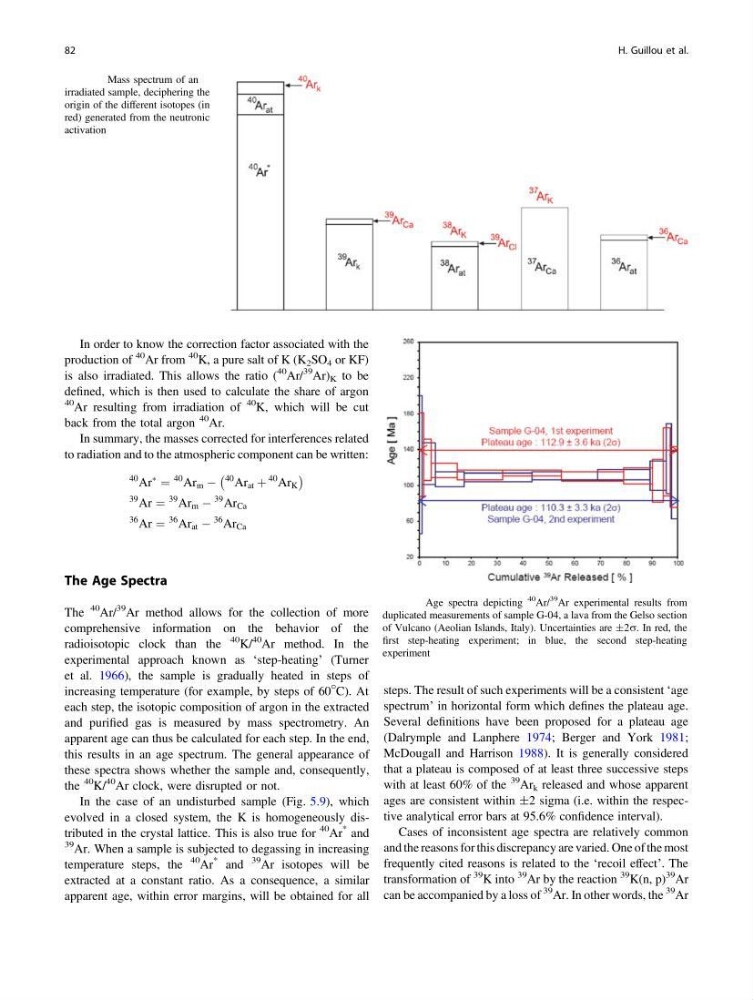
In the case of an undisturbed sample (Fig. 5.9), which
evolved in a closed system, the K is homogeneously distributed in the crystal lattice. This is also true for
40 Ar
* and
39 Ar. When a sample is subjected to degassing in increasing
temperature steps, the
40 Ar
* and
39 Ar isotopes will be
extracted at a constant ratio. As a consequence, a similar
apparent age, within error margins, will be obtained for all
steps. The result of such experiments will be a consistent ‘age
spectrum’ in horizontal form which defines the plateau age.
Several definitions have been proposed for a plateau age
(Dalrymple and Lanphere 1974; Berger and York 1981;
McDougall and Harrison 1988). It is generally considered
that a plateau is composed of at least three successive steps
with at least 60% of the
39 Ar k released and whose apparent
ages are consistent within ±2 sigma (i.e. within the respective analytical error bars at 95.6% confidence interval).
Cases of inconsistent age spectra are relatively common
and the reasons for this discrepancy are varied. One of the most
frequently cited reasons is related to the ‘recoil effect’. The
transformation of
39 K into
39 Ar by the reaction
39 K(n, p)
39 Ar
can be accompanied by a loss of
39 Ar. In other words, the
39 Ar
Fig. 5.8 Mass spectrum of an
irradiated sample, deciphering the
origin of the different isotopes (in
red) generated from the neutronic
activation
Fig. 5.9 Age spectra depicting
40
Ar/
39
Ar experimental results from
duplicated measurements of sample G-04, a lava from the Gelso section
of Vulcano (Aeolian Islands, Italy). Uncertainties are ±2r. In red, the
first step-heating experiment; in blue, the second step-heating
experiment
82
H. Guillou et al.
production of
40 Ar from
40 K, a pure salt of K (K 2 SO 4 or KF)
is also irradiated. This allows the ratio (
40 Ar/
39 Ar) K to be
defined, which is then used to calculate the share of argon
40 Ar resulting from irradiation of
40 K, which will be cut
back from the total argon
40 Ar.
In summary, the masses corrected for interferences related
to radiation and to the atmospheric component can be written:
40
Ar
Ã
¼
40
Ar m À
40
Ar at þ
40
Ar K
À
Á
39
Ar ¼
39
Ar m À
39
Ar Ca
36
Ar ¼
36
Ar at À
36
Ar Ca
The Age Spectra
The
40 Ar/
39 Ar method allows for the collection of more
comprehensive information on the behavior of the
radioisotopic clock than the
40 K/
40 Ar method. In the
experimental approach known as ‘step-heating’ (Turner
et al. 1966), the sample is gradually heated in steps of
increasing temperature (for example, by steps of 60
◦ C). At
each step, the isotopic composition of argon in the extracted
and purified gas is measured by mass spectrometry. An
apparent age can thus be calculated for each step. In the end,
this results in an age spectrum. The general appearance of
these spectra shows whether the sample and, consequently,
the
40 K/
40 Ar clock, were disrupted or not.
In the case of an undisturbed sample (Fig. 5.9), which
evolved in a closed system, the K is homogeneously distributed in the crystal lattice. This is also true for
40 Ar
* and
39 Ar. When a sample is subjected to degassing in increasing
temperature steps, the
40 Ar
* and
39 Ar isotopes will be
extracted at a constant ratio. As a consequence, a similar
apparent age, within error margins, will be obtained for all
steps. The result of such experiments will be a consistent ‘age
spectrum’ in horizontal form which defines the plateau age.
Several definitions have been proposed for a plateau age
(Dalrymple and Lanphere 1974; Berger and York 1981;
McDougall and Harrison 1988). It is generally considered
that a plateau is composed of at least three successive steps
with at least 60% of the
39 Ar k released and whose apparent
ages are consistent within ±2 sigma (i.e. within the respective analytical error bars at 95.6% confidence interval).
Cases of inconsistent age spectra are relatively common
and the reasons for this discrepancy are varied. One of the most
frequently cited reasons is related to the ‘recoil effect’. The
transformation of
39 K into
39 Ar by the reaction
39 K(n, p)
39 Ar
can be accompanied by a loss of
39 Ar. In other words, the
39 Ar
Fig. 5.8 Mass spectrum of an
irradiated sample, deciphering the
origin of the different isotopes (in
red) generated from the neutronic
activation
Fig. 5.9 Age spectra depicting
40
Ar/
39
Ar experimental results from
duplicated measurements of sample G-04, a lava from the Gelso section
of Vulcano (Aeolian Islands, Italy). Uncertainties are ±2r. In red, the
first step-heating experiment; in blue, the second step-heating
experiment
82
H. Guillou et al.