

atom can be founder-distributed, due to this reaction, in a
different crystallographic site than that occupied by its parent,
39 K. The distance of this backwards movement is proportional,
firstly, to the energy employed during the neutron activation,
and secondly, to the sample density. Thus, this recoil effect can
lead to a redistribution of
39 Ar K in the samples with grains of a
size less than 5–10 lm. This redistribution of
39 Ar K can cause
an over or underestimation of apparent ages at different temperature steps. The loss of
39 Ar K , related to the recoil effect, is
seen in an overestimation of the ages obtained.
Other natural phenomena are also the cause of inconsistent age spectra. Alteration, metamorphism, hydrothermalism are all processes that might disrupt the K/Ar clock.
These processes are the source of migration, loss or gain of
argon and potassium isotopes.
The Single Grain Method
Technological developments of recent decades (increasing
sensitivity of mass spectrometers, laser fusion system) make
it possible to work on samples of smaller and smaller size. It
is thus possible to get down to the level of the crystal. This
approach is used in particular for dating tephra. Within a
given tephra layer, several crystals of the same mineral type
are selected. After irradiation, each crystal is individually
melted by laser, the gas is extracted and it is then analyzed
by mass spectrometer. An age is obtained for each constituent crystal at the tephra level. It is thus possible to
establish spectra of age probability for a given tephra (Deino
and Potts 1992). The analysis of these spectra allows
homogeneity at the stratigraphic level to be estimated and
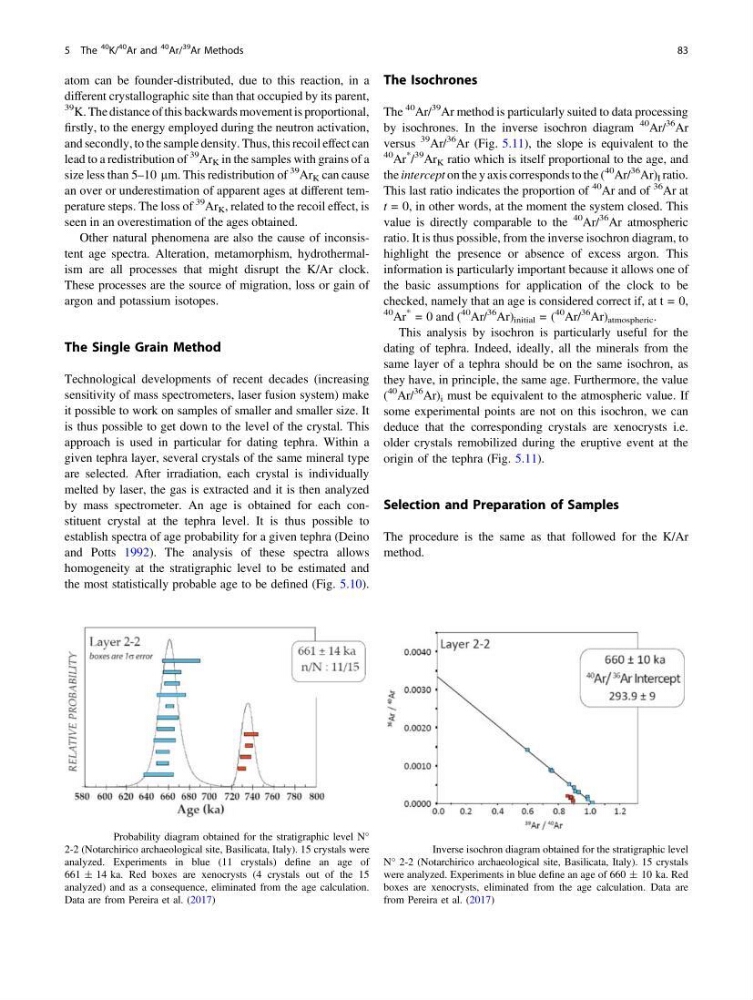
the most statistically probable age to be defined (Fig. 5.10).
The Isochrones
The
40 Ar/
39 Ar method is particularly suited to data processing
by isochrones. In the inverse isochron diagram
40 Ar/
36 Ar
versus
39 Ar/
36 Ar (Fig. 5.11), the slope is equivalent to the
40 Ar
* /
39 Ar K ratio which is itself proportional to the age, and
the intercept on the y axis corresponds to the (
40
Ar/
36
Ar) I ratio.
This last ratio indicates the proportion of
40 Ar and of
36 Ar at
t = 0, in other words, at the moment the system closed. This
value is directly comparable to the
40 Ar/
36 Ar atmospheric
ratio. It is thus possible, from the inverse isochron diagram, to
highlight the presence or absence of excess argon. This
information is particularly important because it allows one of
the basic assumptions for application of the clock to be
checked, namely that an age is considered correct if, at t = 0,
40 Ar
* = 0 and (
40 Ar/
36 Ar) initial = (
40 Ar/
36 Ar) atmospheric .
This analysis by isochron is particularly useful for the
dating of tephra. Indeed, ideally, all the minerals from the
same layer of a tephra should be on the same isochron, as
they have, in principle, the same age. Furthermore, the value
(
40 Ar/
36 Ar) i must be equivalent to the atmospheric value. If
some experimental points are not on this isochron, we can
deduce that the corresponding crystals are xenocrysts i.e.
older crystals remobilized during the eruptive event at the
origin of the tephra (Fig. 5.11).
Selection and Preparation of Samples
The procedure is the same as that followed for the K/Ar
method.
Fig. 5.10 Probability diagram obtained for the stratigraphic level N°
2-2 (Notarchirico archaeological site, Basilicata, Italy). 15 crystals were
analyzed. Experiments in blue (11 crystals) define an age of
661 ± 14 ka. Red boxes are xenocrysts (4 crystals out of the 15
analyzed) and as a consequence, eliminated from the age calculation.
Data are from Pereira et al. (2017)
Fig. 5.11 Inverse isochron diagram obtained for the stratigraphic level
N° 2-2 (Notarchirico archaeological site, Basilicata, Italy). 15 crystals
were analyzed. Experiments in blue define an age of 660 ± 10 ka. Red
boxes are xenocrysts, eliminated from the age calculation. Data are
from Pereira et al. (2017)
5 The
40
K/
40
Ar and
40 Ar/
39
Ar Methods
83
different crystallographic site than that occupied by its parent,
39 K. The distance of this backwards movement is proportional,
firstly, to the energy employed during the neutron activation,
and secondly, to the sample density. Thus, this recoil effect can
lead to a redistribution of
39 Ar K in the samples with grains of a
size less than 5–10 lm. This redistribution of
39 Ar K can cause
an over or underestimation of apparent ages at different temperature steps. The loss of
39 Ar K , related to the recoil effect, is
seen in an overestimation of the ages obtained.
Other natural phenomena are also the cause of inconsistent age spectra. Alteration, metamorphism, hydrothermalism are all processes that might disrupt the K/Ar clock.
These processes are the source of migration, loss or gain of
argon and potassium isotopes.
The Single Grain Method
Technological developments of recent decades (increasing
sensitivity of mass spectrometers, laser fusion system) make
it possible to work on samples of smaller and smaller size. It
is thus possible to get down to the level of the crystal. This
approach is used in particular for dating tephra. Within a
given tephra layer, several crystals of the same mineral type
are selected. After irradiation, each crystal is individually
melted by laser, the gas is extracted and it is then analyzed
by mass spectrometer. An age is obtained for each constituent crystal at the tephra level. It is thus possible to
establish spectra of age probability for a given tephra (Deino
and Potts 1992). The analysis of these spectra allows
homogeneity at the stratigraphic level to be estimated and
the most statistically probable age to be defined (Fig. 5.10).
The Isochrones
The
40 Ar/
39 Ar method is particularly suited to data processing
by isochrones. In the inverse isochron diagram
40 Ar/
36 Ar
versus
39 Ar/
36 Ar (Fig. 5.11), the slope is equivalent to the
40 Ar
* /
39 Ar K ratio which is itself proportional to the age, and
the intercept on the y axis corresponds to the (
40
Ar/
36
Ar) I ratio.
This last ratio indicates the proportion of
40 Ar and of
36 Ar at
t = 0, in other words, at the moment the system closed. This
value is directly comparable to the
40 Ar/
36 Ar atmospheric
ratio. It is thus possible, from the inverse isochron diagram, to
highlight the presence or absence of excess argon. This
information is particularly important because it allows one of
the basic assumptions for application of the clock to be
checked, namely that an age is considered correct if, at t = 0,
40 Ar
* = 0 and (
40 Ar/
36 Ar) initial = (
40 Ar/
36 Ar) atmospheric .
This analysis by isochron is particularly useful for the
dating of tephra. Indeed, ideally, all the minerals from the
same layer of a tephra should be on the same isochron, as
they have, in principle, the same age. Furthermore, the value
(
40 Ar/
36 Ar) i must be equivalent to the atmospheric value. If
some experimental points are not on this isochron, we can
deduce that the corresponding crystals are xenocrysts i.e.
older crystals remobilized during the eruptive event at the
origin of the tephra (Fig. 5.11).
Selection and Preparation of Samples
The procedure is the same as that followed for the K/Ar
method.
Fig. 5.10 Probability diagram obtained for the stratigraphic level N°
2-2 (Notarchirico archaeological site, Basilicata, Italy). 15 crystals were
analyzed. Experiments in blue (11 crystals) define an age of
661 ± 14 ka. Red boxes are xenocrysts (4 crystals out of the 15
analyzed) and as a consequence, eliminated from the age calculation.
Data are from Pereira et al. (2017)
Fig. 5.11 Inverse isochron diagram obtained for the stratigraphic level
N° 2-2 (Notarchirico archaeological site, Basilicata, Italy). 15 crystals
were analyzed. Experiments in blue define an age of 660 ± 10 ka. Red
boxes are xenocrysts, eliminated from the age calculation. Data are
from Pereira et al. (2017)
5 The
40
K/
40
Ar and
40 Ar/
39
Ar Methods
83