

capture of the reaction
39 K !
39 Ar at energy E; DT, the
irradiation duration.
The amount of
40 Ar
* produced by the disintegration of
40 K follows the equation:
40
Ar
Ã
¼
ke
k
40
K e
kt s À 1
À
Á
ð5:6Þ
with t s , known age of the standard.
Combining (5.5) and (5.6), we obtain:
40
Ar
Ã
39 Ar
à ¼
40
K
39 K
ke
k
1
DT
e
kt s À 1
À
Á
I
ð5:7Þ
Equation (5.7) is simplified by defining the J parameter
which is the radiation flux actually received by the sample:
J ¼
39
K
40 K
k
ke
DTI
ð5:8Þ
From (5.7), J becomes,
J ¼
e
kt s À 1
40 Ar
Ã
= 39 Ar
ð5:9Þ
It is then possible to resolve the age equation:
t e ¼
1
k
ln 1 þ
40
Ar
Ã
=
39
Ar
ð
Þ e
ð40 Ar
Ã
= 39 ArÞ s
e
kt s À 1
À
Á
!
ð5:10Þ
with s = standard and e = sample.
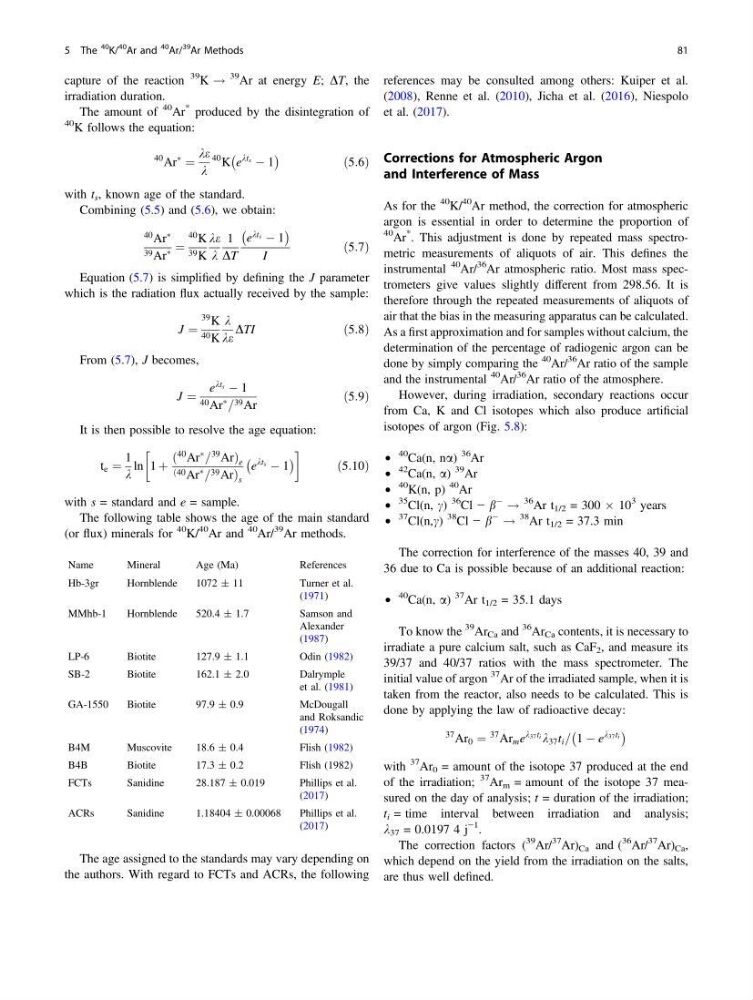
The following table shows the age of the main standard
(or flux) minerals for
40 K/
40 Ar and
40
Ar/
39
Ar methods.
Name
Mineral
Age (Ma)
References
Hb-3gr
Hornblende
1072 ± 11
Turner et al.
(1971)
MMhb-1
Hornblende
520.4 ± 1.7
Samson and
Alexander
(1987)
LP-6
Biotite
127.9 ± 1.1
Odin (1982)
SB-2
Biotite
162.1 ± 2.0
Dalrymple
et al. (1981)
GA-1550
Biotite
97.9 ± 0.9
McDougall
and Roksandic
(1974)
B4M
Muscovite
18.6 ± 0.4
Flish (1982)
B4B
Biotite
17.3 ± 0.2
Flish (1982)
FCTs
Sanidine
28.187 ± 0.019
Phillips et al.
(2017)
ACRs
Sanidine
1.18404 ± 0.00068
Phillips et al.
(2017)
The age assigned to the standards may vary depending on
the authors. With regard to FCTs and ACRs, the following
references may be consulted among others: Kuiper et al.
(2008), Renne et al. (2010), Jicha et al. (2016), Niespolo
et al. (2017).
Corrections for Atmospheric Argon
and Interference of Mass
As for the
40 K/
40
Ar method, the correction for atmospheric
argon is essential in order to determine the proportion of
40 Ar
* . This adjustment is done by repeated mass spectrometric measurements of aliquots of air. This defines the
instrumental
40
Ar/
36
Ar atmospheric ratio. Most mass spectrometers give values slightly different from 298.56. It is
therefore through the repeated measurements of aliquots of
air that the bias in the measuring apparatus can be calculated.
As a first approximation and for samples without calcium, the
determination of the percentage of radiogenic argon can be
done by simply comparing the
40
Ar/
36
Ar ratio of the sample
and the instrumental
40 Ar/
36 Ar ratio of the atmosphere.
However, during irradiation, secondary reactions occur
from Ca, K and Cl isotopes which also produce artificial
isotopes of argon (Fig. 5.8):
•
40 Ca(n, na)
36
Ar
•
42 Ca(n, a)
39 Ar
•
40 K(n, p)
40 Ar
•
35 Cl(n, c)
36 Cl − b
À
!
36 Ar t 1/2 = 300 Â 10
3 years
•
37 Cl(n,c)
38 Cl − b
À
!
38 Ar t 1/2 = 37.3 min
The correction for interference of the masses 40, 39 and
36 due to Ca is possible because of an additional reaction:
•
40 Ca(n, a)
37 Ar t 1/2 = 35.1 days
To know the
39 Ar Ca and
36
Ar Ca contents, it is necessary to
irradiate a pure calcium salt, such as CaF 2 , and measure its
39/37 and 40/37 ratios with the mass spectrometer. The
initial value of argon
37 Ar of the irradiated sample, when it is
taken from the reactor, also needs to be calculated. This is
done by applying the law of radioactive decay:
37
Ar 0 ¼
37
Ar m e
k 37 t i k 37 t i = 1 À e
k 37 t i
À
Á
with
37 Ar 0 = amount of the isotope 37 produced at the end
of the irradiation;
37 Ar m = amount of the isotope 37 measured on the day of analysis; t = duration of the irradiation;
t i = time interval between irradiation and analysis;
k 37 = 0.0197 4 j
−1 .
The correction factors (
39 Ar/
37 Ar) Ca and (
36 Ar/
37 Ar) Ca ,
which depend on the yield from the irradiation on the salts,
are thus well defined.
5 The
40
K/
40
Ar and
40 Ar/
39
Ar Methods
81
39 K !
39 Ar at energy E; DT, the
irradiation duration.
The amount of
40 Ar
* produced by the disintegration of
40 K follows the equation:
40
Ar
Ã
¼
ke
k
40
K e
kt s À 1
À
Á
ð5:6Þ
with t s , known age of the standard.
Combining (5.5) and (5.6), we obtain:
40
Ar
Ã
39 Ar
à ¼
40
K
39 K
ke
k
1
DT
e
kt s À 1
À
Á
I
ð5:7Þ
Equation (5.7) is simplified by defining the J parameter
which is the radiation flux actually received by the sample:
J ¼
39
K
40 K
k
ke
DTI
ð5:8Þ
From (5.7), J becomes,
J ¼
e
kt s À 1
40 Ar
Ã
= 39 Ar
ð5:9Þ
It is then possible to resolve the age equation:
t e ¼
1
k
ln 1 þ
40
Ar
Ã
=
39
Ar
ð
Þ e
ð40 Ar
Ã
= 39 ArÞ s
e
kt s À 1
À
Á
!
ð5:10Þ
with s = standard and e = sample.
The following table shows the age of the main standard
(or flux) minerals for
40 K/
40 Ar and
40
Ar/
39
Ar methods.
Name
Mineral
Age (Ma)
References
Hb-3gr
Hornblende
1072 ± 11
Turner et al.
(1971)
MMhb-1
Hornblende
520.4 ± 1.7
Samson and
Alexander
(1987)
LP-6
Biotite
127.9 ± 1.1
Odin (1982)
SB-2
Biotite
162.1 ± 2.0
Dalrymple
et al. (1981)
GA-1550
Biotite
97.9 ± 0.9
McDougall
and Roksandic
(1974)
B4M
Muscovite
18.6 ± 0.4
Flish (1982)
B4B
Biotite
17.3 ± 0.2
Flish (1982)
FCTs
Sanidine
28.187 ± 0.019
Phillips et al.
(2017)
ACRs
Sanidine
1.18404 ± 0.00068
Phillips et al.
(2017)
The age assigned to the standards may vary depending on
the authors. With regard to FCTs and ACRs, the following
references may be consulted among others: Kuiper et al.
(2008), Renne et al. (2010), Jicha et al. (2016), Niespolo
et al. (2017).
Corrections for Atmospheric Argon
and Interference of Mass
As for the
40 K/
40
Ar method, the correction for atmospheric
argon is essential in order to determine the proportion of
40 Ar
* . This adjustment is done by repeated mass spectrometric measurements of aliquots of air. This defines the
instrumental
40
Ar/
36
Ar atmospheric ratio. Most mass spectrometers give values slightly different from 298.56. It is
therefore through the repeated measurements of aliquots of
air that the bias in the measuring apparatus can be calculated.
As a first approximation and for samples without calcium, the
determination of the percentage of radiogenic argon can be
done by simply comparing the
40
Ar/
36
Ar ratio of the sample
and the instrumental
40 Ar/
36 Ar ratio of the atmosphere.
However, during irradiation, secondary reactions occur
from Ca, K and Cl isotopes which also produce artificial
isotopes of argon (Fig. 5.8):
•
40 Ca(n, na)
36
Ar
•
42 Ca(n, a)
39 Ar
•
40 K(n, p)
40 Ar
•
35 Cl(n, c)
36 Cl − b
À
!
36 Ar t 1/2 = 300 Â 10
3 years
•
37 Cl(n,c)
38 Cl − b
À
!
38 Ar t 1/2 = 37.3 min
The correction for interference of the masses 40, 39 and
36 due to Ca is possible because of an additional reaction:
•
40 Ca(n, a)
37 Ar t 1/2 = 35.1 days
To know the
39 Ar Ca and
36
Ar Ca contents, it is necessary to
irradiate a pure calcium salt, such as CaF 2 , and measure its
39/37 and 40/37 ratios with the mass spectrometer. The
initial value of argon
37 Ar of the irradiated sample, when it is
taken from the reactor, also needs to be calculated. This is
done by applying the law of radioactive decay:
37
Ar 0 ¼
37
Ar m e
k 37 t i k 37 t i = 1 À e
k 37 t i
À
Á
with
37 Ar 0 = amount of the isotope 37 produced at the end
of the irradiation;
37 Ar m = amount of the isotope 37 measured on the day of analysis; t = duration of the irradiation;
t i = time interval between irradiation and analysis;
k 37 = 0.0197 4 j
−1 .
The correction factors (
39 Ar/
37 Ar) Ca and (
36 Ar/
37 Ar) Ca ,
which depend on the yield from the irradiation on the salts,
are thus well defined.
5 The
40
K/
40
Ar and
40 Ar/
39
Ar Methods
81