

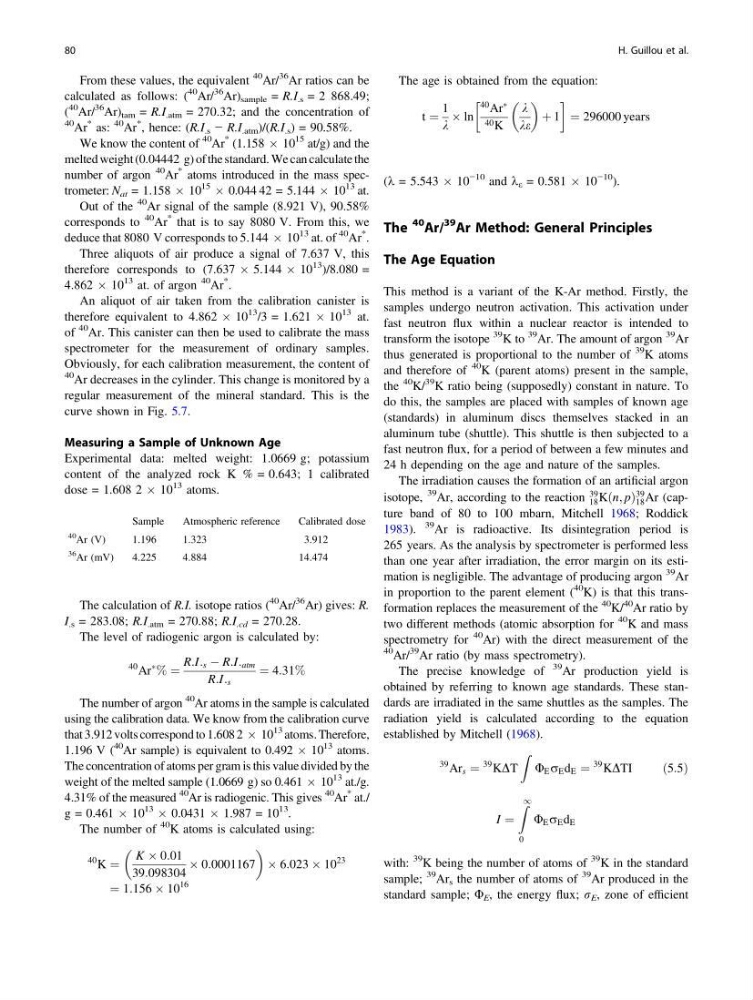
From these values, the equivalent
40 Ar/
36 Ar ratios can be
calculated as follows: (
40 Ar/
36 Ar) sample = R.I .s = 2 868.49;
(
40 Ar/
36 Ar) tam = R.I .atm = 270.32; and the concentration of
40 Ar
* as:
40 Ar
* , hence: (R.I .s − R.I .atm )/(R.I .s ) = 90.58%.
We know the content of
40
Ar
* (1.158 Â 10
15 at/g) and the
melted weight (0.04442 g) of the standard. We can calculate the
number of argon
40
Ar
* atoms introduced in the mass spectrometer: N at = 1.158 Â 10
15 Â 0.044 42 = 5.144 Â 10
13 at.
Out of the
40 Ar signal of the sample (8.921 V), 90.58%
corresponds to
40 Ar
* that is to say 8080 V. From this, we
deduce that 8080 V corresponds to 5.144 Â 10
13 at. of
40 Ar
* .
Three aliquots of air produce a signal of 7.637 V, this
therefore corresponds to (7.637 Â 5.144 Â 10
13 )/8.080 =
4.862 Â 10
13 at. of argon
40 Ar
* .
An aliquot of air taken from the calibration canister is
therefore equivalent to 4.862 Â 10
13 /3 = 1.621 Â 10
13 at.
of
40 Ar. This canister can then be used to calibrate the mass
spectrometer for the measurement of ordinary samples.
Obviously, for each calibration measurement, the content of
40 Ar decreases in the cylinder. This change is monitored by a
regular measurement of the mineral standard. This is the
curve shown in Fig. 5.7.
Measuring a Sample of Unknown Age
Experimental data: melted weight: 1.0669 g; potassium
content of the analyzed rock K % = 0.643; 1 calibrated
dose = 1.608 2 Â 10
13 atoms.
Sample
Atmospheric reference
Calibrated dose
40
Ar (V)
1.196
1.323
3.912
36
Ar (mV)
4.225
4.884
14.474
The calculation of R.I. isotope ratios (
40 Ar/
36 Ar) gives: R.
I .s = 283.08; R.I .atm = 270.88; R.I .cd = 270.28.
The level of radiogenic argon is calculated by:
40
Ar
Ã
% ¼
R:I: s À R:I: atm
R:I: s
¼ 4:31%
The number of argon
40
Ar atoms in the sample is calculated
using the calibration data. We know from the calibration curve
that 3.912 volts correspond to 1.608 2 Â 10
13 atoms. Therefore,
1.196 V (
40
Ar sample) is equivalent to 0.492 Â 10
13 atoms.
The concentration of atoms per gram is this value divided by the
weight of the melted sample (1.0669 g) so 0.461 Â 10
13 at./g.
4.31% of the measured
40
Ar is radiogenic. This gives
40
Ar
* at./
g = 0.461 Â 10
13
 0.0431  1.987 = 10
13
.
The number of
40 K atoms is calculated using:
40
K ¼
K Â 0:01
39:098304
 0:0001167
 6:023  10
23
¼ 1:156 Â 10
16
The age is obtained from the equation:
t ¼
1
k
 ln
40
Ar
Ã
40 K
k
ke
þ 1
!
¼ 296000 years
(k = 5.543 Â 10
−10 and k e = 0.581 Â 10
−10 ).
The
40
Ar/
39
Ar Method: General Principles
The Age Equation
This method is a variant of the K-Ar method. Firstly, the
samples undergo neutron activation. This activation under
fast neutron flux within a nuclear reactor is intended to
transform the isotope
39 K to
39 Ar. The amount of argon
39 Ar
thus generated is proportional to the number of
39 K atoms
and therefore of
40 K (parent atoms) present in the sample,
the
40 K/
39 K ratio being (supposedly) constant in nature. To
do this, the samples are placed with samples of known age
(standards) in aluminum discs themselves stacked in an
aluminum tube (shuttle). This shuttle is then subjected to a
fast neutron flux, for a period of between a few minutes and
24 h depending on the age and nature of the samples.
The irradiation causes the formation of an artificial argon
isotope,
39 Ar, according to the reaction
39
18 Kðn; pÞ
39
18 Ar (capture band of 80 to 100 mbarn, Mitchell 1968; Roddick
1983).
39 Ar is radioactive. Its disintegration period is
265 years. As the analysis by spectrometer is performed less
than one year after irradiation, the error margin on its estimation is negligible. The advantage of producing argon
39 Ar
in proportion to the parent element (
40 K) is that this transformation replaces the measurement of the
40 K/
40 Ar ratio by
two different methods (atomic absorption for
40 K and mass
spectrometry for
40 Ar) with the direct measurement of the
40 Ar/
39 Ar ratio (by mass spectrometry).
The precise knowledge of
39 Ar production yield is
obtained by referring to known age standards. These standards are irradiated in the same shuttles as the samples. The
radiation yield is calculated according to the equation
established by Mitchell (1968).
39
Ar s ¼
39
KDT
Z
U E r E d E ¼
39
KDTI
ð5:5Þ
I ¼
Z 1
0
U E r E d E
with:
39 K being the number of atoms of
39 K in the standard
sample;
39 Ar s the number of atoms of
39
Ar produced in the
standard sample; U E , the energy flux; r E , zone of efficient
80
H. Guillou et al.
40 Ar/
36 Ar ratios can be
calculated as follows: (
40 Ar/
36 Ar) sample = R.I .s = 2 868.49;
(
40 Ar/
36 Ar) tam = R.I .atm = 270.32; and the concentration of
40 Ar
* as:
40 Ar
* , hence: (R.I .s − R.I .atm )/(R.I .s ) = 90.58%.
We know the content of
40
Ar
* (1.158 Â 10
15 at/g) and the
melted weight (0.04442 g) of the standard. We can calculate the
number of argon
40
Ar
* atoms introduced in the mass spectrometer: N at = 1.158 Â 10
15 Â 0.044 42 = 5.144 Â 10
13 at.
Out of the
40 Ar signal of the sample (8.921 V), 90.58%
corresponds to
40 Ar
* that is to say 8080 V. From this, we
deduce that 8080 V corresponds to 5.144 Â 10
13 at. of
40 Ar
* .
Three aliquots of air produce a signal of 7.637 V, this
therefore corresponds to (7.637 Â 5.144 Â 10
13 )/8.080 =
4.862 Â 10
13 at. of argon
40 Ar
* .
An aliquot of air taken from the calibration canister is
therefore equivalent to 4.862 Â 10
13 /3 = 1.621 Â 10
13 at.
of
40 Ar. This canister can then be used to calibrate the mass
spectrometer for the measurement of ordinary samples.
Obviously, for each calibration measurement, the content of
40 Ar decreases in the cylinder. This change is monitored by a
regular measurement of the mineral standard. This is the
curve shown in Fig. 5.7.
Measuring a Sample of Unknown Age
Experimental data: melted weight: 1.0669 g; potassium
content of the analyzed rock K % = 0.643; 1 calibrated
dose = 1.608 2 Â 10
13 atoms.
Sample
Atmospheric reference
Calibrated dose
40
Ar (V)
1.196
1.323
3.912
36
Ar (mV)
4.225
4.884
14.474
The calculation of R.I. isotope ratios (
40 Ar/
36 Ar) gives: R.
I .s = 283.08; R.I .atm = 270.88; R.I .cd = 270.28.
The level of radiogenic argon is calculated by:
40
Ar
Ã
% ¼
R:I: s À R:I: atm
R:I: s
¼ 4:31%
The number of argon
40
Ar atoms in the sample is calculated
using the calibration data. We know from the calibration curve
that 3.912 volts correspond to 1.608 2 Â 10
13 atoms. Therefore,
1.196 V (
40
Ar sample) is equivalent to 0.492 Â 10
13 atoms.
The concentration of atoms per gram is this value divided by the
weight of the melted sample (1.0669 g) so 0.461 Â 10
13 at./g.
4.31% of the measured
40
Ar is radiogenic. This gives
40
Ar
* at./
g = 0.461 Â 10
13
 0.0431  1.987 = 10
13
.
The number of
40 K atoms is calculated using:
40
K ¼
K Â 0:01
39:098304
 0:0001167
 6:023  10
23
¼ 1:156 Â 10
16
The age is obtained from the equation:
t ¼
1
k
 ln
40
Ar
Ã
40 K
k
ke
þ 1
!
¼ 296000 years
(k = 5.543 Â 10
−10 and k e = 0.581 Â 10
−10 ).
The
40
Ar/
39
Ar Method: General Principles
The Age Equation
This method is a variant of the K-Ar method. Firstly, the
samples undergo neutron activation. This activation under
fast neutron flux within a nuclear reactor is intended to
transform the isotope
39 K to
39 Ar. The amount of argon
39 Ar
thus generated is proportional to the number of
39 K atoms
and therefore of
40 K (parent atoms) present in the sample,
the
40 K/
39 K ratio being (supposedly) constant in nature. To
do this, the samples are placed with samples of known age
(standards) in aluminum discs themselves stacked in an
aluminum tube (shuttle). This shuttle is then subjected to a
fast neutron flux, for a period of between a few minutes and
24 h depending on the age and nature of the samples.
The irradiation causes the formation of an artificial argon
isotope,
39 Ar, according to the reaction
39
18 Kðn; pÞ
39
18 Ar (capture band of 80 to 100 mbarn, Mitchell 1968; Roddick
1983).
39 Ar is radioactive. Its disintegration period is
265 years. As the analysis by spectrometer is performed less
than one year after irradiation, the error margin on its estimation is negligible. The advantage of producing argon
39 Ar
in proportion to the parent element (
40 K) is that this transformation replaces the measurement of the
40 K/
40 Ar ratio by
two different methods (atomic absorption for
40 K and mass
spectrometry for
40 Ar) with the direct measurement of the
40 Ar/
39 Ar ratio (by mass spectrometry).
The precise knowledge of
39 Ar production yield is
obtained by referring to known age standards. These standards are irradiated in the same shuttles as the samples. The
radiation yield is calculated according to the equation
established by Mitchell (1968).
39
Ar s ¼
39
KDT
Z
U E r E d E ¼
39
KDTI
ð5:5Þ
I ¼
Z 1
0
U E r E d E
with:
39 K being the number of atoms of
39 K in the standard
sample;
39 Ar s the number of atoms of
39
Ar produced in the
standard sample; U E , the energy flux; r E , zone of efficient
80
H. Guillou et al.