

3 Spin-Polarized Plasmonics: Fresh View …
69
Shown in Fig. 3.14 are dynamic light scattering (DLS) results on particle size
distribution of undiluted Co nanoparticles samples. As grown Co nanoparticles have
DLS average particle size 8.7 nm. Then, the solution was sonicated in the presence of
130 mT external DC magnetic field. The effective particles size has been increased
from 8.7 nm to 12 nm. This increase in particle size is due to agglomeration of Co
nanoparticles in the presence of magnetic field. To reverse the agglomeration, the
sample was sonicated for 1 h in the absence of an external DC magnetic field. The
particle size has been reduced down to 10 nm. When an external field is removed,
sonication isolates the nanoparticles and results in decreasing of the effective particle
size. The DLS measurements were performed at the same time as collected the optical
spectra and prepared sample for magnetometry like in Fig. 3.13.
The following experiment illustrates interaction of Co nanoparticles separated by
thin surfactant shell. To initiate aggregation, the 130 mT DC magnetic field together
with sonication were applied to the Co NP hexane suspension in a quartz cuvette.
After 1 h of “aggregation” the dynamic light scattering and absorption spectra were
collected. Figure 3.3 shows reduced plasmon peak (shown in blue). After 2.5 h sonication in magnetic field plasmon peak disappeared (shown in green). The dynamic
light scattering shown in the Fig. 3.3b gives increase in the hydrodynamic particles size from 8.7 to 12–13 nm corresponding to small, two-three particles aggregates. Remarkable, that the following up sonication, without external magnetic field,
separates aggregated particles and the plasmon resonance is restored. Thus, this
magnetic/sonication induced aggregation is a reversible process.
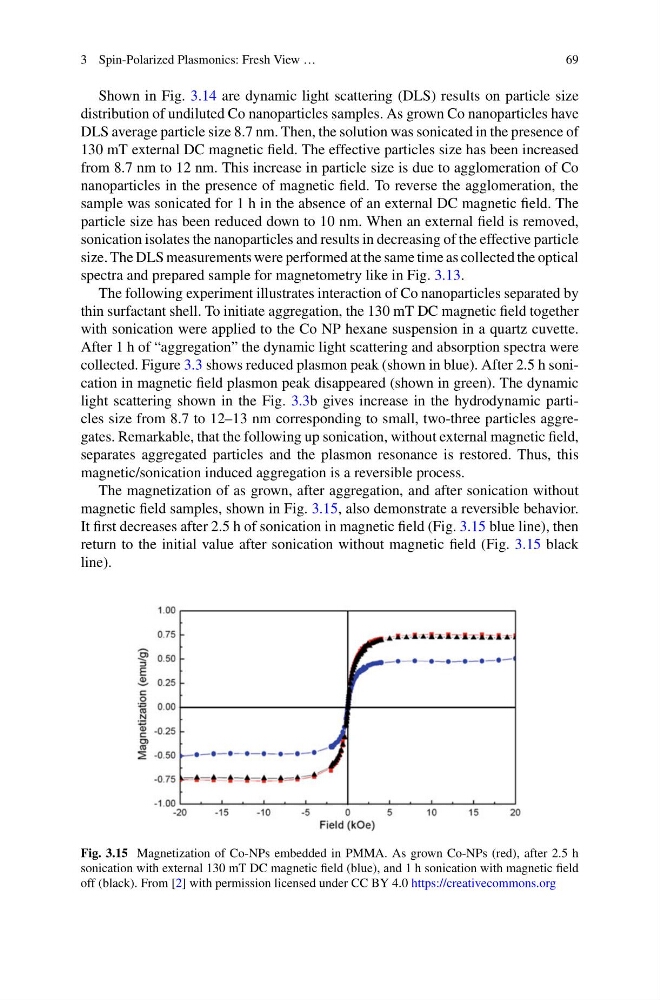
The magnetization of as grown, after aggregation, and after sonication without
magnetic field samples, shown in Fig. 3.15, also demonstrate a reversible behavior.
It first decreases after 2.5 h of sonication in magnetic field (Fig. 3.15 blue line), then
return to the initial value after sonication without magnetic field (Fig. 3.15 black
line).
Fig. 3.15 Magnetization of Co-NPs embedded in PMMA. As grown Co-NPs (red), after 2.5 h
sonication with external 130 mT DC magnetic field (blue), and 1 h sonication with magnetic field
off (black). From [2] with permission licensed under CC BY 4.0 https://creativecommons.org
69
Shown in Fig. 3.14 are dynamic light scattering (DLS) results on particle size
distribution of undiluted Co nanoparticles samples. As grown Co nanoparticles have
DLS average particle size 8.7 nm. Then, the solution was sonicated in the presence of
130 mT external DC magnetic field. The effective particles size has been increased
from 8.7 nm to 12 nm. This increase in particle size is due to agglomeration of Co
nanoparticles in the presence of magnetic field. To reverse the agglomeration, the
sample was sonicated for 1 h in the absence of an external DC magnetic field. The
particle size has been reduced down to 10 nm. When an external field is removed,
sonication isolates the nanoparticles and results in decreasing of the effective particle
size. The DLS measurements were performed at the same time as collected the optical
spectra and prepared sample for magnetometry like in Fig. 3.13.
The following experiment illustrates interaction of Co nanoparticles separated by
thin surfactant shell. To initiate aggregation, the 130 mT DC magnetic field together
with sonication were applied to the Co NP hexane suspension in a quartz cuvette.
After 1 h of “aggregation” the dynamic light scattering and absorption spectra were
collected. Figure 3.3 shows reduced plasmon peak (shown in blue). After 2.5 h sonication in magnetic field plasmon peak disappeared (shown in green). The dynamic
light scattering shown in the Fig. 3.3b gives increase in the hydrodynamic particles size from 8.7 to 12–13 nm corresponding to small, two-three particles aggregates. Remarkable, that the following up sonication, without external magnetic field,
separates aggregated particles and the plasmon resonance is restored. Thus, this
magnetic/sonication induced aggregation is a reversible process.
The magnetization of as grown, after aggregation, and after sonication without
magnetic field samples, shown in Fig. 3.15, also demonstrate a reversible behavior.
It first decreases after 2.5 h of sonication in magnetic field (Fig. 3.15 blue line), then
return to the initial value after sonication without magnetic field (Fig. 3.15 black
line).
Fig. 3.15 Magnetization of Co-NPs embedded in PMMA. As grown Co-NPs (red), after 2.5 h
sonication with external 130 mT DC magnetic field (blue), and 1 h sonication with magnetic field
off (black). From [2] with permission licensed under CC BY 4.0 https://creativecommons.org