

70
V. P. Drachev et al.
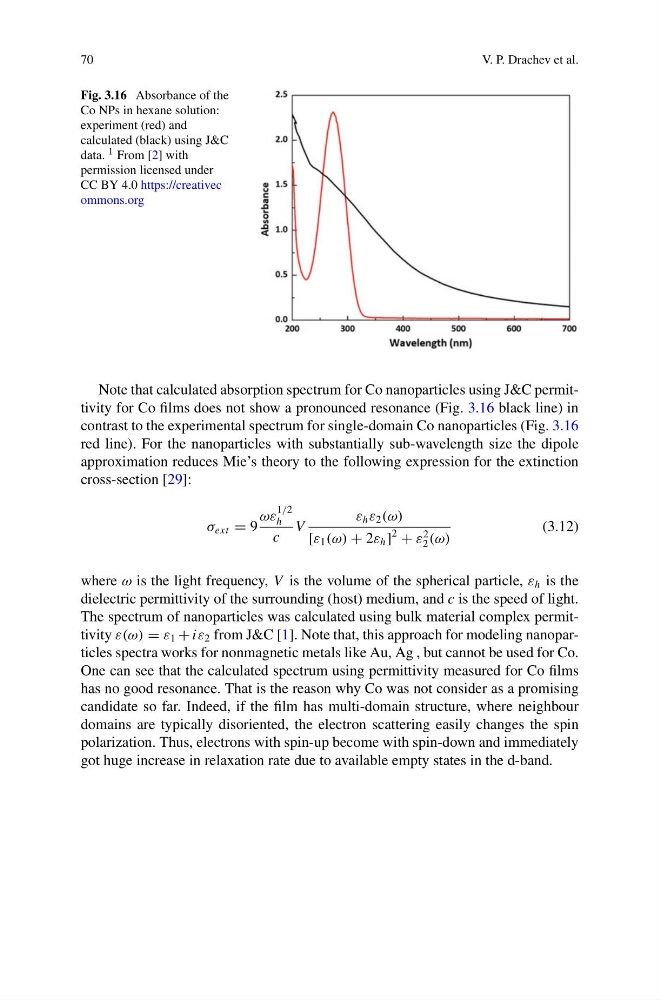
Fig. 3.16 Absorbance of the
Co NPs in hexane solution:
experiment (red) and
calculated (black) using J&C
data. 1 From [2] with
permission licensed under
CC BY 4.0 https://creativec
ommons.org
Note that calculated absorption spectrum for Co nanoparticles using J&C permittivity for Co films does not show a pronounced resonance (Fig. 3.16 black line) in
contrast to the experimental spectrum for single-domain Co nanoparticles (Fig. 3.16
red line). For the nanoparticles with substantially sub-wavelength size the dipole
approximation reduces Mie’s theory to the following expression for the extinction
cross-section [29]:
σ ext = 9
ωε
1/2
h
c
V
ε h ε 2 (ω)
[ε 1 (ω) + 2ε h ]
2
+ ε
2
2 (ω)
(3.12)
where ω is the light frequency, V is the volume of the spherical particle, ε h is the
dielectric permittivity of the surrounding (host) medium, and c is the speed of light.
The spectrum of nanoparticles was calculated using bulk material complex permittivity ε(ω) = ε 1 + iε 2 from J&C [1]. Note that, this approach for modeling nanoparticles spectra works for nonmagnetic metals like Au, Ag , but cannot be used for Co.
One can see that the calculated spectrum using permittivity measured for Co films
has no good resonance. That is the reason why Co was not consider as a promising
candidate so far. Indeed, if the film has multi-domain structure, where neighbour
domains are typically disoriented, the electron scattering easily changes the spin
polarization. Thus, electrons with spin-up become with spin-down and immediately
got huge increase in relaxation rate due to available empty states in the d-band.
V. P. Drachev et al.
Fig. 3.16 Absorbance of the
Co NPs in hexane solution:
experiment (red) and
calculated (black) using J&C
data. 1 From [2] with
permission licensed under
CC BY 4.0 https://creativec
ommons.org
Note that calculated absorption spectrum for Co nanoparticles using J&C permittivity for Co films does not show a pronounced resonance (Fig. 3.16 black line) in
contrast to the experimental spectrum for single-domain Co nanoparticles (Fig. 3.16
red line). For the nanoparticles with substantially sub-wavelength size the dipole
approximation reduces Mie’s theory to the following expression for the extinction
cross-section [29]:
σ ext = 9
ωε
1/2
h
c
V
ε h ε 2 (ω)
[ε 1 (ω) + 2ε h ]
2
+ ε
2
2 (ω)
(3.12)
where ω is the light frequency, V is the volume of the spherical particle, ε h is the
dielectric permittivity of the surrounding (host) medium, and c is the speed of light.
The spectrum of nanoparticles was calculated using bulk material complex permittivity ε(ω) = ε 1 + iε 2 from J&C [1]. Note that, this approach for modeling nanoparticles spectra works for nonmagnetic metals like Au, Ag , but cannot be used for Co.
One can see that the calculated spectrum using permittivity measured for Co films
has no good resonance. That is the reason why Co was not consider as a promising
candidate so far. Indeed, if the film has multi-domain structure, where neighbour
domains are typically disoriented, the electron scattering easily changes the spin
polarization. Thus, electrons with spin-up become with spin-down and immediately
got huge increase in relaxation rate due to available empty states in the d-band.