

3 Spin-Polarized Plasmonics: Fresh View …
67
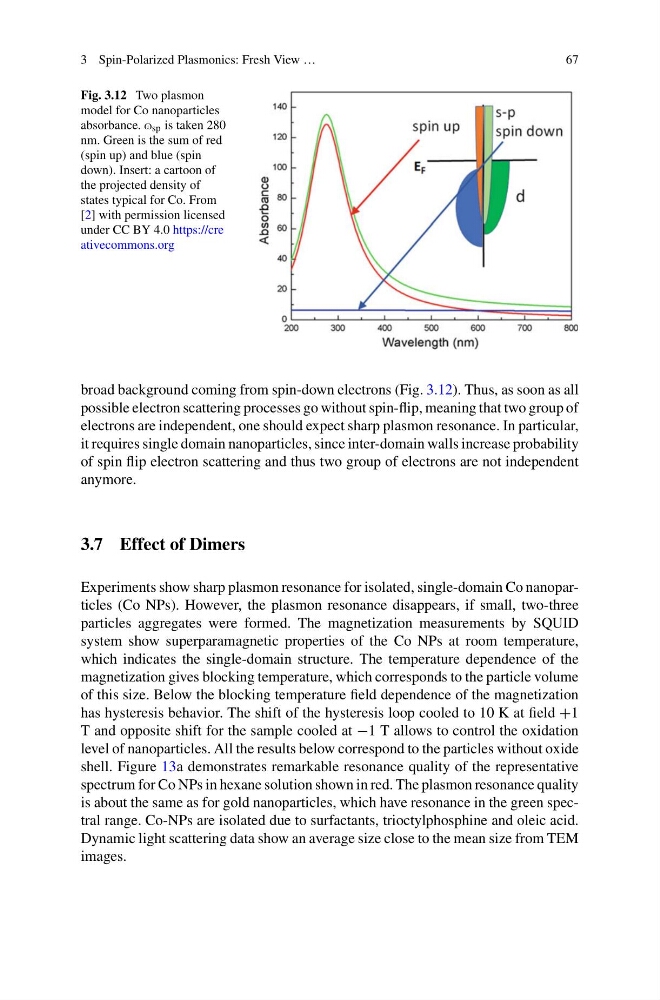
Fig. 3.12 Two plasmon
model for Co nanoparticles
absorbance. Ñ sp is taken 280
nm. Green is the sum of red
(spin up) and blue (spin
down). Insert: a cartoon of
the projected density of
states typical for Co. From
[2] with permission licensed
under CC BY 4.0 https://cre
ativecommons.org
broad background coming from spin-down electrons (Fig. 3.12). Thus, as soon as all
possible electron scattering processes go without spin-flip, meaning that two group of
electrons are independent, one should expect sharp plasmon resonance. In particular,
it requires single domain nanoparticles, since inter-domain walls increase probability
of spin flip electron scattering and thus two group of electrons are not independent
anymore.
3.7 Effect of Dimers
Experiments show sharp plasmon resonance for isolated, single-domain Co nanoparticles (Co NPs). However, the plasmon resonance disappears, if small, two-three
particles aggregates were formed. The magnetization measurements by SQUID
system show superparamagnetic properties of the Co NPs at room temperature,
which indicates the single-domain structure. The temperature dependence of the
magnetization gives blocking temperature, which corresponds to the particle volume
of this size. Below the blocking temperature field dependence of the magnetization
has hysteresis behavior. The shift of the hysteresis loop cooled to 10 K at field +1
T and opposite shift for the sample cooled at −1 T allows to control the oxidation
level of nanoparticles. All the results below correspond to the particles without oxide
shell. Figure 13a demonstrates remarkable resonance quality of the representative
spectrum for Co NPs in hexane solution shown in red. The plasmon resonance quality
is about the same as for gold nanoparticles, which have resonance in the green spectral range. Co-NPs are isolated due to surfactants, trioctylphosphine and oleic acid.
Dynamic light scattering data show an average size close to the mean size from TEM
images.
67
Fig. 3.12 Two plasmon
model for Co nanoparticles
absorbance. Ñ sp is taken 280
nm. Green is the sum of red
(spin up) and blue (spin
down). Insert: a cartoon of
the projected density of
states typical for Co. From
[2] with permission licensed
under CC BY 4.0 https://cre
ativecommons.org
broad background coming from spin-down electrons (Fig. 3.12). Thus, as soon as all
possible electron scattering processes go without spin-flip, meaning that two group of
electrons are independent, one should expect sharp plasmon resonance. In particular,
it requires single domain nanoparticles, since inter-domain walls increase probability
of spin flip electron scattering and thus two group of electrons are not independent
anymore.
3.7 Effect of Dimers
Experiments show sharp plasmon resonance for isolated, single-domain Co nanoparticles (Co NPs). However, the plasmon resonance disappears, if small, two-three
particles aggregates were formed. The magnetization measurements by SQUID
system show superparamagnetic properties of the Co NPs at room temperature,
which indicates the single-domain structure. The temperature dependence of the
magnetization gives blocking temperature, which corresponds to the particle volume
of this size. Below the blocking temperature field dependence of the magnetization
has hysteresis behavior. The shift of the hysteresis loop cooled to 10 K at field +1
T and opposite shift for the sample cooled at −1 T allows to control the oxidation
level of nanoparticles. All the results below correspond to the particles without oxide
shell. Figure 13a demonstrates remarkable resonance quality of the representative
spectrum for Co NPs in hexane solution shown in red. The plasmon resonance quality
is about the same as for gold nanoparticles, which have resonance in the green spectral range. Co-NPs are isolated due to surfactants, trioctylphosphine and oleic acid.
Dynamic light scattering data show an average size close to the mean size from TEM
images.