

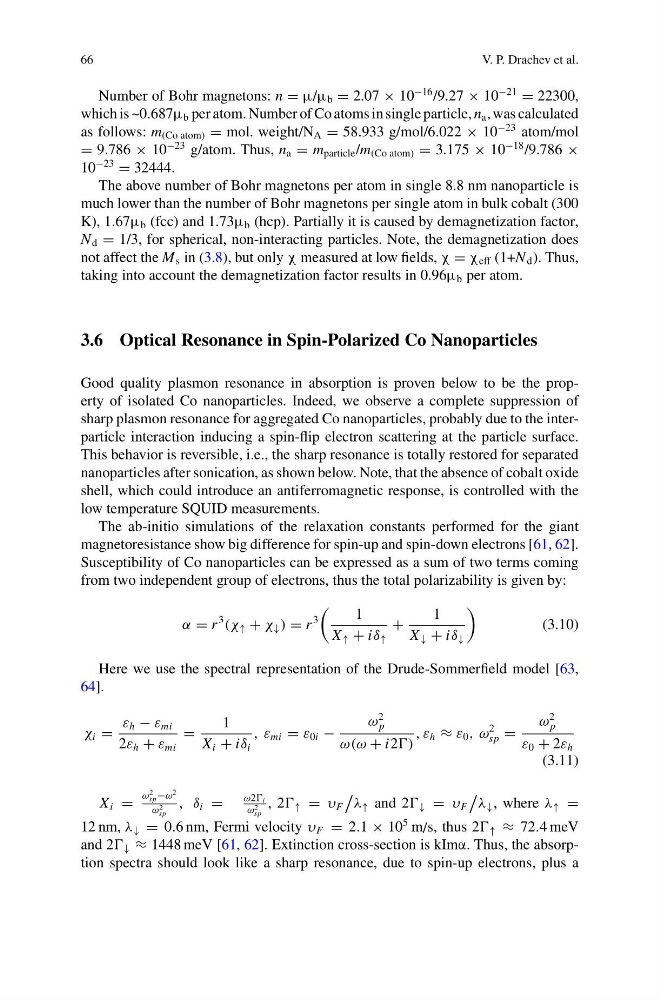
66
V. P. Drachev et al.
Number of Bohr magnetons: n = μ/μ b = 2.07 × 10
−16 /9.27 × 10
−21
= 22300,
which is ~0.687μ b per atom. Number of Co atoms in single particle, n a , was calculated
as follows: m (Co atom) = mol. weight/N A = 58.933 g/mol/6.022 × 10
−23 atom/mol
= 9.786 × 10
−23 g/atom. Thus, n a = m particle /m (Co atom) = 3.175 × 10
−18 /9.786 ×
10
−23
= 32444.
The above number of Bohr magnetons per atom in single 8.8 nm nanoparticle is
much lower than the number of Bohr magnetons per single atom in bulk cobalt (300
K), 1.67μ b (fcc) and 1.73μ b (hcp). Partially it is caused by demagnetization factor,
N d = 1/3, for spherical, non-interacting particles. Note, the demagnetization does
not affect the M s in (3.8), but only χ measured at low fields, χ = χ eff (1+N d ). Thus,
taking into account the demagnetization factor results in 0.96μ b per atom.
3.6 Optical Resonance in Spin-Polarized Co Nanoparticles
Good quality plasmon resonance in absorption is proven below to be the property of isolated Co nanoparticles. Indeed, we observe a complete suppression of
sharp plasmon resonance for aggregated Co nanoparticles, probably due to the interparticle interaction inducing a spin-flip electron scattering at the particle surface.
This behavior is reversible, i.e., the sharp resonance is totally restored for separated
nanoparticles after sonication, as shown below. Note, that the absence of cobalt oxide
shell, which could introduce an antiferromagnetic response, is controlled with the
low temperature SQUID measurements.
The ab-initio simulations of the relaxation constants performed for the giant
magnetoresistance show big difference for spin-up and spin-down electrons [61, 62].
Susceptibility of Co nanoparticles can be expressed as a sum of two terms coming
from two independent group of electrons, thus the total polarizability is given by:
α = r
3
(χ ↑ + χ ↓ ) = r
3
1
X ↑ + iδ ↑
+
1
X ↓ + iδ ↓
(3.10)
Here we use the spectral representation of the Drude-Sommerfield model [63,
64].
χ i =
ε h − ε mi
2ε h + ε mi
=
1
X i + iδ i
, ε mi = ε 0i −
ω
2
p
ω(ω + i2)
, ε h ≈ ε 0 , ω
2
sp =
ω
2
p
ε 0 + 2ε h
(3.11)
X i =
ω
2
sp −ω
2
ω 2
sp
, δ i =
ω2 i
ω 2
sp
, 2 ↑ = υ F
λ ↑ and 2 ↓ = υ F
λ ↓ , where λ ↑ =
12 nm, λ ↓ = 0.6 nm, Fermi velocity υ F = 2.1 × 10
5 m/s, thus 2 ↑ ≈ 72.4 meV
and 2 ↓ ≈ 1448 meV [61, 62]. Extinction cross-section is kImα. Thus, the absorption spectra should look like a sharp resonance, due to spin-up electrons, plus a
V. P. Drachev et al.
Number of Bohr magnetons: n = μ/μ b = 2.07 × 10
−16 /9.27 × 10
−21
= 22300,
which is ~0.687μ b per atom. Number of Co atoms in single particle, n a , was calculated
as follows: m (Co atom) = mol. weight/N A = 58.933 g/mol/6.022 × 10
−23 atom/mol
= 9.786 × 10
−23 g/atom. Thus, n a = m particle /m (Co atom) = 3.175 × 10
−18 /9.786 ×
10
−23
= 32444.
The above number of Bohr magnetons per atom in single 8.8 nm nanoparticle is
much lower than the number of Bohr magnetons per single atom in bulk cobalt (300
K), 1.67μ b (fcc) and 1.73μ b (hcp). Partially it is caused by demagnetization factor,
N d = 1/3, for spherical, non-interacting particles. Note, the demagnetization does
not affect the M s in (3.8), but only χ measured at low fields, χ = χ eff (1+N d ). Thus,
taking into account the demagnetization factor results in 0.96μ b per atom.
3.6 Optical Resonance in Spin-Polarized Co Nanoparticles
Good quality plasmon resonance in absorption is proven below to be the property of isolated Co nanoparticles. Indeed, we observe a complete suppression of
sharp plasmon resonance for aggregated Co nanoparticles, probably due to the interparticle interaction inducing a spin-flip electron scattering at the particle surface.
This behavior is reversible, i.e., the sharp resonance is totally restored for separated
nanoparticles after sonication, as shown below. Note, that the absence of cobalt oxide
shell, which could introduce an antiferromagnetic response, is controlled with the
low temperature SQUID measurements.
The ab-initio simulations of the relaxation constants performed for the giant
magnetoresistance show big difference for spin-up and spin-down electrons [61, 62].
Susceptibility of Co nanoparticles can be expressed as a sum of two terms coming
from two independent group of electrons, thus the total polarizability is given by:
α = r
3
(χ ↑ + χ ↓ ) = r
3
1
X ↑ + iδ ↑
+
1
X ↓ + iδ ↓
(3.10)
Here we use the spectral representation of the Drude-Sommerfield model [63,
64].
χ i =
ε h − ε mi
2ε h + ε mi
=
1
X i + iδ i
, ε mi = ε 0i −
ω
2
p
ω(ω + i2)
, ε h ≈ ε 0 , ω
2
sp =
ω
2
p
ε 0 + 2ε h
(3.11)
X i =
ω
2
sp −ω
2
ω 2
sp
, δ i =
ω2 i
ω 2
sp
, 2 ↑ = υ F
λ ↑ and 2 ↓ = υ F
λ ↓ , where λ ↑ =
12 nm, λ ↓ = 0.6 nm, Fermi velocity υ F = 2.1 × 10
5 m/s, thus 2 ↑ ≈ 72.4 meV
and 2 ↓ ≈ 1448 meV [61, 62]. Extinction cross-section is kImα. Thus, the absorption spectra should look like a sharp resonance, due to spin-up electrons, plus a