

3 Spin-Polarized Plasmonics: Fresh View …
61
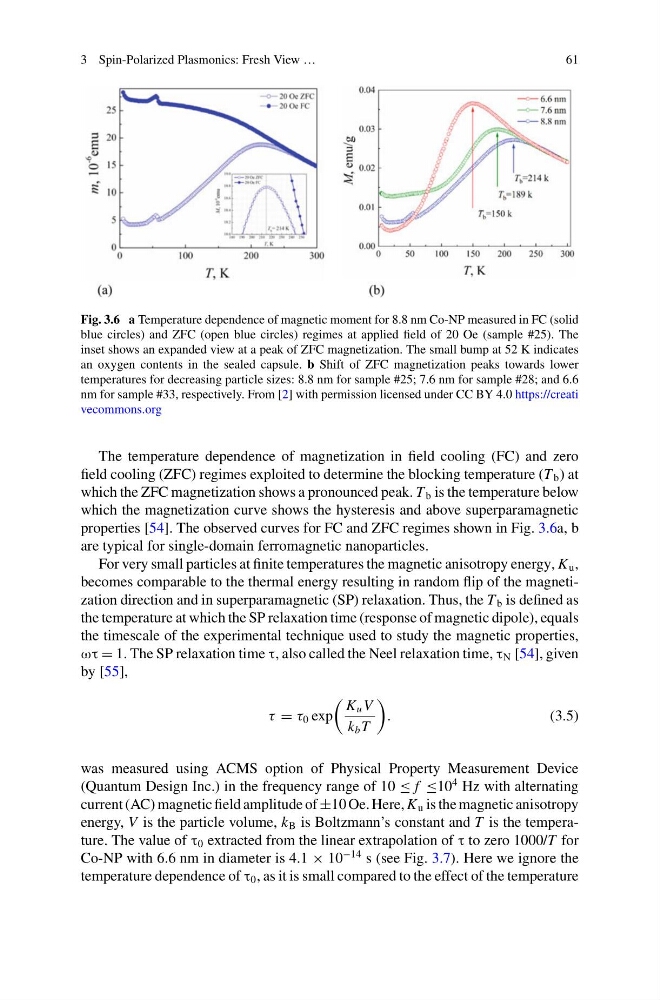
Fig. 3.6 a Temperature dependence of magnetic moment for 8.8 nm Co-NP measured in FC (solid
blue circles) and ZFC (open blue circles) regimes at applied field of 20 Oe (sample #25). The
inset shows an expanded view at a peak of ZFC magnetization. The small bump at 52 K indicates
an oxygen contents in the sealed capsule. b Shift of ZFC magnetization peaks towards lower
temperatures for decreasing particle sizes: 8.8 nm for sample #25; 7.6 nm for sample #28; and 6.6
nm for sample #33, respectively. From [2] with permission licensed under CC BY 4.0 https://creati
vecommons.org
The temperature dependence of magnetization in field cooling (FC) and zero
field cooling (ZFC) regimes exploited to determine the blocking temperature (T b ) at
which the ZFC magnetization shows a pronounced peak. T b is the temperature below
which the magnetization curve shows the hysteresis and above superparamagnetic
properties [54]. The observed curves for FC and ZFC regimes shown in Fig. 3.6a, b
are typical for single-domain ferromagnetic nanoparticles.
For very small particles at finite temperatures the magnetic anisotropy energy, K u ,
becomes comparable to the thermal energy resulting in random flip of the magnetization direction and in superparamagnetic (SP) relaxation. Thus, the T b is defined as
the temperature at which the SP relaxation time (response of magnetic dipole), equals
the timescale of the experimental technique used to study the magnetic properties,
ωτ = 1. The SP relaxation time τ, also called the Neel relaxation time, τ N [54], given
by [55],
τ = τ 0 exp
K u V
k b T
.
(3.5)
was measured using ACMS option of Physical Property Measurement Device
(Quantum Design Inc.) in the frequency range of 10 ≤ f ≤10
4 Hz with alternating
current (AC) magnetic field amplitude of ±10 Oe. Here, K u is the magnetic anisotropy
energy, V is the particle volume, k B is Boltzmann’s constant and T is the temperature. The value of τ 0 extracted from the linear extrapolation of τ to zero 1000/T for
Co-NP with 6.6 nm in diameter is 4.1 × 10
−14 s (see Fig. 3.7). Here we ignore the
temperature dependence of τ 0 , as it is small compared to the effect of the temperature
61
Fig. 3.6 a Temperature dependence of magnetic moment for 8.8 nm Co-NP measured in FC (solid
blue circles) and ZFC (open blue circles) regimes at applied field of 20 Oe (sample #25). The
inset shows an expanded view at a peak of ZFC magnetization. The small bump at 52 K indicates
an oxygen contents in the sealed capsule. b Shift of ZFC magnetization peaks towards lower
temperatures for decreasing particle sizes: 8.8 nm for sample #25; 7.6 nm for sample #28; and 6.6
nm for sample #33, respectively. From [2] with permission licensed under CC BY 4.0 https://creati
vecommons.org
The temperature dependence of magnetization in field cooling (FC) and zero
field cooling (ZFC) regimes exploited to determine the blocking temperature (T b ) at
which the ZFC magnetization shows a pronounced peak. T b is the temperature below
which the magnetization curve shows the hysteresis and above superparamagnetic
properties [54]. The observed curves for FC and ZFC regimes shown in Fig. 3.6a, b
are typical for single-domain ferromagnetic nanoparticles.
For very small particles at finite temperatures the magnetic anisotropy energy, K u ,
becomes comparable to the thermal energy resulting in random flip of the magnetization direction and in superparamagnetic (SP) relaxation. Thus, the T b is defined as
the temperature at which the SP relaxation time (response of magnetic dipole), equals
the timescale of the experimental technique used to study the magnetic properties,
ωτ = 1. The SP relaxation time τ, also called the Neel relaxation time, τ N [54], given
by [55],
τ = τ 0 exp
K u V
k b T
.
(3.5)
was measured using ACMS option of Physical Property Measurement Device
(Quantum Design Inc.) in the frequency range of 10 ≤ f ≤10
4 Hz with alternating
current (AC) magnetic field amplitude of ±10 Oe. Here, K u is the magnetic anisotropy
energy, V is the particle volume, k B is Boltzmann’s constant and T is the temperature. The value of τ 0 extracted from the linear extrapolation of τ to zero 1000/T for
Co-NP with 6.6 nm in diameter is 4.1 × 10
−14 s (see Fig. 3.7). Here we ignore the
temperature dependence of τ 0 , as it is small compared to the effect of the temperature