

62
V. P. Drachev et al.
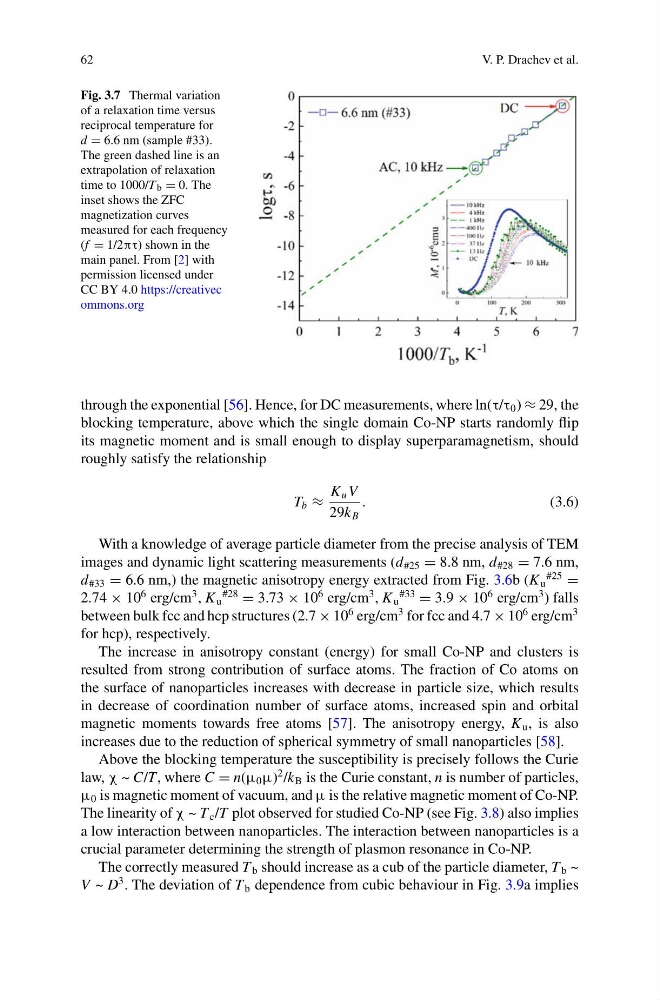
Fig. 3.7 Thermal variation
of a relaxation time versus
reciprocal temperature for
d = 6.6 nm (sample #33).
The green dashed line is an
extrapolation of relaxation
time to 1000/T b = 0. The
inset shows the ZFC
magnetization curves
measured for each frequency
(f = 1/2πτ) shown in the
main panel. From [2] with
permission licensed under
CC BY 4.0 https://creativec
ommons.org
through the exponential [56]. Hence, for DC measurements, where ln(τ/τ 0 ) ≈ 29, the
blocking temperature, above which the single domain Co-NP starts randomly flip
its magnetic moment and is small enough to display superparamagnetism, should
roughly satisfy the relationship
T b ≈
K u V
29k B
.
(3.6)
With a knowledge of average particle diameter from the precise analysis of TEM
images and dynamic light scattering measurements (d #25 = 8.8 nm, d #28 = 7.6 nm,
d #33 = 6.6 nm,) the magnetic anisotropy energy extracted from Fig. 3.6b (K u
#25
=
2.74 × 10
6 erg/cm
3 , K u
#28
= 3.73 × 10
6 erg/cm
3 , K u
#33
= 3.9 × 10
6 erg/cm
3 ) falls
between bulk fcc and hcp structures (2.7 × 10
6 erg/cm
3 for fcc and 4.7 × 10
6 erg/cm
3
for hcp), respectively.
The increase in anisotropy constant (energy) for small Co-NP and clusters is
resulted from strong contribution of surface atoms. The fraction of Co atoms on
the surface of nanoparticles increases with decrease in particle size, which results
in decrease of coordination number of surface atoms, increased spin and orbital
magnetic moments towards free atoms [57]. The anisotropy energy, K u , is also
increases due to the reduction of spherical symmetry of small nanoparticles [58].
Above the blocking temperature the susceptibility is precisely follows the Curie
law, χ ~ C/T, where C = n(μ 0 μ)
2 /k B is the Curie constant, n is number of particles,
μ 0 is magnetic moment of vacuum, and μ is the relative magnetic moment of Co-NP.
The linearity of χ ~ T c /T plot observed for studied Co-NP (see Fig. 3.8) also implies
a low interaction between nanoparticles. The interaction between nanoparticles is a
crucial parameter determining the strength of plasmon resonance in Co-NP.
The correctly measured T b should increase as a cub of the particle diameter, T b ~
V ~ D
3 . The deviation of T b dependence from cubic behaviour in Fig. 3.9a implies
V. P. Drachev et al.
Fig. 3.7 Thermal variation
of a relaxation time versus
reciprocal temperature for
d = 6.6 nm (sample #33).
The green dashed line is an
extrapolation of relaxation
time to 1000/T b = 0. The
inset shows the ZFC
magnetization curves
measured for each frequency
(f = 1/2πτ) shown in the
main panel. From [2] with
permission licensed under
CC BY 4.0 https://creativec
ommons.org
through the exponential [56]. Hence, for DC measurements, where ln(τ/τ 0 ) ≈ 29, the
blocking temperature, above which the single domain Co-NP starts randomly flip
its magnetic moment and is small enough to display superparamagnetism, should
roughly satisfy the relationship
T b ≈
K u V
29k B
.
(3.6)
With a knowledge of average particle diameter from the precise analysis of TEM
images and dynamic light scattering measurements (d #25 = 8.8 nm, d #28 = 7.6 nm,
d #33 = 6.6 nm,) the magnetic anisotropy energy extracted from Fig. 3.6b (K u
#25
=
2.74 × 10
6 erg/cm
3 , K u
#28
= 3.73 × 10
6 erg/cm
3 , K u
#33
= 3.9 × 10
6 erg/cm
3 ) falls
between bulk fcc and hcp structures (2.7 × 10
6 erg/cm
3 for fcc and 4.7 × 10
6 erg/cm
3
for hcp), respectively.
The increase in anisotropy constant (energy) for small Co-NP and clusters is
resulted from strong contribution of surface atoms. The fraction of Co atoms on
the surface of nanoparticles increases with decrease in particle size, which results
in decrease of coordination number of surface atoms, increased spin and orbital
magnetic moments towards free atoms [57]. The anisotropy energy, K u , is also
increases due to the reduction of spherical symmetry of small nanoparticles [58].
Above the blocking temperature the susceptibility is precisely follows the Curie
law, χ ~ C/T, where C = n(μ 0 μ)
2 /k B is the Curie constant, n is number of particles,
μ 0 is magnetic moment of vacuum, and μ is the relative magnetic moment of Co-NP.
The linearity of χ ~ T c /T plot observed for studied Co-NP (see Fig. 3.8) also implies
a low interaction between nanoparticles. The interaction between nanoparticles is a
crucial parameter determining the strength of plasmon resonance in Co-NP.
The correctly measured T b should increase as a cub of the particle diameter, T b ~
V ~ D
3 . The deviation of T b dependence from cubic behaviour in Fig. 3.9a implies