

528
E. Kamenetskii
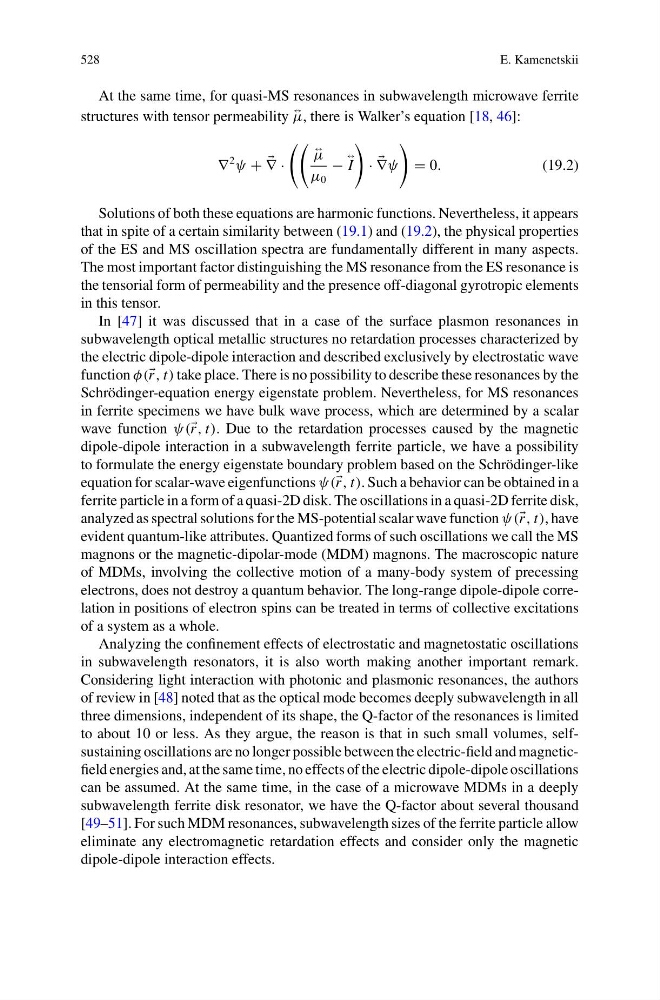
At the same time, for quasi-MS resonances in subwavelength microwave ferrite
structures with tensor permeability
↔
μ, there is Walker’s equation [18, 46]:
∇
2
ψ +
∇ ·
↔
μ
μ 0
−
↔
I
·
∇ψ
= 0.
(19.2)
Solutions of both these equations are harmonic functions. Nevertheless, it appears
that in spite of a certain similarity between (19.1) and (19.2), the physical properties
of the ES and MS oscillation spectra are fundamentally different in many aspects.
The most important factor distinguishing the MS resonance from the ES resonance is
the tensorial form of permeability and the presence off-diagonal gyrotropic elements
in this tensor.
In [47] it was discussed that in a case of the surface plasmon resonances in
subwavelength optical metallic structures no retardation processes characterized by
the electric dipole-dipole interaction and described exclusively by electrostatic wave
function φ( r, t) take place. There is no possibility to describe these resonances by the
Schrödinger-equation energy eigenstate problem. Nevertheless, for MS resonances
in ferrite specimens we have bulk wave process, which are determined by a scalar
wave function ψ( r , t). Due to the retardation processes caused by the magnetic
dipole-dipole interaction in a subwavelength ferrite particle, we have a possibility
to formulate the energy eigenstate boundary problem based on the Schrödinger-like
equation for scalar-wave eigenfunctions ψ( r , t). Such a behavior can be obtained in a
ferrite particle in a form of a quasi-2D disk. The oscillations in a quasi-2D ferrite disk,
analyzed as spectral solutions for the MS-potential scalar wave function ψ( r , t), have
evident quantum-like attributes. Quantized forms of such oscillations we call the MS
magnons or the magnetic-dipolar-mode (MDM) magnons. The macroscopic nature
of MDMs, involving the collective motion of a many-body system of precessing
electrons, does not destroy a quantum behavior. The long-range dipole-dipole correlation in positions of electron spins can be treated in terms of collective excitations
of a system as a whole.
Analyzing the confinement effects of electrostatic and magnetostatic oscillations
in subwavelength resonators, it is also worth making another important remark.
Considering light interaction with photonic and plasmonic resonances, the authors
of review in [48] noted that as the optical mode becomes deeply subwavelength in all
three dimensions, independent of its shape, the Q-factor of the resonances is limited
to about 10 or less. As they argue, the reason is that in such small volumes, selfsustaining oscillations are no longer possible between the electric-field and magneticfield energies and, at the same time, no effects of the electric dipole-dipole oscillations
can be assumed. At the same time, in the case of a microwave MDMs in a deeply
subwavelength ferrite disk resonator, we have the Q-factor about several thousand
[49–51]. For such MDM resonances, subwavelength sizes of the ferrite particle allow
eliminate any electromagnetic retardation effects and consider only the magnetic
dipole-dipole interaction effects.
E. Kamenetskii
At the same time, for quasi-MS resonances in subwavelength microwave ferrite
structures with tensor permeability
↔
μ, there is Walker’s equation [18, 46]:
∇
2
ψ +
∇ ·
↔
μ
μ 0
−
↔
I
·
∇ψ
= 0.
(19.2)
Solutions of both these equations are harmonic functions. Nevertheless, it appears
that in spite of a certain similarity between (19.1) and (19.2), the physical properties
of the ES and MS oscillation spectra are fundamentally different in many aspects.
The most important factor distinguishing the MS resonance from the ES resonance is
the tensorial form of permeability and the presence off-diagonal gyrotropic elements
in this tensor.
In [47] it was discussed that in a case of the surface plasmon resonances in
subwavelength optical metallic structures no retardation processes characterized by
the electric dipole-dipole interaction and described exclusively by electrostatic wave
function φ( r, t) take place. There is no possibility to describe these resonances by the
Schrödinger-equation energy eigenstate problem. Nevertheless, for MS resonances
in ferrite specimens we have bulk wave process, which are determined by a scalar
wave function ψ( r , t). Due to the retardation processes caused by the magnetic
dipole-dipole interaction in a subwavelength ferrite particle, we have a possibility
to formulate the energy eigenstate boundary problem based on the Schrödinger-like
equation for scalar-wave eigenfunctions ψ( r , t). Such a behavior can be obtained in a
ferrite particle in a form of a quasi-2D disk. The oscillations in a quasi-2D ferrite disk,
analyzed as spectral solutions for the MS-potential scalar wave function ψ( r , t), have
evident quantum-like attributes. Quantized forms of such oscillations we call the MS
magnons or the magnetic-dipolar-mode (MDM) magnons. The macroscopic nature
of MDMs, involving the collective motion of a many-body system of precessing
electrons, does not destroy a quantum behavior. The long-range dipole-dipole correlation in positions of electron spins can be treated in terms of collective excitations
of a system as a whole.
Analyzing the confinement effects of electrostatic and magnetostatic oscillations
in subwavelength resonators, it is also worth making another important remark.
Considering light interaction with photonic and plasmonic resonances, the authors
of review in [48] noted that as the optical mode becomes deeply subwavelength in all
three dimensions, independent of its shape, the Q-factor of the resonances is limited
to about 10 or less. As they argue, the reason is that in such small volumes, selfsustaining oscillations are no longer possible between the electric-field and magneticfield energies and, at the same time, no effects of the electric dipole-dipole oscillations
can be assumed. At the same time, in the case of a microwave MDMs in a deeply
subwavelength ferrite disk resonator, we have the Q-factor about several thousand
[49–51]. For such MDM resonances, subwavelength sizes of the ferrite particle allow
eliminate any electromagnetic retardation effects and consider only the magnetic
dipole-dipole interaction effects.