

19 Magnetoelectric Near Fields
527
solve the problem of creation of the ME-polariton condensate? To answer these questions, we should analyze the possibility of finding ME properties in subwavelength
resonators with quasistatic (dipolar-mode) oscillations.
A. On the possibility to observe the quantum confinement effects of electrostatic and magnetostatic oscillations
Electromagnetic (EM) responses of plasmon oscillations in optics and magnon oscillations in microwaves give rise to a strong enhancement of local fields near the
surfaces of subwavelength resonators. We can classify these oscillations as electrostatic (ES) and magnetostatic (MS) resonances, respectively [18, 40]. In ES resonances in small metallic samples, one neglects a time variation of magnetic energy
in comparison with a time variation of electric energy. It means that one neglects a
magnetic displacement current and an electric field is expressed via an ES potential,
E = −
∇φ [40]. However, the Ampere–Maxwell law gives the presence of a curl
magnetic field. In like manner, in the case of MS resonances in ferrite samples, one
neglects a time variation of electric energy in comparison with a time variation of
magnetic energy. It means that the MS-resonance problem is considered as zero-order
approximation of Maxwell’s equations when one neglects the electric displacement
current and expresses a magnetic field via a MS potential,
H = −
∇ψ [18]. While
Faraday’s law gives the presence of a curl electric field. Importantly, from a classical
electrodynamics point of view, one does not have a physical mechanism describing
the reverse effect of transformation of a curl magnetic field to a potential electric
field in the case of ES resonances. Also, one does not have a physical mechanism
describing the reverse effect of transformation of a curl electric field to a potential
magnetic field a case of the MS resonance [1, 41]. It means that, fundamentally,
subwavelength sizes of the particles should eliminate any EM retardation effects.
We can say that for an EM wavelength λ and particle of a characteristic size a, the
quasistatic approximation 2πa
λ 1 implies the transition to a small EM phase.
What kind of the time-varying field structure one can expect to see when an electric
or magnetic displacements currents are neglected and so the electromagnetic-field
symmetry (dual symmetry) of Maxwell equations is broken? When one neglects a
displacement current (magnetic or electric) and considers the scalar-function [φ( r, t)
or ψ( r , t)] solutions, as the wave-propagation solutions, one has to accept the possibility to observe the quantum confinement effects of electrostatic and magnetostatic oscillations. Such an analysis of quasistatic resonances is based on postulates about a physical meaning of scalar function as a complex scalar wavefunction,
which presumes a long-range phase coherence in dipole–dipole interactions. These
solutions should be based on the Schrödinger-like equation.
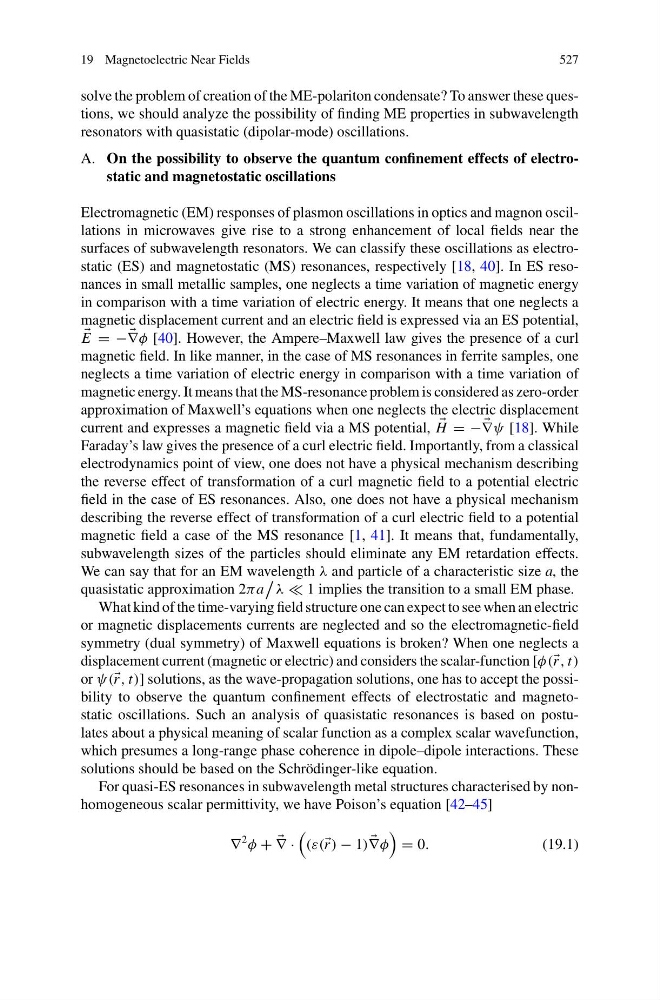
For quasi-ES resonances in subwavelength metal structures characterised by nonhomogeneous scalar permittivity, we have Poison’s equation [42–45]
∇
2
φ +
∇ ·
(ε( r ) − 1)
∇φ
= 0.
(19.1)
527
solve the problem of creation of the ME-polariton condensate? To answer these questions, we should analyze the possibility of finding ME properties in subwavelength
resonators with quasistatic (dipolar-mode) oscillations.
A. On the possibility to observe the quantum confinement effects of electrostatic and magnetostatic oscillations
Electromagnetic (EM) responses of plasmon oscillations in optics and magnon oscillations in microwaves give rise to a strong enhancement of local fields near the
surfaces of subwavelength resonators. We can classify these oscillations as electrostatic (ES) and magnetostatic (MS) resonances, respectively [18, 40]. In ES resonances in small metallic samples, one neglects a time variation of magnetic energy
in comparison with a time variation of electric energy. It means that one neglects a
magnetic displacement current and an electric field is expressed via an ES potential,
E = −
∇φ [40]. However, the Ampere–Maxwell law gives the presence of a curl
magnetic field. In like manner, in the case of MS resonances in ferrite samples, one
neglects a time variation of electric energy in comparison with a time variation of
magnetic energy. It means that the MS-resonance problem is considered as zero-order
approximation of Maxwell’s equations when one neglects the electric displacement
current and expresses a magnetic field via a MS potential,
H = −
∇ψ [18]. While
Faraday’s law gives the presence of a curl electric field. Importantly, from a classical
electrodynamics point of view, one does not have a physical mechanism describing
the reverse effect of transformation of a curl magnetic field to a potential electric
field in the case of ES resonances. Also, one does not have a physical mechanism
describing the reverse effect of transformation of a curl electric field to a potential
magnetic field a case of the MS resonance [1, 41]. It means that, fundamentally,
subwavelength sizes of the particles should eliminate any EM retardation effects.
We can say that for an EM wavelength λ and particle of a characteristic size a, the
quasistatic approximation 2πa
λ 1 implies the transition to a small EM phase.
What kind of the time-varying field structure one can expect to see when an electric
or magnetic displacements currents are neglected and so the electromagnetic-field
symmetry (dual symmetry) of Maxwell equations is broken? When one neglects a
displacement current (magnetic or electric) and considers the scalar-function [φ( r, t)
or ψ( r , t)] solutions, as the wave-propagation solutions, one has to accept the possibility to observe the quantum confinement effects of electrostatic and magnetostatic oscillations. Such an analysis of quasistatic resonances is based on postulates about a physical meaning of scalar function as a complex scalar wavefunction,
which presumes a long-range phase coherence in dipole–dipole interactions. These
solutions should be based on the Schrödinger-like equation.
For quasi-ES resonances in subwavelength metal structures characterised by nonhomogeneous scalar permittivity, we have Poison’s equation [42–45]
∇
2
φ +
∇ ·
(ε( r ) − 1)
∇φ
= 0.
(19.1)