

19 Magnetoelectric Near Fields
529
To make the MDM spectral problem analytically integrable, two approaches were
suggested. These approaches, distinguished by differential operators and boundary
conditions used for solving the spectral problem, give two types of MDM oscillation
spectra in a quasi-2D ferrite disk. These two approaches are conditionally called
as the G and L modes in the magnetic dipolar spectra [52–57]. The MS-potential
wave function ψ( r , t) manifests itself in different manners for each of these types of
spectra. In the case of the G-mode spectrum, where the physically observable quantities are energy eigenstates, the MS-potential wave function appears as a Hilbert-space
scalar wave function. In the case of the L modes, the MS-potential wave function
is considered as a generating function for the vector harmonics of the magnetic and
electric fields.
B. Spectral problems for MDM magnetostatic oscillations: G modes
The MDM-resonance spectral solutions obtained from the second-order differential
equation—the Walker’s equation [18, 46]—are constructed in accordance with basic
symmetry considerations for the sample geometry. For an open quasi-2D ferrite
disk normally magnetized along the z axis, we can use separation of variables. In
cylindrical coordinate system (z, r, θ), the solutions are represented as [52–57]
ψ p,ν,q = A p,ν,q ξ p,ν,q (z) ˜
η ν,q (r, θ),
(19.3)
where A p,ν,q is a dimensional amplitude coefficient, ξ p,ν,q (z) is a dimensionless
function of the MS-potential distribution along z axis, and ˜
η ν,q (r, θ) is dimensionless
membrane function. The membrane function ˜
η is defined by a Bessel-function order
ν and a number of zeros of the Bessel function corresponding to a radial variations
q. The dimensionless “thickness-mode” function ξ(z) is determined by the axialvariation number p.
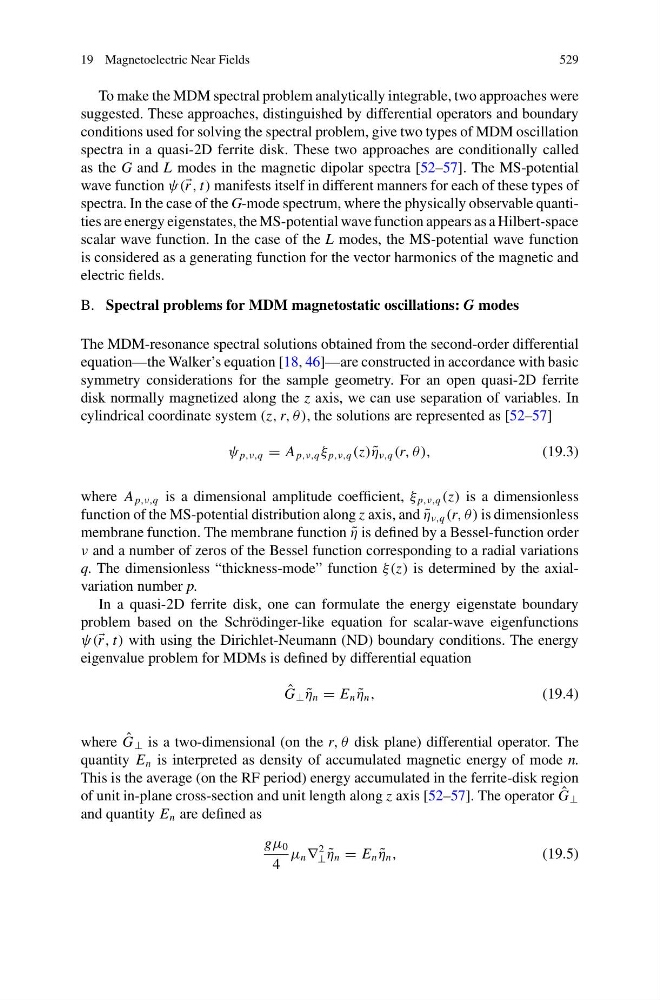
In a quasi-2D ferrite disk, one can formulate the energy eigenstate boundary
problem based on the Schrödinger-like equation for scalar-wave eigenfunctions
ψ( r , t) with using the Dirichlet-Neumann (ND) boundary conditions. The energy
eigenvalue problem for MDMs is defined by differential equation
ˆ
G ⊥ ˜
η n = E n ˜
η n ,
(19.4)
where ˆ
G ⊥ is a two-dimensional (on the r, θ disk plane) differential operator. The
quantity E n is interpreted as density of accumulated magnetic energy of mode n.
This is the average (on the RF period) energy accumulated in the ferrite-disk region
of unit in-plane cross-section and unit length along z axis [52–57]. The operator ˆ
G ⊥
and quantity E n are defined as
gμ 0
4
μ n ∇
2
⊥ ˜
η n = E n ˜
η n ,
(19.5)
529
To make the MDM spectral problem analytically integrable, two approaches were
suggested. These approaches, distinguished by differential operators and boundary
conditions used for solving the spectral problem, give two types of MDM oscillation
spectra in a quasi-2D ferrite disk. These two approaches are conditionally called
as the G and L modes in the magnetic dipolar spectra [52–57]. The MS-potential
wave function ψ( r , t) manifests itself in different manners for each of these types of
spectra. In the case of the G-mode spectrum, where the physically observable quantities are energy eigenstates, the MS-potential wave function appears as a Hilbert-space
scalar wave function. In the case of the L modes, the MS-potential wave function
is considered as a generating function for the vector harmonics of the magnetic and
electric fields.
B. Spectral problems for MDM magnetostatic oscillations: G modes
The MDM-resonance spectral solutions obtained from the second-order differential
equation—the Walker’s equation [18, 46]—are constructed in accordance with basic
symmetry considerations for the sample geometry. For an open quasi-2D ferrite
disk normally magnetized along the z axis, we can use separation of variables. In
cylindrical coordinate system (z, r, θ), the solutions are represented as [52–57]
ψ p,ν,q = A p,ν,q ξ p,ν,q (z) ˜
η ν,q (r, θ),
(19.3)
where A p,ν,q is a dimensional amplitude coefficient, ξ p,ν,q (z) is a dimensionless
function of the MS-potential distribution along z axis, and ˜
η ν,q (r, θ) is dimensionless
membrane function. The membrane function ˜
η is defined by a Bessel-function order
ν and a number of zeros of the Bessel function corresponding to a radial variations
q. The dimensionless “thickness-mode” function ξ(z) is determined by the axialvariation number p.
In a quasi-2D ferrite disk, one can formulate the energy eigenstate boundary
problem based on the Schrödinger-like equation for scalar-wave eigenfunctions
ψ( r , t) with using the Dirichlet-Neumann (ND) boundary conditions. The energy
eigenvalue problem for MDMs is defined by differential equation
ˆ
G ⊥ ˜
η n = E n ˜
η n ,
(19.4)
where ˆ
G ⊥ is a two-dimensional (on the r, θ disk plane) differential operator. The
quantity E n is interpreted as density of accumulated magnetic energy of mode n.
This is the average (on the RF period) energy accumulated in the ferrite-disk region
of unit in-plane cross-section and unit length along z axis [52–57]. The operator ˆ
G ⊥
and quantity E n are defined as
gμ 0
4
μ n ∇
2
⊥ ˜
η n = E n ˜
η n ,
(19.5)