

518
A. Karabchevsky et al.
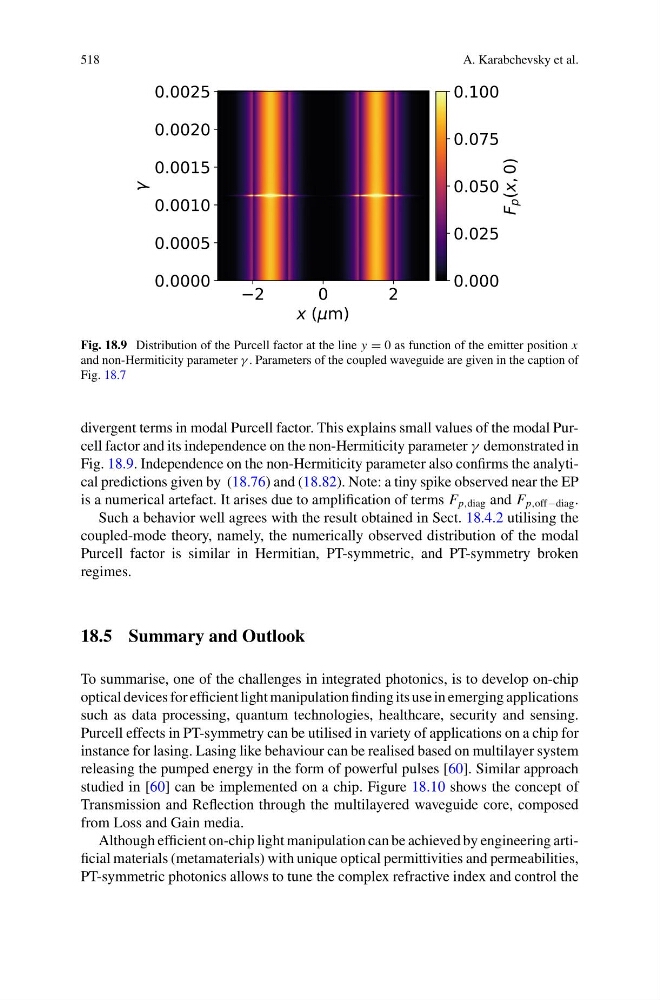
Fig. 18.9 Distribution of the Purcell factor at the line y = 0 as function of the emitter position x
and non-Hermiticity parameter γ . Parameters of the coupled waveguide are given in the caption of
Fig. 18.7
divergent terms in modal Purcell factor. This explains small values of the modal Purcell factor and its independence on the non-Hermiticity parameter γ demonstrated in
Fig. 18.9. Independence on the non-Hermiticity parameter also confirms the analytical predictions given by (18.76) and (18.82). Note: a tiny spike observed near the EP
is a numerical artefact. It arises due to amplification of terms F p,diag and F p,off−diag .
Such a behavior well agrees with the result obtained in Sect. 18.4.2 utilising the
coupled-mode theory, namely, the numerically observed distribution of the modal
Purcell factor is similar in Hermitian, PT-symmetric, and PT-symmetry broken
regimes.
18.5 Summary and Outlook
To summarise, one of the challenges in integrated photonics, is to develop on-chip
optical devices for efficient light manipulation finding its use in emerging applications
such as data processing, quantum technologies, healthcare, security and sensing.
Purcell effects in PT-symmetry can be utilised in variety of applications on a chip for
instance for lasing. Lasing like behaviour can be realised based on multilayer system
releasing the pumped energy in the form of powerful pulses [60]. Similar approach
studied in [60] can be implemented on a chip. Figure 18.10 shows the concept of
Transmission and Reflection through the multilayered waveguide core, composed
from Loss and Gain media.
Although efficient on-chip light manipulation can be achieved by engineering artificial materials (metamaterials) with unique optical permittivities and permeabilities,
PT-symmetric photonics allows to tune the complex refractive index and control the
A. Karabchevsky et al.
Fig. 18.9 Distribution of the Purcell factor at the line y = 0 as function of the emitter position x
and non-Hermiticity parameter γ . Parameters of the coupled waveguide are given in the caption of
Fig. 18.7
divergent terms in modal Purcell factor. This explains small values of the modal Purcell factor and its independence on the non-Hermiticity parameter γ demonstrated in
Fig. 18.9. Independence on the non-Hermiticity parameter also confirms the analytical predictions given by (18.76) and (18.82). Note: a tiny spike observed near the EP
is a numerical artefact. It arises due to amplification of terms F p,diag and F p,off−diag .
Such a behavior well agrees with the result obtained in Sect. 18.4.2 utilising the
coupled-mode theory, namely, the numerically observed distribution of the modal
Purcell factor is similar in Hermitian, PT-symmetric, and PT-symmetry broken
regimes.
18.5 Summary and Outlook
To summarise, one of the challenges in integrated photonics, is to develop on-chip
optical devices for efficient light manipulation finding its use in emerging applications
such as data processing, quantum technologies, healthcare, security and sensing.
Purcell effects in PT-symmetry can be utilised in variety of applications on a chip for
instance for lasing. Lasing like behaviour can be realised based on multilayer system
releasing the pumped energy in the form of powerful pulses [60]. Similar approach
studied in [60] can be implemented on a chip. Figure 18.10 shows the concept of
Transmission and Reflection through the multilayered waveguide core, composed
from Loss and Gain media.
Although efficient on-chip light manipulation can be achieved by engineering artificial materials (metamaterials) with unique optical permittivities and permeabilities,
PT-symmetric photonics allows to tune the complex refractive index and control the