

18 Purcell Effect in PT-Symmetric Waveguides
519
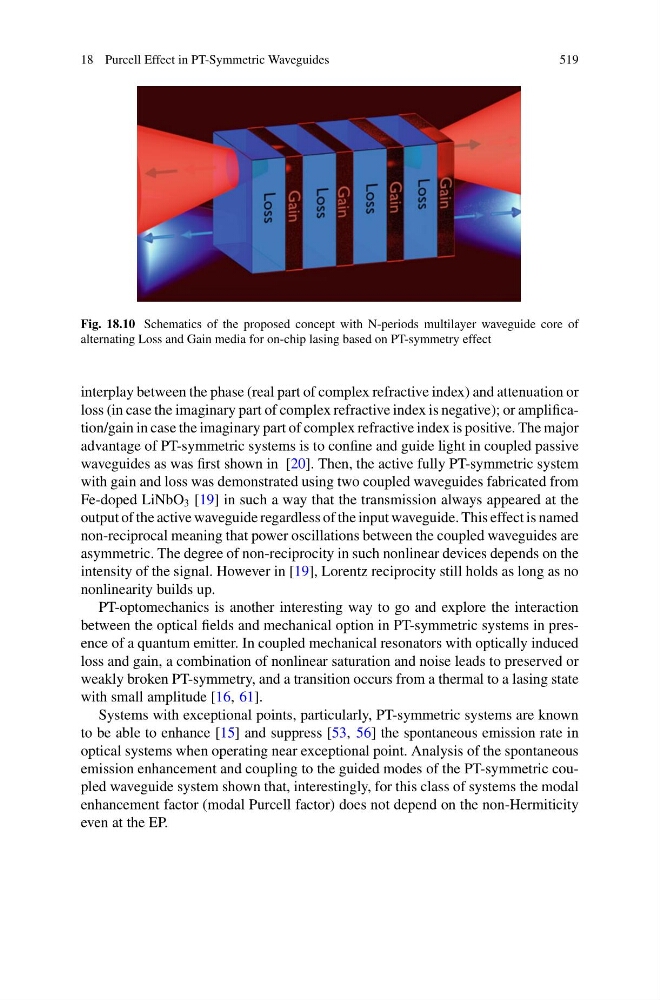
Fig. 18.10 Schematics of the proposed concept with N-periods multilayer waveguide core of
alternating Loss and Gain media for on-chip lasing based on PT-symmetry effect
interplay between the phase (real part of complex refractive index) and attenuation or
loss (in case the imaginary part of complex refractive index is negative); or amplification/gain in case the imaginary part of complex refractive index is positive. The major
advantage of PT-symmetric systems is to confine and guide light in coupled passive
waveguides as was first shown in [20]. Then, the active fully PT-symmetric system
with gain and loss was demonstrated using two coupled waveguides fabricated from
Fe-doped LiNbO 3 [19] in such a way that the transmission always appeared at the
output of the active waveguide regardless of the input waveguide. This effect is named
non-reciprocal meaning that power oscillations between the coupled waveguides are
asymmetric. The degree of non-reciprocity in such nonlinear devices depends on the
intensity of the signal. However in [19], Lorentz reciprocity still holds as long as no
nonlinearity builds up.
PT-optomechanics is another interesting way to go and explore the interaction
between the optical fields and mechanical option in PT-symmetric systems in presence of a quantum emitter. In coupled mechanical resonators with optically induced
loss and gain, a combination of nonlinear saturation and noise leads to preserved or
weakly broken PT-symmetry, and a transition occurs from a thermal to a lasing state
with small amplitude [16, 61].
Systems with exceptional points, particularly, PT-symmetric systems are known
to be able to enhance [15] and suppress [53, 56] the spontaneous emission rate in
optical systems when operating near exceptional point. Analysis of the spontaneous
emission enhancement and coupling to the guided modes of the PT-symmetric coupled waveguide system shown that, interestingly, for this class of systems the modal
enhancement factor (modal Purcell factor) does not depend on the non-Hermiticity
even at the EP.
519
Fig. 18.10 Schematics of the proposed concept with N-periods multilayer waveguide core of
alternating Loss and Gain media for on-chip lasing based on PT-symmetry effect
interplay between the phase (real part of complex refractive index) and attenuation or
loss (in case the imaginary part of complex refractive index is negative); or amplification/gain in case the imaginary part of complex refractive index is positive. The major
advantage of PT-symmetric systems is to confine and guide light in coupled passive
waveguides as was first shown in [20]. Then, the active fully PT-symmetric system
with gain and loss was demonstrated using two coupled waveguides fabricated from
Fe-doped LiNbO 3 [19] in such a way that the transmission always appeared at the
output of the active waveguide regardless of the input waveguide. This effect is named
non-reciprocal meaning that power oscillations between the coupled waveguides are
asymmetric. The degree of non-reciprocity in such nonlinear devices depends on the
intensity of the signal. However in [19], Lorentz reciprocity still holds as long as no
nonlinearity builds up.
PT-optomechanics is another interesting way to go and explore the interaction
between the optical fields and mechanical option in PT-symmetric systems in presence of a quantum emitter. In coupled mechanical resonators with optically induced
loss and gain, a combination of nonlinear saturation and noise leads to preserved or
weakly broken PT-symmetry, and a transition occurs from a thermal to a lasing state
with small amplitude [16, 61].
Systems with exceptional points, particularly, PT-symmetric systems are known
to be able to enhance [15] and suppress [53, 56] the spontaneous emission rate in
optical systems when operating near exceptional point. Analysis of the spontaneous
emission enhancement and coupling to the guided modes of the PT-symmetric coupled waveguide system shown that, interestingly, for this class of systems the modal
enhancement factor (modal Purcell factor) does not depend on the non-Hermiticity
even at the EP.