

18 Purcell Effect in PT-Symmetric Waveguides
517
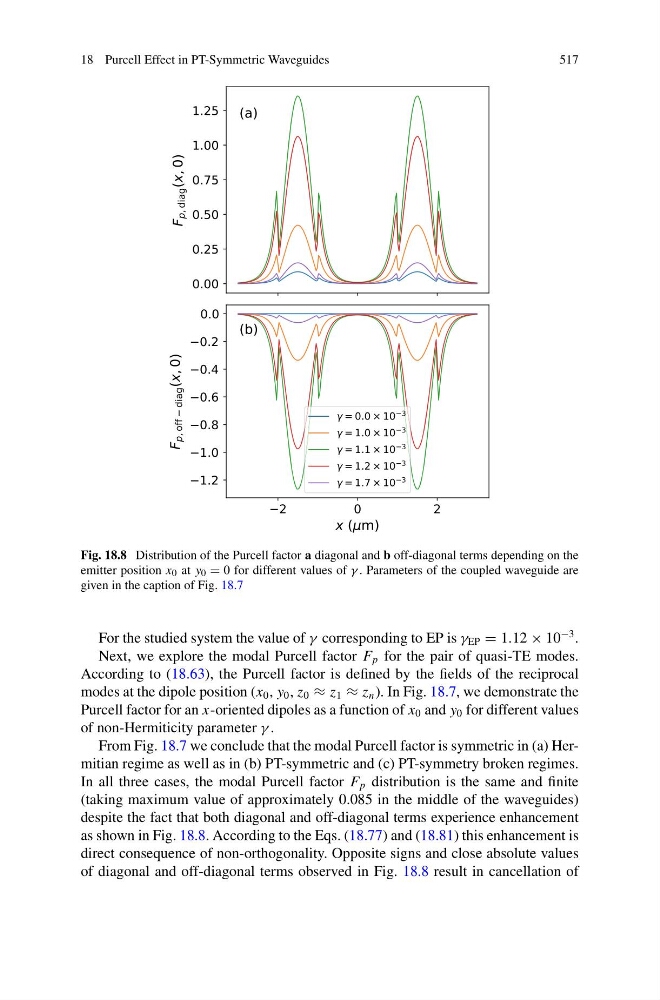
Fig. 18.8 Distribution of the Purcell factor a diagonal and b off-diagonal terms depending on the
emitter position x 0 at y 0 = 0 for different values of γ . Parameters of the coupled waveguide are
given in the caption of Fig. 18.7
For the studied system the value of γ corresponding to EP is γ EP = 1.12 × 10
−3 .
Next, we explore the modal Purcell factor F p for the pair of quasi-TE modes.
According to (18.63), the Purcell factor is defined by the fields of the reciprocal
modes at the dipole position (x 0 , y 0 , z 0 ≈ z 1 ≈ z n ). In Fig. 18.7, we demonstrate the
Purcell factor for an x-oriented dipoles as a function of x 0 and y 0 for different values
of non-Hermiticity parameter γ .
From Fig. 18.7 we conclude that the modal Purcell factor is symmetric in (a) Hermitian regime as well as in (b) PT-symmetric and (c) PT-symmetry broken regimes.
In all three cases, the modal Purcell factor F p distribution is the same and finite
(taking maximum value of approximately 0.085 in the middle of the waveguides)
despite the fact that both diagonal and off-diagonal terms experience enhancement
as shown in Fig. 18.8. According to the Eqs. (18.77) and (18.81) this enhancement is
direct consequence of non-orthogonality. Opposite signs and close absolute values
of diagonal and off-diagonal terms observed in Fig. 18.8 result in cancellation of
517
Fig. 18.8 Distribution of the Purcell factor a diagonal and b off-diagonal terms depending on the
emitter position x 0 at y 0 = 0 for different values of γ . Parameters of the coupled waveguide are
given in the caption of Fig. 18.7
For the studied system the value of γ corresponding to EP is γ EP = 1.12 × 10
−3 .
Next, we explore the modal Purcell factor F p for the pair of quasi-TE modes.
According to (18.63), the Purcell factor is defined by the fields of the reciprocal
modes at the dipole position (x 0 , y 0 , z 0 ≈ z 1 ≈ z n ). In Fig. 18.7, we demonstrate the
Purcell factor for an x-oriented dipoles as a function of x 0 and y 0 for different values
of non-Hermiticity parameter γ .
From Fig. 18.7 we conclude that the modal Purcell factor is symmetric in (a) Hermitian regime as well as in (b) PT-symmetric and (c) PT-symmetry broken regimes.
In all three cases, the modal Purcell factor F p distribution is the same and finite
(taking maximum value of approximately 0.085 in the middle of the waveguides)
despite the fact that both diagonal and off-diagonal terms experience enhancement
as shown in Fig. 18.8. According to the Eqs. (18.77) and (18.81) this enhancement is
direct consequence of non-orthogonality. Opposite signs and close absolute values
of diagonal and off-diagonal terms observed in Fig. 18.8 result in cancellation of