

34
S. Droulias and L. Bougas
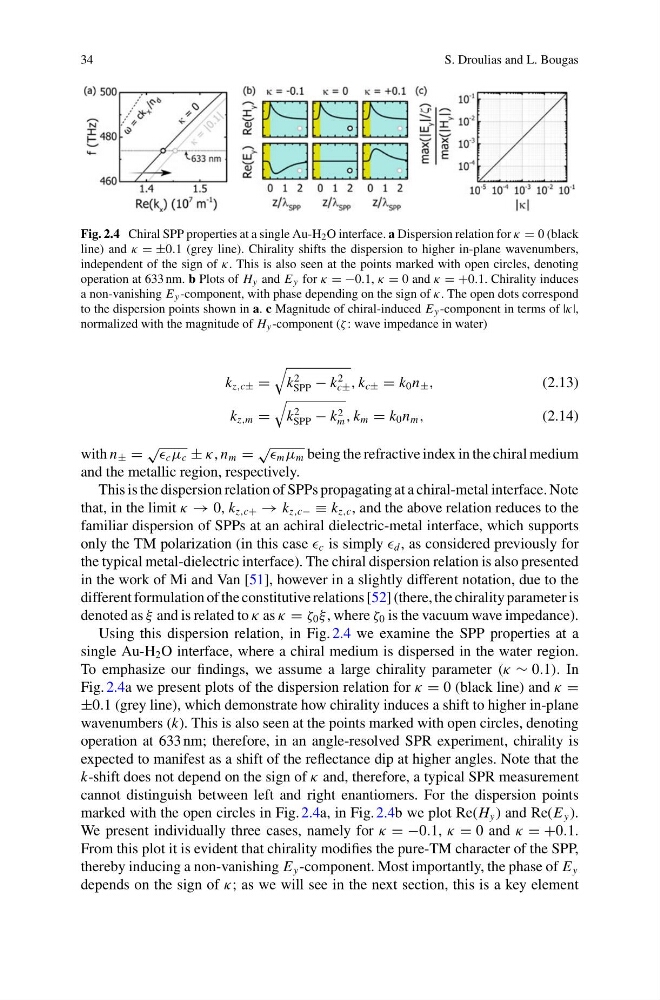
Fig. 2.4 Chiral SPP properties at a single Au-H 2 O interface. a Dispersion relation for κ = 0 (black
line) and κ = ±0.1 (grey line). Chirality shifts the dispersion to higher in-plane wavenumbers,
independent of the sign of κ. This is also seen at the points marked with open circles, denoting
operation at 633 nm. b Plots of H y and E y for κ = −0.1, κ = 0 and κ = +0.1. Chirality induces
a non-vanishing E y -component, with phase depending on the sign of κ. The open dots correspond
to the dispersion points shown in a. c Magnitude of chiral-induced E y -component in terms of |κ|,
normalized with the magnitude of H y -component (ζ : wave impedance in water)
k z,c± =
k
2
SPP − k
2
c± , k c± = k 0 n ± ,
(2.13)
k z,m =
k
2
SPP − k 2
m , k m = k 0 n m ,
(2.14)
with n ± =
√ c μ c ± κ, n m =
√
m μ m being the refractive index in the chiral medium
and the metallic region, respectively.
This is the dispersion relation of SPPs propagating at a chiral-metal interface. Note
that, in the limit κ → 0, k z,c+ → k z,c− ≡ k z,c , and the above relation reduces to the
familiar dispersion of SPPs at an achiral dielectric-metal interface, which supports
only the TM polarization (in this case c is simply d , as considered previously for
the typical metal-dielectric interface). The chiral dispersion relation is also presented
in the work of Mi and Van [51], however in a slightly different notation, due to the
different formulation of the constitutive relations [52] (there, the chirality parameter is
denoted as ξ and is related to κ as κ = ζ 0 ξ , where ζ 0 is the vacuum wave impedance).
Using this dispersion relation, in Fig. 2.4 we examine the SPP properties at a
single Au-H 2 O interface, where a chiral medium is dispersed in the water region.
To emphasize our findings, we assume a large chirality parameter (κ ∼ 0.1). In
Fig. 2.4a we present plots of the dispersion relation for κ = 0 (black line) and κ =
±0.1 (grey line), which demonstrate how chirality induces a shift to higher in-plane
wavenumbers (k). This is also seen at the points marked with open circles, denoting
operation at 633 nm; therefore, in an angle-resolved SPR experiment, chirality is
expected to manifest as a shift of the reflectance dip at higher angles. Note that the
k-shift does not depend on the sign of κ and, therefore, a typical SPR measurement
cannot distinguish between left and right enantiomers. For the dispersion points
marked with the open circles in Fig. 2.4a, in Fig. 2.4b we plot Re(H y ) and Re(E y ).
We present individually three cases, namely for κ = −0.1, κ = 0 and κ = +0.1.
From this plot it is evident that chirality modifies the pure-TM character of the SPP,
thereby inducing a non-vanishing E y -component. Most importantly, the phase of E y
depends on the sign of κ; as we will see in the next section, this is a key element
S. Droulias and L. Bougas
Fig. 2.4 Chiral SPP properties at a single Au-H 2 O interface. a Dispersion relation for κ = 0 (black
line) and κ = ±0.1 (grey line). Chirality shifts the dispersion to higher in-plane wavenumbers,
independent of the sign of κ. This is also seen at the points marked with open circles, denoting
operation at 633 nm. b Plots of H y and E y for κ = −0.1, κ = 0 and κ = +0.1. Chirality induces
a non-vanishing E y -component, with phase depending on the sign of κ. The open dots correspond
to the dispersion points shown in a. c Magnitude of chiral-induced E y -component in terms of |κ|,
normalized with the magnitude of H y -component (ζ : wave impedance in water)
k z,c± =
k
2
SPP − k
2
c± , k c± = k 0 n ± ,
(2.13)
k z,m =
k
2
SPP − k 2
m , k m = k 0 n m ,
(2.14)
with n ± =
√ c μ c ± κ, n m =
√
m μ m being the refractive index in the chiral medium
and the metallic region, respectively.
This is the dispersion relation of SPPs propagating at a chiral-metal interface. Note
that, in the limit κ → 0, k z,c+ → k z,c− ≡ k z,c , and the above relation reduces to the
familiar dispersion of SPPs at an achiral dielectric-metal interface, which supports
only the TM polarization (in this case c is simply d , as considered previously for
the typical metal-dielectric interface). The chiral dispersion relation is also presented
in the work of Mi and Van [51], however in a slightly different notation, due to the
different formulation of the constitutive relations [52] (there, the chirality parameter is
denoted as ξ and is related to κ as κ = ζ 0 ξ , where ζ 0 is the vacuum wave impedance).
Using this dispersion relation, in Fig. 2.4 we examine the SPP properties at a
single Au-H 2 O interface, where a chiral medium is dispersed in the water region.
To emphasize our findings, we assume a large chirality parameter (κ ∼ 0.1). In
Fig. 2.4a we present plots of the dispersion relation for κ = 0 (black line) and κ =
±0.1 (grey line), which demonstrate how chirality induces a shift to higher in-plane
wavenumbers (k). This is also seen at the points marked with open circles, denoting
operation at 633 nm; therefore, in an angle-resolved SPR experiment, chirality is
expected to manifest as a shift of the reflectance dip at higher angles. Note that the
k-shift does not depend on the sign of κ and, therefore, a typical SPR measurement
cannot distinguish between left and right enantiomers. For the dispersion points
marked with the open circles in Fig. 2.4a, in Fig. 2.4b we plot Re(H y ) and Re(E y ).
We present individually three cases, namely for κ = −0.1, κ = 0 and κ = +0.1.
From this plot it is evident that chirality modifies the pure-TM character of the SPP,
thereby inducing a non-vanishing E y -component. Most importantly, the phase of E y
depends on the sign of κ; as we will see in the next section, this is a key element