

2 Surface Plasmons for Chiral Sensing
33
confined to the interface) and (b) acquires high k-values with increasing frequency
(i.e. the confinement becomes stronger); note that the SPP fields in the dielectric fall
off as e
−|k d ||z| with k d =
k
2
SPP − k
2
0 d [see (2.7), (2.8)]. The field-penetration depth
δ SPP = 1/Im[k d ], i.e. the distance over which the field amplitudes drop to 1/e of
their initial magnitude, is shown in Fig. 2.3c for both cases. As shown, δ SPP is in the
range of a few nm and, therefore, SPPs are ideal for sensing material changes particularly close to the metal-dielectric interface, such as those from thin-subwavelength
in size-films.
2.2.2 SPPs at a Metal-Chiral Interface
The introduction of chirality in the dielectric medium that comprises the metaldielectric system imposes changes in the features of the SPP, as examined in detail
in the work of Mi and Van [51]. With chirality, SPPs are still supported at a metalchiral interface, however both their field components and their dispersion change. Let
us consider such an interface, where the chiral medium is characterized by permittivity c , permeability μ c , and chirality (Pasteur) parameter κ. Chirality introduces
magneto-electric coupling by means of κ and, as a result, in the chiral medium the
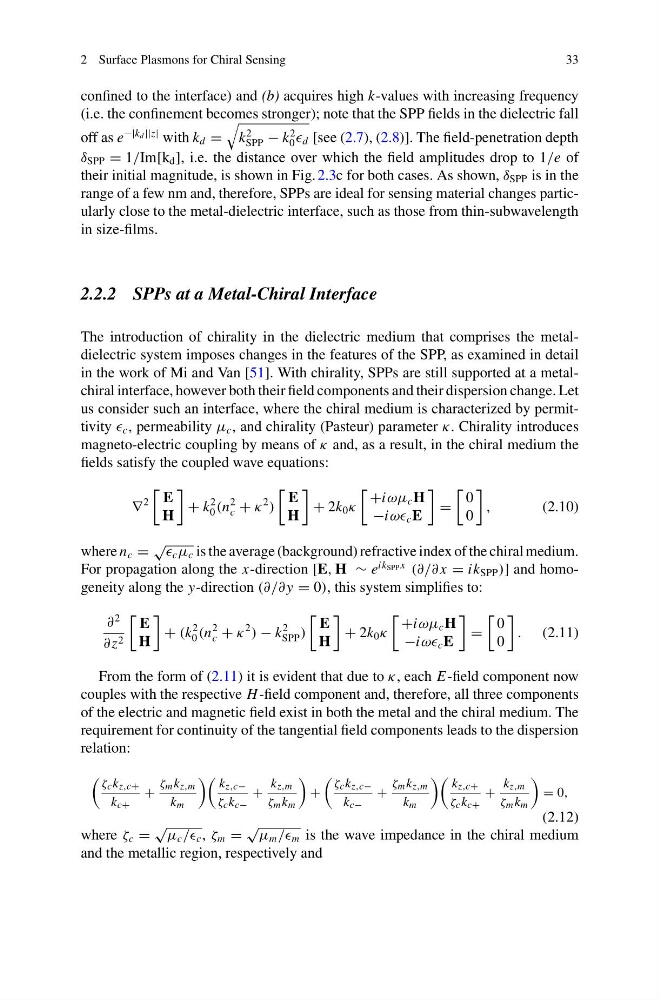
fields satisfy the coupled wave equations:
∇
2
E
H
+ k
2
0 (n
2
c + κ
2
)
E
H
+ 2k 0 κ
+iωμ c H
−iωω c E
=
0
0
,
(2.10)
where n c =
√ c μ c is the average (background) refractive index of the chiral medium.
For propagation along the x-direction [E, H ∼ e
ik SPP x
(∂/∂ x = ik SPP )] and homogeneity along the y-direction (∂/∂ y = 0), this system simplifies to:
∂
2
∂z 2
E
H
+ (k
2
0 (n
2
c + κ
2
) − k
2
SPP )
E
H
+ 2k 0 κ
+iωμ c H
−iωω c E
=
0
0
. (2.11)
From the form of (2.11) it is evident that due to κ, each E-field component now
couples with the respective H -field component and, therefore, all three components
of the electric and magnetic field exist in both the metal and the chiral medium. The
requirement for continuity of the tangential field components leads to the dispersion
relation:
ζ c k z,c+
k c+
+
ζ m k z,m
k m
k z,c−
ζ c k c−
+
k z,m
ζ m k m
+
ζ c k z,c−
k c−
+
ζ m k z,m
k m
k z,c+
ζ c k c+
+
k z,m
ζ m k m
= 0,
(2.12)
where ζ c =
√ μ c // c , ζ m =
√ μ m // m is the wave impedance in the chiral medium
and the metallic region, respectively and
33
confined to the interface) and (b) acquires high k-values with increasing frequency
(i.e. the confinement becomes stronger); note that the SPP fields in the dielectric fall
off as e
−|k d ||z| with k d =
k
2
SPP − k
2
0 d [see (2.7), (2.8)]. The field-penetration depth
δ SPP = 1/Im[k d ], i.e. the distance over which the field amplitudes drop to 1/e of
their initial magnitude, is shown in Fig. 2.3c for both cases. As shown, δ SPP is in the
range of a few nm and, therefore, SPPs are ideal for sensing material changes particularly close to the metal-dielectric interface, such as those from thin-subwavelength
in size-films.
2.2.2 SPPs at a Metal-Chiral Interface
The introduction of chirality in the dielectric medium that comprises the metaldielectric system imposes changes in the features of the SPP, as examined in detail
in the work of Mi and Van [51]. With chirality, SPPs are still supported at a metalchiral interface, however both their field components and their dispersion change. Let
us consider such an interface, where the chiral medium is characterized by permittivity c , permeability μ c , and chirality (Pasteur) parameter κ. Chirality introduces
magneto-electric coupling by means of κ and, as a result, in the chiral medium the
fields satisfy the coupled wave equations:
∇
2
E
H
+ k
2
0 (n
2
c + κ
2
)
E
H
+ 2k 0 κ
+iωμ c H
−iωω c E
=
0
0
,
(2.10)
where n c =
√ c μ c is the average (background) refractive index of the chiral medium.
For propagation along the x-direction [E, H ∼ e
ik SPP x
(∂/∂ x = ik SPP )] and homogeneity along the y-direction (∂/∂ y = 0), this system simplifies to:
∂
2
∂z 2
E
H
+ (k
2
0 (n
2
c + κ
2
) − k
2
SPP )
E
H
+ 2k 0 κ
+iωμ c H
−iωω c E
=
0
0
. (2.11)
From the form of (2.11) it is evident that due to κ, each E-field component now
couples with the respective H -field component and, therefore, all three components
of the electric and magnetic field exist in both the metal and the chiral medium. The
requirement for continuity of the tangential field components leads to the dispersion
relation:
ζ c k z,c+
k c+
+
ζ m k z,m
k m
k z,c−
ζ c k c−
+
k z,m
ζ m k m
+
ζ c k z,c−
k c−
+
ζ m k z,m
k m
k z,c+
ζ c k c+
+
k z,m
ζ m k m
= 0,
(2.12)
where ζ c =
√ μ c // c , ζ m =
√ μ m // m is the wave impedance in the chiral medium
and the metallic region, respectively and