

32
S. Droulias and L. Bougas
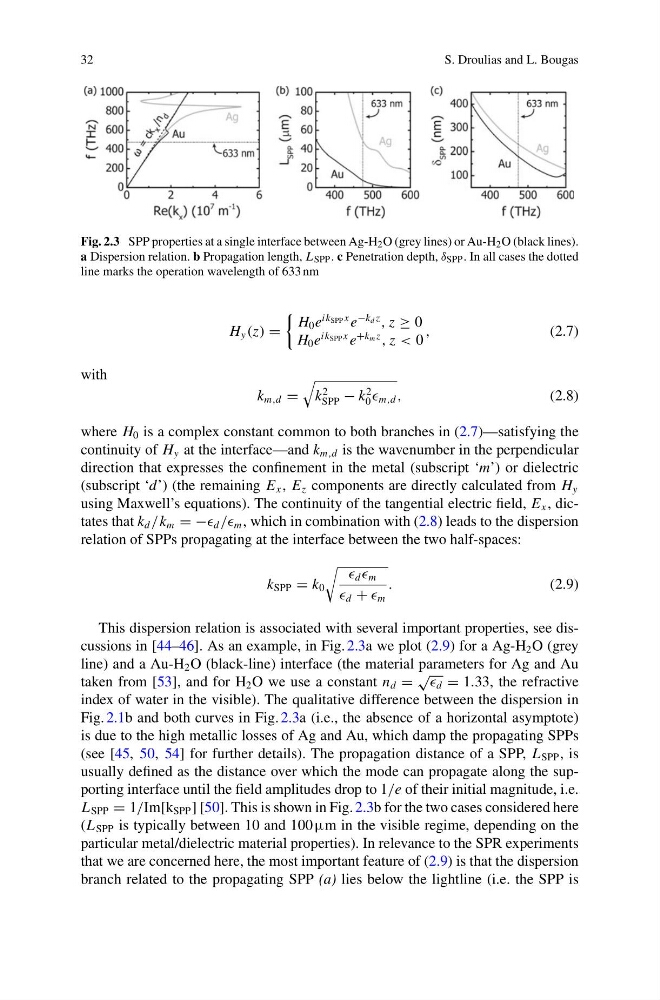
Fig. 2.3 SPP properties at a single interface between Ag-H 2 O (grey lines) or Au-H 2 O (black lines).
a Dispersion relation. b Propagation length, L SPP . c Penetration depth, δ SPP . In all cases the dotted
line marks the operation wavelength of 633 nm
H y (z) =
H 0 e
ik SPP x e
−k d z
, z ≥ 0
H 0 e
ik SPP x e
+k m z
, z < 0
,
(2.7)
with
k m,d =
k
2
SPP − k
2
0 m,d ,
(2.8)
where H 0 is a complex constant common to both branches in (2.7)—satisfying the
continuity of H y at the interface—and k m,d is the wavenumber in the perpendicular
direction that expresses the confinement in the metal (subscript ‘m’) or dielectric
(subscript ‘d’) (the remaining E x , E z components are directly calculated from H y
using Maxwell’s equations). The continuity of the tangential electric field, E x , dictates that k d /k m = − d // m , which in combination with (2.8) leads to the dispersion
relation of SPPs propagating at the interface between the two half-spaces:
k SPP = k 0
d m
d + m
.
(2.9)
This dispersion relation is associated with several important properties, see discussions in [44–46]. As an example, in Fig. 2.3a we plot (2.9) for a Ag-H 2 O (grey
line) and a Au-H 2 O (black-line) interface (the material parameters for Ag and Au
taken from [53], and for H 2 O we use a constant n d =
√
d = 1.33, the refractive
index of water in the visible). The qualitative difference between the dispersion in
Fig. 2.1b and both curves in Fig. 2.3a (i.e., the absence of a horizontal asymptote)
is due to the high metallic losses of Ag and Au, which damp the propagating SPPs
(see [45, 50, 54] for further details). The propagation distance of a SPP, L SPP , is
usually defined as the distance over which the mode can propagate along the supporting interface until the field amplitudes drop to 1/e of their initial magnitude, i.e.
L SPP = 1/Im[k SPP ] [50]. This is shown in Fig. 2.3b for the two cases considered here
(L SPP is typically between 10 and 100 µm in the visible regime, depending on the
particular metal/dielectric material properties). In relevance to the SPR experiments
that we are concerned here, the most important feature of (2.9) is that the dispersion
branch related to the propagating SPP (a) lies below the lightline (i.e. the SPP is
S. Droulias and L. Bougas
Fig. 2.3 SPP properties at a single interface between Ag-H 2 O (grey lines) or Au-H 2 O (black lines).
a Dispersion relation. b Propagation length, L SPP . c Penetration depth, δ SPP . In all cases the dotted
line marks the operation wavelength of 633 nm
H y (z) =
H 0 e
ik SPP x e
−k d z
, z ≥ 0
H 0 e
ik SPP x e
+k m z
, z < 0
,
(2.7)
with
k m,d =
k
2
SPP − k
2
0 m,d ,
(2.8)
where H 0 is a complex constant common to both branches in (2.7)—satisfying the
continuity of H y at the interface—and k m,d is the wavenumber in the perpendicular
direction that expresses the confinement in the metal (subscript ‘m’) or dielectric
(subscript ‘d’) (the remaining E x , E z components are directly calculated from H y
using Maxwell’s equations). The continuity of the tangential electric field, E x , dictates that k d /k m = − d // m , which in combination with (2.8) leads to the dispersion
relation of SPPs propagating at the interface between the two half-spaces:
k SPP = k 0
d m
d + m
.
(2.9)
This dispersion relation is associated with several important properties, see discussions in [44–46]. As an example, in Fig. 2.3a we plot (2.9) for a Ag-H 2 O (grey
line) and a Au-H 2 O (black-line) interface (the material parameters for Ag and Au
taken from [53], and for H 2 O we use a constant n d =
√
d = 1.33, the refractive
index of water in the visible). The qualitative difference between the dispersion in
Fig. 2.1b and both curves in Fig. 2.3a (i.e., the absence of a horizontal asymptote)
is due to the high metallic losses of Ag and Au, which damp the propagating SPPs
(see [45, 50, 54] for further details). The propagation distance of a SPP, L SPP , is
usually defined as the distance over which the mode can propagate along the supporting interface until the field amplitudes drop to 1/e of their initial magnitude, i.e.
L SPP = 1/Im[k SPP ] [50]. This is shown in Fig. 2.3b for the two cases considered here
(L SPP is typically between 10 and 100 µm in the visible regime, depending on the
particular metal/dielectric material properties). In relevance to the SPR experiments
that we are concerned here, the most important feature of (2.9) is that the dispersion
branch related to the propagating SPP (a) lies below the lightline (i.e. the SPP is