

18 Purcell Effect in PT-Symmetric Waveguides
511
P = Re
k,l
A k,z 1 A
∗
l,z 1
P kl ,
(18.56)
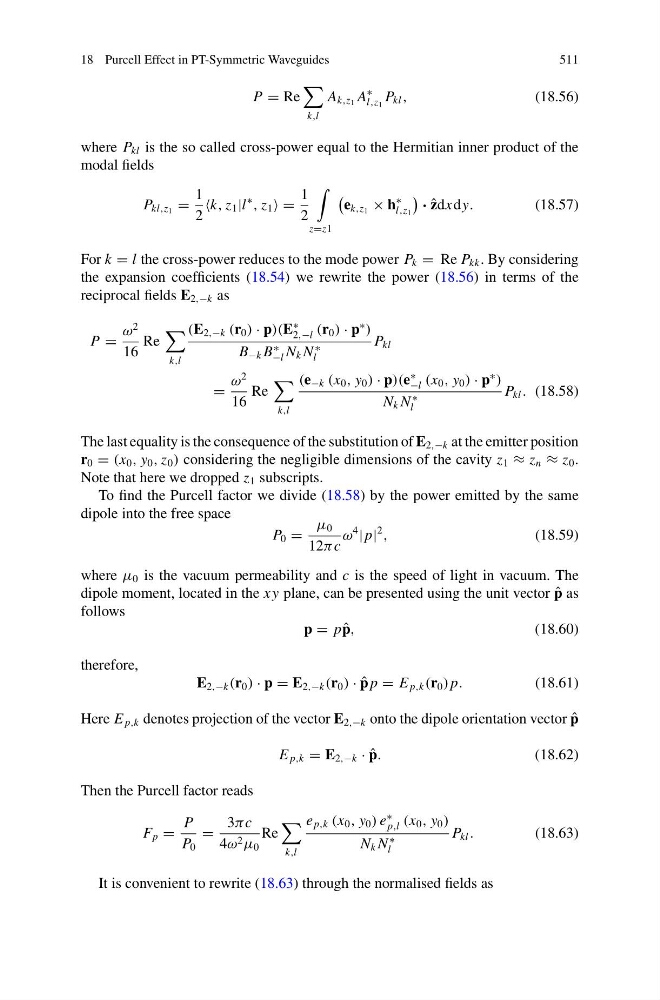
where P kl is the so called cross-power equal to the Hermitian inner product of the
modal fields
P kl,z 1 =
1
2
k, z 1 |l
∗
, z 1 =
1
2
z=z1
e k,z 1 × h
∗
l,z 1
· ˆ
zdxdy.
(18.57)
For k = l the cross-power reduces to the mode power P k = Re P kk . By considering
the expansion coefficients (18.54) we rewrite the power (18.56) in terms of the
reciprocal fields E 2,−k as
P =
ω
2
16
Re
k,l
(E 2,−k (r 0 ) · p)(E
∗
2,−l (r 0 ) · p
∗
)
B −k B
∗
−l N k N
∗
l
P kl
=
ω
2
16
Re
k,l
(e −k (x 0 , y 0 ) · p)(e
∗
−l (x 0 , y 0 ) · p
∗
)
N k N
∗
l
P kl . (18.58)
The last equality is the consequence of the substitution of E 2,−k at the emitter position
r 0 = (x 0 , y 0 , z 0 ) considering the negligible dimensions of the cavity z 1 ≈ z n ≈ z 0 .
Note that here we dropped z 1 subscripts.
To find the Purcell factor we divide (18.58) by the power emitted by the same
dipole into the free space
P 0 =
μ 0
12π c
ω
4
| p|
2
,
(18.59)
where μ 0 is the vacuum permeability and c is the speed of light in vacuum. The
dipole moment, located in the x y plane, can be presented using the unit vector ˆ
p as
follows
p = p ˆ
p,
(18.60)
therefore,
E 2,−k (r 0 ) · p = E 2,−k (r 0 ) · ˆ
p p = E p,k (r 0 ) p.
(18.61)
Here E p,k denotes projection of the vector E 2,−k onto the dipole orientation vector ˆ
p
E p,k = E 2,−k · ˆ
p.
(18.62)
Then the Purcell factor reads
F p =
P
P 0
=
3π c
4ω 2 μ 0
Re
k,l
e p,k (x 0 , y 0 ) e
∗
p,l (x 0 , y 0 )
N k N
∗
l
P kl .
(18.63)
It is convenient to rewrite (18.63) through the normalised fields as
511
P = Re
k,l
A k,z 1 A
∗
l,z 1
P kl ,
(18.56)
where P kl is the so called cross-power equal to the Hermitian inner product of the
modal fields
P kl,z 1 =
1
2
k, z 1 |l
∗
, z 1 =
1
2
z=z1
e k,z 1 × h
∗
l,z 1
· ˆ
zdxdy.
(18.57)
For k = l the cross-power reduces to the mode power P k = Re P kk . By considering
the expansion coefficients (18.54) we rewrite the power (18.56) in terms of the
reciprocal fields E 2,−k as
P =
ω
2
16
Re
k,l
(E 2,−k (r 0 ) · p)(E
∗
2,−l (r 0 ) · p
∗
)
B −k B
∗
−l N k N
∗
l
P kl
=
ω
2
16
Re
k,l
(e −k (x 0 , y 0 ) · p)(e
∗
−l (x 0 , y 0 ) · p
∗
)
N k N
∗
l
P kl . (18.58)
The last equality is the consequence of the substitution of E 2,−k at the emitter position
r 0 = (x 0 , y 0 , z 0 ) considering the negligible dimensions of the cavity z 1 ≈ z n ≈ z 0 .
Note that here we dropped z 1 subscripts.
To find the Purcell factor we divide (18.58) by the power emitted by the same
dipole into the free space
P 0 =
μ 0
12π c
ω
4
| p|
2
,
(18.59)
where μ 0 is the vacuum permeability and c is the speed of light in vacuum. The
dipole moment, located in the x y plane, can be presented using the unit vector ˆ
p as
follows
p = p ˆ
p,
(18.60)
therefore,
E 2,−k (r 0 ) · p = E 2,−k (r 0 ) · ˆ
p p = E p,k (r 0 ) p.
(18.61)
Here E p,k denotes projection of the vector E 2,−k onto the dipole orientation vector ˆ
p
E p,k = E 2,−k · ˆ
p.
(18.62)
Then the Purcell factor reads
F p =
P
P 0
=
3π c
4ω 2 μ 0
Re
k,l
e p,k (x 0 , y 0 ) e
∗
p,l (x 0 , y 0 )
N k N
∗
l
P kl .
(18.63)
It is convenient to rewrite (18.63) through the normalised fields as